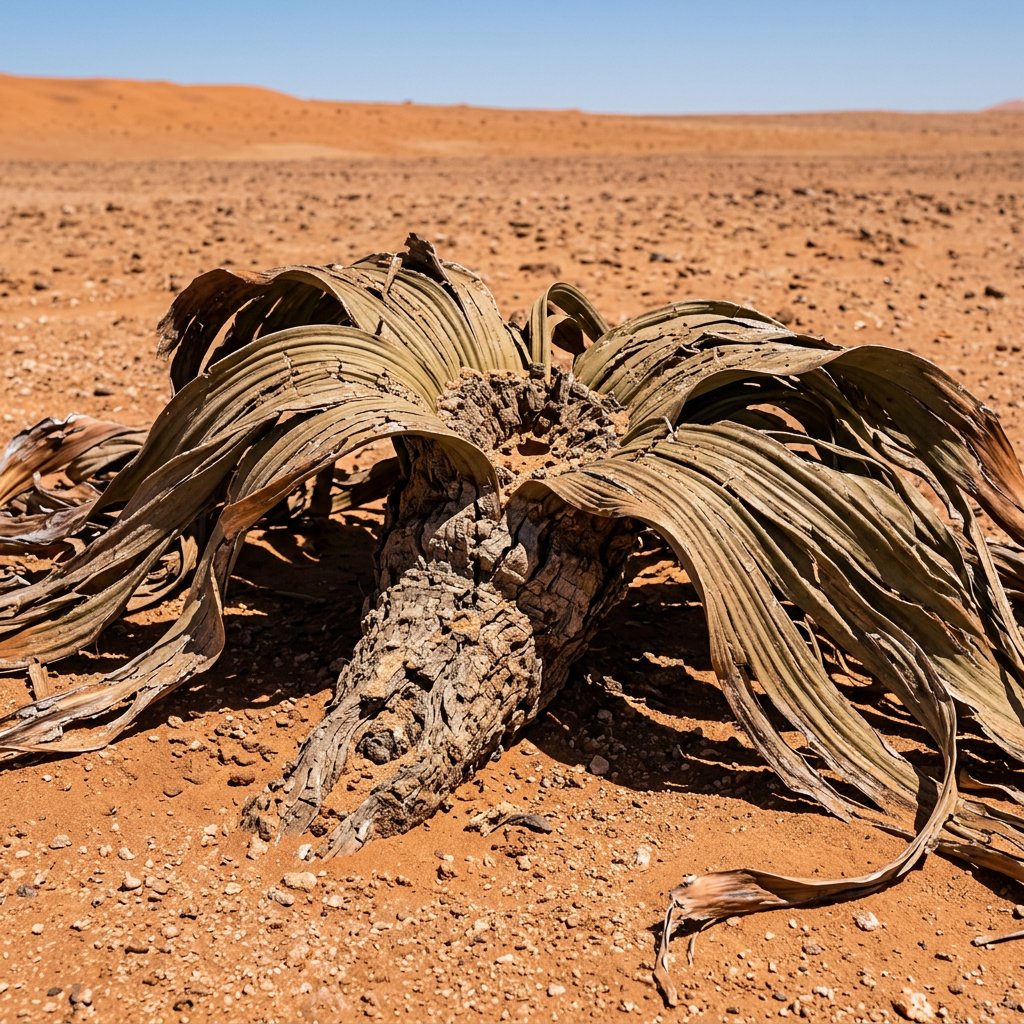
Plant Overview
Often described as a "living fossil," the Welwitschia mirabilis is a true botanical enigma that looks more like a heap of shredded leather than a living plant. Native only to the ancient Namib Desert, this plant is nicknamed the "Onion of the Desert" by local tribes. It is famous for its incredible longevity, with some specimens living for over 1,500 years, surviving in one of the harshest environments on Earth.
🔍 How to Identify
- 🍃 The Eternal Leaves: Remarkably, this plant only ever grows two true leaves. Over centuries, these leaves are split by desert winds and heat into dozens of ribbon-like strips, making it look like a tangled pile of foliage.
- 🪵 The Woody Base: The stem is short, thick, and obconic (shaped like an upside-down cone). It grows wider rather than taller, often resembling a scorched tree stump partially buried in the sand.
- 🍍 Cones instead of Flowers: As a gymnosperm (related to pines), it produces cones. Female plants grow large, blue-green cones that turn reddish-brown, while male plants produce smaller, salmon-colored cones.
🏡 In Your Garden
- 🏺 The Taproot Challenge: This plant is rarely seen in home gardens because it grows a massive, deep taproot. If you are a collector attempting to grow one, it requires an exceptionally deep, narrow pot. It notoriously hates being moved; even a tiny bit of root damage during transplanting can be fatal.
- 🌫️ Fog Drinkers: In the wild, Welwitschia survives by absorbing moisture from coastal fog through its leaves. While it needs very little liquid water in the soil, it appreciates high atmospheric humidity or a fine misting that mimics the Namibian mornings.
- ⏳ Patience is Mandatory: Growth is measured in millimeters per year. If you plant a seed today, it may take several decades before it resembles the iconic "shaggy" look of the desert giants.
⚠️ Safety & Toxicity
- 🟢 Non-Toxic: Welwitschia mirabilis is generally considered non-toxic to humans, cats, and dogs.
- 🌵 Physical Toughness: The leaves are extremely fibrous and tough, similar to heavy-duty leather. While not poisonous, they are not edible and could cause digestive upset if a pet were to chew on the rigid, woody fibers.
✨ Fun Fact
Welwitschia is so resilient that it survived the era of the dinosaurs. Because it grows so slowly and lives so long, a single plant sitting in the desert today might have been a young seedling when the Roman Empire was at its height!

Detailed Care Instructions
| Humidity | Dry |
| Lighting | Full Sun |
| Difficulty | Hard |
| Temperature | 20°C - 28°C |
| Hardiness Zones | 8 - 11 |
Growing Welwitschia mirabilis plants can be a bit challenging, as they have specific requirements. Here are some steps to help you grow Welwitschia mirabilis:
- Obtaining Seeds: Welwitschia mirabilis plants are native to the Namib Desert in southwestern Africa. You can try to find seeds from nurseries that specialize in desert plants or search for online suppliers.
- Proper Soil: Welwitschia mirabilis prefers well-draining soil that resembles its natural habitat. Prepare a mixture of equal parts sand, gravel, and peat moss to create a suitable growing medium.
- Temperature and Light: These plants require warm temperatures between 70-85°F (21-29°C) during the day and cooler temperatures between 50-65°F (10-18°C) at night. They also need plenty of sunlight, so place them in a location that receives direct sunlight for several hours a day.
- Watering: Welwitschia mirabilis is a desert plant that has adapted to survive with minimal water. Water it sparingly, about once every 2-3 weeks during the growing season (spring and summer). Allow the soil to dry out completely before watering again. In winter, reduce watering to once every 4-6 weeks.
- Careful Transplanting: When the seedlings are large enough to handle, you can carefully transplant them into individual pots. Handle the plants with care as their root system is delicate. Ensure that the soil is well-draining in the new pots.
- Pruning: Unlike most plants, Welwitschia mirabilis does not require pruning. The plant naturally grows only two leaves, which will slowly split apart as it ages. Avoid cutting or damaging the leaves.
- Patience: Welwitschia mirabilis is a slow-growing plant, and it may take several years to reach a significant size. Be patient and provide consistent care.
Remember that growing Welwitschia mirabilis can be challenging due to its specific habitat requirements and slow growth. It is recommended for experienced gardeners and plant enthusiasts.

Place in a bright room that is sun drenched almost all day. Or directly in a south-facing window.

The plant in question requires a relatively small amount of water, as it has adapted to living in a desert climate. The best way to water it is to do so infrequently but deeply, soaking the soil thoroughly each time. It is important to avoid getting water on the leaves, as this can cause damage or rot. Additionally, the plant should not be allowed to sit in standing water, as this can lead to root rot. Ideally, the soil should be allowed to dry out almost completely between waterings, and care should be taken not to over-water.
To fertilize this plant, use a balanced fertilizer with equal amounts of nitrogen, phosphorus, and potassium. Apply the fertilizer every two to three months during the growing season. Be careful not to over-fertilize, as this can damage the plant's roots. Water the plant well after fertilizing to help distribute the nutrients.
For best growth and health, it is recommended to use a well-draining soil mix with a pH range of 6.0 to 7.5. The soil should have a good balance of nutrients, including macronutrients such as nitrogen, phosphorus, and potassium, as well as micronutrients such as calcium, magnesium, and iron. Avoid using heavy or clay soils that can retain too much moisture and lead to root rot. Instead, opt for a sandy or rocky soil mix that can provide good drainage and aeration. It may also be helpful to add organic matter, such as compost or peat moss, to improve soil structure and fertility. Regular watering is important, but be sure not to over-water, as this can also lead to root rot.
Welwitschia Mirabilis is a plant that is native to the Namib Desert in Southern Africa. It is a unique and long-lived plant, with a lifespan of up to 2000 years. Propagating this plant can be done through several methods, including seed propagation, cutting propagation, or division propagation.
Seed propagation: Propagating Welwitschia Mirabilis from seed can be a bit tricky due to the plant's specific germination requirements. Seeds should be obtained from a reputable source and then soaked in water for several hours before being planted in a well-draining soil mixture. The seedling should be kept moist and in a warm environment until it has developed its first set of true leaves.
Cutting propagation: Welwitschia Mirabilis can be propagated from cuttings taken from the stem of a mature plant. Cuttings should be taken from a healthy plant and allowed to dry for several days before being replanted in a well-draining soil mixture. The cutting should be kept moist and in a warm environment until it develops roots and begins to grow new leaves.
Division propagation: This method of propagation involves carefully dividing a mature Welwitschia Mirabilis plant into two or more sections. Each section should have its own root system and be replanted in a well-draining soil mixture. The new plants should be kept moist and in a warm environment until they have become established.
Regardless of the propagation method used, it is important to provide the Welwitschia Mirabilis plant with the proper growing conditions. This includes bright, indirect sunlight, well-draining soil, and regular watering. With proper care, a propagated Welwitschia Mirabilis plant can grow into a healthy and long-lived specimen.
Common pests of the welwitschia include Scale insect, mealybugs. Make a habit of checking your welwitschia frequently for pests so that any infestations can be caught and managed early.








