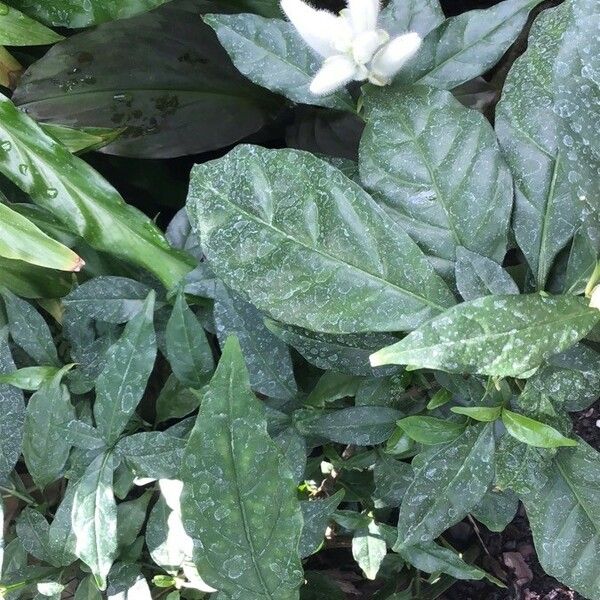
Plant Overview
Known affectionately as "White Candles," this elegant tropical shrub hails from the shaded understory of African forests. It is prized by collectors for its luminous, architectural blooms that appear to glow against its dark foliage. Whether kept as a sophisticated houseplant or a shade-garden centerpiece, it brings a serene, classic beauty to any collection.
🔍 How to Identify
- 🕯️ The "Candles": Upright spikes (racemes) of pure white, tubular flowers emerging from large, persistent white bracts that resemble flickering flames.
- 🍃 Lush Foliage: Large, lance-shaped leaves with a deep emerald hue and a glossy, quilted texture that reflects light beautifully.
- 🌿 Stature: A compact, evergreen shrub that typically maintains a rounded, bushy shape, reaching about 3 to 5 feet in height.
🏡 In Your Garden
- 🌥️ Light Nuance: Because it originated on the forest floor, this plant is highly sensitive to direct sunlight. It prefers "bright-indirect" light; too much sun will bleach the leaves, while too little will stop the "candles" from forming.
- 💧 The Humidity Factor: Whitfieldia is a humidity lover. It dislikes dry indoor air, which can cause the flower buds to drop prematurely. Placing it near a humidifier or on a pebble tray is the secret to keeping it lush.
- 🍂 Soil Preference: It prefers rich, organic soil that stays consistently moist but never waterlogged. It has a delicate root system that can suffer if the soil becomes compacted or too dry.
⚠️ Safety & Toxicity
- ✅ Status: Generally considered non-toxic and safe for homes.
- 🐾 Details: There are no recorded reports of high toxicity toward cats, dogs, or children. However, as with any ornamental plant, ingestion may cause mild stomach upset, so it is best kept as a visual treat rather than a snack.
✨ Fun Fact
The "White Candle" plant is a member of the Acanthaceae family, making it a close relative to the famous "Shrimp Plant." While the Shrimp Plant looks tropical and wild, the Whitfieldia is often called its more "formal" and "elegant" cousin due to its crisp white-on-green color palette.

Detailed Care Instructions
To successfully grow Whitfieldia elongata (commonly known as the watermelon peperomia or red edge peperomia), follow these steps:
- Light: Provide bright, indirect light for the plant. Place it near a window where it receives filtered sunlight. Avoid exposure to direct sunlight as it can scorch the leaves.
- Temperature: This plant thrives in average room temperatures between 65-80°F (18-27°C). Keep it away from cold drafts and sudden temperature fluctuations.
- Watering: Water the plant when the top inch of the soil feels dry. Ensure the soil is well-draining as it prefers evenly moist conditions. Avoid overwatering, which can lead to root rot. Always drain excess water from the saucer or tray beneath the pot after watering.
- Humidity: As a tropical plant, Whitfieldia elongata appreciates higher humidity levels. You can increase humidity by placing the pot on a tray filled with water and pebbles or by using a humidifier nearby. Regularly misting the leaves can also help maintain humidity levels.
- Soil: Use a well-draining potting mix that retains moisture without becoming waterlogged. A mixture of peat moss, perlite, and coco coir works well for this plant.
- Fertilizer: Feed the plant monthly during the growing season (spring and summer) with a balanced houseplant fertilizer diluted to half the recommended strength. Avoid fertilizing during the winter months.
- Pruning: Trim off any yellow, dead, or leggy foliage to encourage healthy growth. Regular pruning will also help maintain a bushy appearance.
- Repotting: Whitfieldia elongata prefers slightly crowded root conditions. Repot only when the plant becomes severely root-bound or if you notice signs of root rot. Choose a pot that allows for about 1-2 inches of space around the root ball.
By following these care instructions, you should be able to successfully grow Whitfieldia elongata and enjoy its attractive foliage.
Whitfieldia Elongata plants should be watered regularly, but care should be taken not to overwater them as this can lead to root rot. The best method is to water them when the top inch of soil feels dry to the touch. When watering, use a watering can or hose to water at the base of the plant, avoiding wetting the leaves. Water should be allowed to drain out of the pot or container, and standing water should be removed to prevent root rot. The frequency of watering may depend on factors such as the plant's location, temperature, humidity, and soil type. In dry or hot weather conditions, the plant may require more frequent watering.
To fertilize Whitfieldia Elongata plant, use a balanced fertilizer with an N-P-K ratio of 10-10-10 or 20-20-20. Apply the fertilizer every 2-3 weeks during the growing season, from spring to fall. Dilute the fertilizer to half-strength according to the package instructions. Water the plant thoroughly before and after fertilizing. Avoid fertilizing during the winter months and reduce the frequency of fertilization during periods of drought.
Whitfieldia Elongata plant requires a soil that is well-draining and rich in organic matter. The soil pH should be slightly acidic, with a range of 5.5-6.5. It is suggested to use a soil mixture composed of peat moss, perlite or vermiculite, and a high-quality potting soil. The soil should not have too much moisture, as excessive water can cause root rot. Adding some sand to the soil mixture can improve drainage. Additionally, incorporating some slow-release fertilizer can help provide the necessary nutrients for the plant's growth.
Propagation of this plant can be achieved through stem cuttings. Select a healthy stem with several nodes and a few leaves. Cut the stem just below a node and remove any leaves from the bottom half of the stem. Optional: dip the cut end in rooting hormone to encourage root growth. Place the stem in a container with well-draining soil and water thoroughly. Cover the container with plastic to create a greenhouse effect and keep the soil moist. After a few weeks, roots will begin to grow from the stem and new leaves will appear. Once the plant has established a strong root system, it can be transplanted to a larger container or into the ground.








