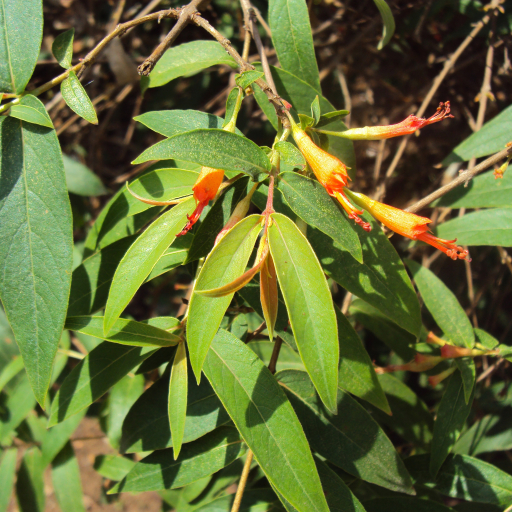
Plant Overview
Often hailed as the "Fire-Flame Bush" or "Dhataki," Woodfordia fruticosa is a spectacular deciduous shrub that seems to set the landscape ablaze when it blooms. Native to the rocky slopes of South Asia, this plant is a cornerstone of traditional Ayurvedic medicine and is beloved by gardeners for its ability to attract vibrant wildlife with its nectar-rich, tubular blossoms.
🔍 How to Identify
- 🔥 The Flowers: The most striking feature is the clusters of brilliant orange-to-scarlet tubular flowers that emerge directly from the branches, often appearing before the new leaves.
- 🍃 The Foliage: Leaves are long, lance-shaped, and arranged in opposite pairs. They often have a slightly velvety texture and pale undersides dotted with tiny translucent glands.
- 🪵 The Bark: As the shrub matures, its bark becomes a beautiful grayish-brown and begins to peel in long, fibrous strips, adding winter interest to the garden.
🏡 In Your Garden
- ☀️ Sun Seeker: This plant is a sun-worshiper. It thrives in bright, direct light, which mimics its native habitat in dry, open forests. In shaded spots, it may become "leggy" and produce fewer of those iconic fiery blooms.
- 🐦 Avian Magnet: If you enjoy birdwatching, this is a must-have. Its nectar is a primary food source for honeybees and sunbirds, who often perch directly on the sturdy branches to reach deep into the flowers.
- 🌱 Tough as Nails: Once established, the Fire-Flame Bush is incredibly drought-tolerant. It prefers well-draining soil and can actually struggle if kept in waterlogged or overly "rich" potting mixes.
⚠️ Safety & Toxicity
- 🟢 Generally Safe: This plant is not considered highly toxic to humans or common household pets. In fact, it has a long history of medicinal use.
- 🧤 Skin Sensitivity: While not poisonous, the fine hairs on the leaves or the rough bark can occasionally cause mild skin irritation for those with sensitive skin. It is always best to wear gloves during heavy pruning.
- 🚫 No Nibbling: Even though it is used medicinally, the flowers and leaves should not be consumed by children or pets, as raw ingestion can lead to mild digestive upset.
✨ Fun Fact
In India, Dhataki flowers are a "secret ingredient" in traditional herbal wines (Arishtas). The dried flowers contain natural yeasts that trigger the fermentation process, essentially acting as the engine that turns herbal decoctions into medicine!

Detailed Care Instructions
To grow Woodfordia Fruticosa plants, you can follow these steps:
- Select a suitable location: Woodfordia Fruticosa plants prefer full sun to partial shade, so choose a spot in your garden that receives at least 4-6 hours of direct sunlight daily. The soil should be well-draining and rich in organic matter.
- Prepare the soil: Before planting, it is recommended to improve the soil by adding compost or well-rotted manure to enhance its fertility and drainage.
- Propagation: Woodfordia Fruticosa can be propagated from seeds, stem cuttings, or root cuttings.
- Seeds: Soak the seeds in water overnight to soften their hard seed coat. Sow the seeds in pots or trays filled with a well-draining potting mix. Keep the soil moist and place the container in a warm and sunny location. Germination can take several weeks.
- Stem cuttings: Take 6-8 inches long stem cuttings from a healthy plant. Remove the lower leaves and dip the cut end in rooting hormone. Insert the cutting into a pot filled with a well-draining potting mix. Keep the soil moist and place it in a warm, bright spot. Roots will develop in a few weeks.
- Root cuttings: Dig out a small section of root from an established plant. Cut it into 2-3 inch long pieces. Plant the cuttings horizontally in a pot filled with well-draining potting mix. Keep the soil moist and place the pot in a warm and bright location. Roots will start to develop within a few weeks.
- Seeds: Soak the seeds in water overnight to soften their hard seed coat. Sow the seeds in pots or trays filled with a well-draining potting mix. Keep the soil moist and place the container in a warm and sunny location. Germination can take several weeks.
- Watering: Woodfordia Fruticosa plants prefer moderately moist soil, so water them regularly to keep the soil evenly moist. However, avoid overwatering, as it can cause root rot.
- Fertilizing: Feed the plants with a balanced organic fertilizer in the early spring and mid-summer to promote healthy growth and flowering.
- Pruning: Woodfordia Fruticosa plants benefit from regular pruning to maintain their shape and stimulate bushier growth. Pruning should be done in early spring before new growth emerges. Remove any dead or weak branches and cut back one-third of the plant's overall size.
- Protection from frost: Woodfordia Fruticosa is susceptible to frost damage, so it is important to protect the plants during cold winters. Mulch around the base of the plant with a thick layer of organic mulch to insulate the roots.
With proper care and maintenance, your Woodfordia Fruticosa plants should grow well and reward you with their beautiful blooms.

Place in a bright room that is sun drenched almost all day. Or directly in a south-facing window.

To water this plant, it is important to take into consideration the planting location and soil type. It is recommended to water deeply, allowing the soil to become moist but not overly saturated. It is best to water in the early morning or late evening to avoid excessive evaporation and to allow the plant to absorb the water properly. One should also avoid watering the foliage to prevent the spread of diseases. Additionally, during hot and dry periods, it may be necessary to water more frequently to ensure the plant's survival.
To fertilize this plant, use a slow-release organic fertilizer that is high in phosphorus and potassium. Apply the fertilizer during the growing season and mix it into the soil around the base of the plant. Water the plant thoroughly after fertilizing. Avoid applying too much fertilizer as it can burn the roots and damage the plant.
The Woodfordia Fruticosa plant requires well-drained soil with good porosity. The ideal soil pH range is between 6.0 to 7.5. A mixture of loamy soil, sand, and organic matter is recommended for healthy growth. The soil should be rich in nutrients, particularly nitrogen, phosphorus, and potassium. The plant prefers soil that is moderately fertile and well-aerated. It is important to avoid waterlogged soil as this can lead to root rot and other diseases. The use of organic fertilizers and compost can help improve soil quality and support healthy plant growth. It is also important to provide adequate drainage to prevent waterlogging and ensure proper moisture levels. Growing Woodfordia Fruticosa in the correct soil can help to promote vigorous growth and vibrant blooms.
Woodfordia Fruticosa is a perennial flowering plant that belongs to the myrtle family. It is a native plant of South and Southeast Asia, and it is often grown in gardens as an ornamental plant due to its attractive red flowers and sweet fragrance.
Propagation of Woodfordia Fruticosa can be done through various methods, including seed propagation, stem cutting propagation, and division propagation. Here are the steps involved in each method:
- Seed propagation:
- Collect mature seeds from the plant after the flowers have bloomed and the seed capsules have dried up.
- Sow the seeds in a pot or tray filled with sterile potting mix.
- Water the soil and keep it moist but not soaked.
- Place the pot or tray in a warm and sunny location.
- The seeds will germinate in 1-2 weeks, and the seedlings can be transplanted into individual pots once they have grown to a suitable size.
- Stem cutting propagation:
- Cut a healthy stem of Woodfordia Fruticosa from the parent plant using a sharp, clean pair of scissors or pruning shears.
- Remove the lower leaves from the stem, leaving only the top few leaves intact.
- Dip the cut end of the stem in rooting hormone powder.
- Plant the stem in a pot or tray filled with sterile potting mix, making sure that the bottom 2 inches of the stem is buried in the soil.
- Water the soil and keep it moist.
- Place the pot or tray in a warm and shady location.
- The stem will develop roots in 3-4 weeks, and the new plant can be transplanted into a larger pot or the ground once it has grown to a suitable size.
- Division propagation:
- Dig up the parent plant carefully, making sure to avoid damaging the roots.
- Divide the plant into smaller sections, ensuring that each section has a good amount of roots and foliage.
- Plant each section in a pot or the ground, making sure to water them well.
- Place the pots or newly divided plants in a warm and shady location.
- The new plants will start to grow and can be transplanted into larger pots or the ground once they have grown to a suitable size.
These are the general steps involved in propagating Woodfordia Fruticosa. However, it is important to note that each method may require specific conditions and care to ensure successful propagation.








