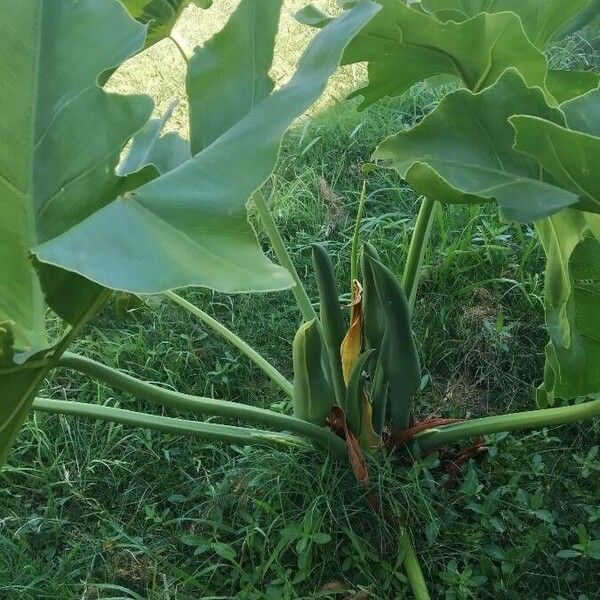
Plant Overview
Meet the "Green Taro" or "Giant Elephant Ear," a tropical titan hailing from the rainforests of Mexico and Central America. Known for its prehistoric silhouette and massive, heart-shaped foliage, this plant is a favorite for those looking to turn their backyard into a lush, Jurassic landscape. It earns its name Robustum by standing tall and unfurling leaves that can easily rival the size of a small umbrella.
🔍 How to Identify
- 🍃 The Leaves: Look for enormous, matte-green leaves shaped like a broad arrowhead (sagittate). They lack the glossy sheen of some relatives, giving them a soft, velvety appearance.
- 🦴 The Veins: Prominent, pale green veins radiate from the center to the edges, creating a deeply textured, ribbed effect across the leaf surface.
- 🪴 The Stems: The petioles (leaf stalks) are thick, succulent, and light green, emerging from a central clump to support the weight of the heavy foliage.
🏡 In Your Garden
- 💧 Thirst for Moisture: Unlike many houseplants that fear root rot, Xanthosoma robustum is a "heavy drinker." It thrives in boggy, consistently moist soil and is perfect for planting near ponds or in low-lying garden spots where water naturally settles.
- ☁️ Humidity is Key: Because its leaves have a massive surface area, they lose water quickly. If the air is too dry, the edges will turn brown and crisp; it appreciates being grouped with other plants to create a humid microclimate.
- 👐 Room to Grow: Do not underestimate the "robust" in its name. This plant requires significant horizontal and vertical space, as a single specimen can easily take over a small corner of a garden within a single season.
⚠️ Safety & Toxicity
- 🚫 Toxicity Status: Toxic to humans and pets.
- 🧪 The Details: The entire plant contains calcium oxalate crystals. If chewed or swallowed, these "microscopic needles" cause immediate swelling of the mouth and throat, intense burning, and digestive distress.
- 🧤 Skin Irritation: The sap can also cause contact dermatitis (itchy skin) for sensitive individuals, so it is best to wear gloves when pruning or dividing the tubers.
✨ Fun Fact
In its native tropical habitats, the massive leaves of Xanthosoma robustum are so water-repellent and sturdy that they are frequently used by locals as makeshift umbrellas during sudden rainforest downpours!

Detailed Care Instructions
| Color | Green Foliage With A White Spadix And Greenish-White Spathe |
| Soil Ph | 6.1 To 6.5 |
| Humidity | Normal |
| Soil Type | Moist, Rich, Well-Draining |
| Bloom Time | Late Spring To Early Autumn |
| Difficulty | Medium |
| Plant Type | Herbaceous Perennial |
| Hibernation | Cold Period |
| Mature Size | Up To 6 Feet Tall And 4 Feet Wide |
| Native Area | Tropical America |
| Temperature | 35°C - 40°C |
| Sun Exposure | Partial Shade |
| Hardiness Zones | 7-9 |
To grow Xanthosoma robustum (also known as elephant ears), you can follow these steps:
- Choose a suitable location: Elephant ears thrive in partial to full shade. Select a spot with well-draining soil that retains some moisture.
- Planting: Plant the tubers or rhizomes of the Xanthosoma robustum in spring after any risk of frost has passed. Dig a hole that is twice as wide and deep as the tuber. Place the tuber with the growing points facing upward and cover it with soil.
- Watering: Keep the soil consistently moist but not waterlogged. Water generously during dry spells. Be careful not to overwater, as it can lead to root rot.
- Fertilization: Apply a balanced, slow-release fertilizer to the soil before planting. You can also top-dress with compost or organic matter during the growing season to boost the plant's growth.
- Mulching: Apply a layer of mulch around the base of the plant to help conserve moisture and suppress weeds. Avoid piling mulch against the stem or crown of the plant to prevent rot.
- Support: Consider staking or providing support for the plant as it grows, especially if it reaches a considerable height.
- Pruning: Remove any dead or damaged leaves as needed. This will help promote healthy growth and improve the plant's appearance.
- Pests and diseases: Monitor for common pests like aphids or slugs, and take appropriate measures to control them. Keep an eye out for any signs of fungal diseases and promptly treat them if necessary.
- Winter care: In areas with cold winters, Xanthosoma robustum is usually treated as an annual. However, in warmer regions, you can leave the tubers in the ground for the next growing season. Mulching heavily can help protect them from frost damage.
By following these guidelines, you should be able to successfully grow Xanthosoma robustum and enjoy its impressive foliage.

Place in a window with dappled sun or a spot in the middle of a room. Or directly in a window facing west or east.

To properly water this particular plant, you should first begin by checking the soil moisture level. You can do this by sticking your finger into the soil up to your knuckle depth – if the soil feels dry, then it is time to water.
When watering, be sure to use room temperature or slightly warm water, as cold water can shock the roots and cause damage. Water the soil around the base of the plant rather than directly onto the plant itself. Avoid overwatering, as this can lead to root rot and other plant diseases.
It is important to note that the frequency of watering may also depend on the temperature and humidity of the plant's environment. In warmer, drier environments, the plant may require more frequent watering, while in cooler, more humid environments, less frequent watering may be necessary.
Additionally, Xanthosoma Robustum plants are sensitive to both under-watering and over-watering, so it is important to strike a balance and maintain consistent watering habits.
To fertilize this plant, you should use a balanced fertilizer with equal amounts of nitrogen, phosphorous, and potassium. Apply it every two weeks during the growing season, which is usually from spring to fall. Be sure to dilute the fertilizer to half the recommended strength to avoid burning the plant's roots. Apply the diluted fertilizer around the base of the plant, making sure not to get any on the leaves. Water the plant immediately after fertilizing to help the nutrients penetrate the soil. Avoid fertilizing during the winter when the plant is dormant.
Xanthosoma robustum is a tropical plant that prefers a well-draining soil mix that is rich in organic matter. The soil should be acidic with a pH range of 5.5-6.5. A blend of peat moss, perlite, sand, and vermiculite would make an ideal soil mix for this plant. The soil should retain moisture but not become waterlogged, as this can lead to root rot. The plant also requires a good amount of nutrients, especially nitrogen, for healthy growth and development. Therefore, incorporating a slow-release fertilizer into the soil mix would be beneficial. It is important to avoid using soil that is heavy and compacted, as this can restrict the root growth of the Xanthosoma robustum plant.
Xanthosoma Robustum plant can be propagated through rhizome division. To do this, carefully dig the plant out of the ground and separate the rhizomes into sections, making sure each section has at least one shoot or leaf attached. Plant each section in well-draining soil and keep it consistently moist. It is also possible to propagate the plant through stem cuttings, by cutting a healthy stem and planting it in moist soil or water until roots form.








