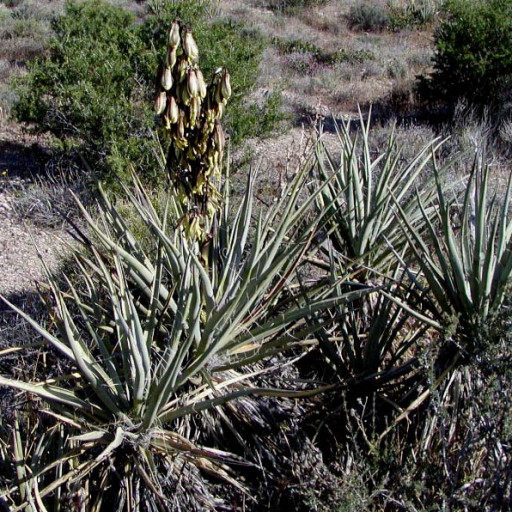
Plant Overview
Often called the Banana Yucca or Datil Yucca, this rugged desert dweller is a hallmark of the American Southwest. It earns its nickname from its fleshy, succulent fruits that resemble small, green bananas. For centuries, it served as a "super-store" for Indigenous peoples, providing food, fiber for sandals, and even soap from its roots.
🔍 How to Identify
- 🗡️ The Foliage: Large, rigid, sword-shaped leaves that are a distinctive blue-green or glaucous color. They typically grow in a low-to-the-ground rosette.
- 🧶 Curled Fibers: Look closely at the leaf margins; you will see thin, white, curly threads peeling away from the edges, giving the plant a "hairy" appearance.
- 🍌 The Fruit: Unlike many yuccas that have dry seed pods, this species produces large, fleshy, hanging fruits (5-8 inches long) that turn brownish-purple when ripe.
🏡 In Your Garden
- 🏜️ Drainage is King: In a garden setting, the Banana Yucca is nearly unkillable as long as it isn't "drowned." It requires very porous, sandy, or rocky soil; sitting in soggy earth will cause the crown to rot almost overnight.
- ❄️ Cold Resilience: While it looks tropical, it is surprisingly cold-hardy compared to other succulents. It can survive temperatures well below freezing, making it a great choice for high-desert or temperate xeriscapes.
- 🧘 Patience Required: This is a slow grower. It puts down a deep, thick taproot first to secure water, which means it resents being transplanted once established. Pick its "forever home" carefully!
⚠️ Safety & Toxicity
- ⚔️ Physical Danger: The primary risk is mechanical. The leaf tips are needle-sharp and can easily puncture skin or cause eye injuries. Plant it away from walkways or areas where children play.
- 🐶 Pet Safety: Like most yuccas, it contains saponins. While the roasted fruit was traditionally eaten by humans, raw parts of the plant can cause drooling, vomiting, or diarrhea in cats and dogs if chewed.
✨ Fun Fact
The roots of the Banana Yucca are rich in natural sudsing agents. Native American tribes, such as the Navajo and Hopi, have traditionally used the crushed roots to create a "shampoo" or soap (often called Amole), which is still used today in certain ceremonial hair-washing rituals.

Detailed Care Instructions
| Color | Cream/White |
| Soil Ph | 6.6-8.7 |
| Humidity | Normal |
| Lighting | Full Sun |
| Soil Type | Dry And Sandy; Well-Drained |
| Bloom Time | Spring |
| Difficulty | Medium |
| Plant Type | Cactus/Succulent |
| Mature Size | Foliage 2-3 Feet; Bloom Spike 4-6 Feet; Clumps Up To 10 Feet Wide |
| Native Area | Southwestern Us And Mexico |
| Sun Exposure | Full Sun |
| Hardiness Zones | 7-11 |
To grow Yucca baccata, also known as Banana Yucca, follow these steps:
- Choose a suitable location: Yucca baccata thrives in full sun and well-draining soil. Select a spot in your garden that receives at least six hours of sunlight per day and has soil that drains well.
- Prepare the soil: Yucca plants prefer sandy or loamy soil. If your soil is heavy or clay-based, amend it by adding sand, perlite, or well-rotted organic matter to improve drainage.
- Planting: Dig a hole that is slightly larger than the root ball of your Yucca baccata. Place the plant in the hole, making sure it is at the same depth as it was in its nursery container. Backfill the hole with soil, gently firming it around the plant's base.
- Watering: Initially, provide frequent watering to help establish the roots. After the first few weeks, reduce the frequency but increase the amount of water each time. Once the plant is established, Yucca baccata is drought-tolerant and requires minimal watering.
- Mulching: Apply a layer of organic mulch, such as wood chips or bark, around the base of the plant. This helps retain moisture, suppress weeds, and protects the roots during extreme temperatures.
- Pruning: Yucca baccata does not require regular pruning. However, you can remove dead or damaged leaves as needed, using clean pruning shears or a sharp knife. Be cautious of the sharp spines along the leaf margins while pruning.
- Fertilizer: Yucca baccata doesn't need heavy fertilization. In fact, excessive fertilizer can be detrimental to its growth. If desired, you can apply a balanced, slow-release fertilizer once a year in early spring.
- Winter care: Yucca baccata is cold hardy and can tolerate temperatures down to around 0°F (-18°C). However, if you live in an area with severe winters, it's advisable to provide some winter protection by covering the plant with a frost cloth or mulch.
By following these steps, you should be able to successfully grow Yucca baccata in your garden. Remember to be patient, as Yucca plants are slow growers and may take a few years to reach their full height and beauty.

Place in a bright room that is sun drenched almost all day. Or directly in a south-facing window.

To properly water this plant, first make sure the soil is completely dry before watering. When watering, choose a pot with drainage holes, and water deeply enough so that water comes out of the drainage holes. Allow the excess water to drain completely before placing the pot back in its regular location. Avoid over-watering, as this can lead to root rot. During cooler months, reduce watering frequency as needed.
For optimal growth, apply a balanced fertilizer in early spring before new growth appears. Use a slow-release granular fertilizer, following package instructions for application rates based on the size of your plant. Avoid fertilizing during the winter months.
The Yucca Baccata plant requires well-draining soil with good aeration. The soil should not be compact or heavy, as this can lead to poor drainage and root rot. It is best to use a mixture of sand, perlite, and peat moss to create a loose, well-draining soil blend. The pH of the soil should be slightly acidic, with a range of 6.0 to 7.0. Additionally, the soil should be free of any harmful chemicals or contaminants, as Yucca Baccata plants are sensitive to toxins. A layer of mulch can be added on top of the soil to help retain moisture and regulate temperature.
To propagate this plant, you will need to identify the offsets or pups which grow from the plant's base. You should select a healthy looking offset or pup and carefully separate it from the parent plant using a sharp, sterilized tool.
Once separated, you will need to plant the offset or pup in well-draining soil mix. Make sure the soil is moist but not overly wet before planting. Pat the soil down around the offset or pup and water it as needed.
After planting, keep the new plant in a partially shaded area and water it regularly to keep the soil moist, but avoid overwatering. Over time, the new plant will grow and develop roots and can eventually be moved to a permanent location, if desired.








