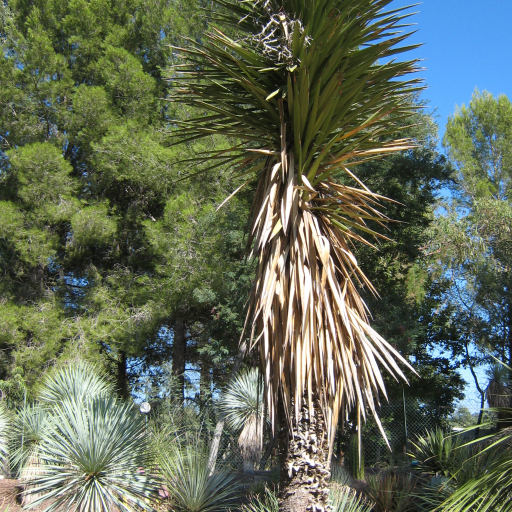
Plant Overview
Known as the Palma China or the Palm Yucca, Yucca filifera is one of the most majestic and largest members of the Yucca family. Native to the high deserts of Mexico, this plant looks like a living monument, growing into a massive, multi-branched tree that can reach heights of over 30 feet. It is a favorite for xeriscaping, bringing a dramatic, prehistoric architectural feel to any dry landscape.
🔍 How to Identify
- 🧵 Threaded Leaves: The name "filifera" refers to the thin, curly white filaments (threads) that peel away from the edges of its stiff, olive-green leaves.
- 🗡️ Sword-Shaped Foliage: The leaves are straight, rigid, and end in a very sharp terminal spine, arranged in dense, symmetrical rosettes.
- 🌲 Massive Trunk: Unlike smaller Yuccas, this species develops a thick, cork-like trunk that widens at the base (pachycaule) and branches out as it matures.
- 🔔 Pendulous Flowers: In late spring, it produces spectacular, creamy-white flower clusters that, unlike many other Yuccas, hang downward like heavy chandeliers.
🏡 In Your Garden
- ☀️ Sun-Seeker Nuances: This plant thrives in "harsh" conditions. While it is incredibly drought-tolerant, it requires excellent drainage; it won't tolerate "wet feet" during winter, which can lead to root rot.
- 🏗️ Space and Permanence: Because it develops a deep, sturdy root system to support its massive weight, it hates being moved once established. Choose its "forever home" carefully, ensuring it is away from walkways where its sharp leaves might poke passersby.
- 🌬️ Climate Resilience: It is surprisingly cold-hardy for a desert giant, but in humid climates, it needs plenty of airflow to prevent leaf spotting or fungal issues.
⚠️ Safety & Toxicity
- ⚔️ Physical Hazard: The most immediate danger is the needle-sharp tip of the leaves. Wear eye protection and thick gloves when pruning or weeding near the base.
- 🐱 Pet Warning: Like most Yuccas, it contains saponins. If chewed on by dogs or cats, it can cause drooling, vomiting, or lethargy.
- 👶 Kid-Friendly Advice: Keep this plant toward the back of garden beds to prevent children from running into the sharp foliage.
✨ Fun Fact
In its native Mexican habitat, the Yucca filifera has a unique "marriage" with the Yucca Moth. The moth is the plant's only pollinator, and in exchange, the moth lays its eggs inside the flowers so its larvae can feed on a small portion of the developing seeds. Neither can survive without the other!

Detailed Care Instructions
To grow a Yucca Filifera plant, you can follow these steps:
- Choose the right location: Yucca Filifera requires full sun to thrive. Select a location with plenty of direct sunlight, preferably a south or west-facing spot in your garden.
- Prepare the soil: Ensure that the soil is well-draining and sandy. Yucca Filifera prefers dry soil, so amend it with sand or gravel to improve drainage if necessary.
- Planting: Dig a hole that is twice the diameter and slightly deeper than the nursery pot. Gently remove the Yucca Filifera from its container and place it in the hole. Backfill with soil, ensuring that the crown of the plant (where the leaves meet the roots) is level with the ground.
- Watering: Initially, water the plant thoroughly after planting to help establish the roots. Afterward, reduce watering frequency as Yucca Filifera prefers dry soil. Water sparingly, only when the soil is completely dry, as overwatering can cause rot.
- Pruning: Prune any dead leaves or spent flower stalks to maintain the plant's appearance and health. Use clean, sharp pruning shears to ensure a clean cut and reduce the risk of infection.
- Fertilizing: Yucca Filifera is a relatively low-maintenance plant that doesn't require frequent fertilization. However, you can apply a balanced fertilizer formulated for succulents once or twice in the growing season to encourage growth.
- Winter care: Yucca Filifera can tolerate cold temperatures, but it's best to protect it during severe winters. Mulch the base of the plant with a layer of organic material, such as straw or wood chips, to insulate the roots and prevent frost damage.
- Propagation: Yucca Filifera can be propagated through stem cuttings or by dividing the root ball of an established plant. However, keep in mind that it may take several years for a new plant to reach full size.
Remember that Yucca Filifera is a slow-growing plant, and it may take several years for it to reach its full height and size. Patience and minimal watering are key to its successful growth.

Place in a bright room that is sun drenched almost all day. Or directly in a south-facing window.

To water this particular plant, you should allow the soil to dry out between watering. When watering, thoroughly saturate the soil, ensuring that water reaches the roots. It's important to avoid over-watering, as this can lead to root rot and other health issues. Additionally, make sure to provide proper drainage to prevent stagnant water from building up in the pot or container. In general, it's best to water less frequently during the winter months, when the plant's growth slows down.
Fertilize the plant during the growing season, which is typically from spring to fall. Use a balanced fertilizer with an NPK ratio of 10-10-10 or 20-20-20. Dilute the fertilizer according to the manufacturer's instructions and apply it to the soil around the base of the plant. Avoid fertilizing during the dormant season in winter.
When planting Yucca Filifera, it is important to choose a well-draining soil that is not too compacted. The soil should be loose and airy, allowing for good circulation of oxygen around the roots. A sandy or loamy soil with a neutral pH level is ideal. It is important to avoid soils that are too heavy, such as clay soils, as these can lead to waterlogging and root rot. When planting in a container, a mix of peat moss, perlite, and sand may be used to create a well-draining soil. Additionally, a layer of gravel or pebbles can be added to the bottom of the container to improve drainage.
To propagate this plant, you will need to select a healthy and mature plant with a strong root system. Carefully remove the plant from its container or from the ground. Next, use a sharp and clean trimming tool to cut away a young shoot or offshoot from the main plant. Make sure the cutting is at least 3-4 inches long and has a few leaves attached to it.
Next, prepare a small container with well-draining soil that is rich in nutrients. Create a hole in the soil where you will place the cutting. Make sure the soil is moist but not soggy. Dip the cut end of the cutting into a rooting hormone powder to encourage root growth.
Place the cutting in the hole and gently pack the soil around it to hold it in place. Water the soil until it is moist, but do not overwater. Place the container in a bright and warm location, but away from direct sunlight. Mist the leaves of the cutting daily to keep them hydrated.
After about 6-8 weeks, the cutting should start to grow roots. Once the roots are well-established, you can transplant the young plant into a larger container or into the ground. Be sure to keep the soil moist and provide the plant with appropriate amounts of light and nutrients to encourage healthy growth.








