Info
Meet the wild cousin of your favorite grocery store button mushroom! Known widely as the Field Mushroom, Agaricus campestris is the quintessential meadow dweller that has been a staple of foragers for centuries. In English folklore, these snowy-white umbrellas appearing overnight were often seen as evidence of dancing fairies or a sudden gift from the earth after a summer rain.
🔍 How to Identify
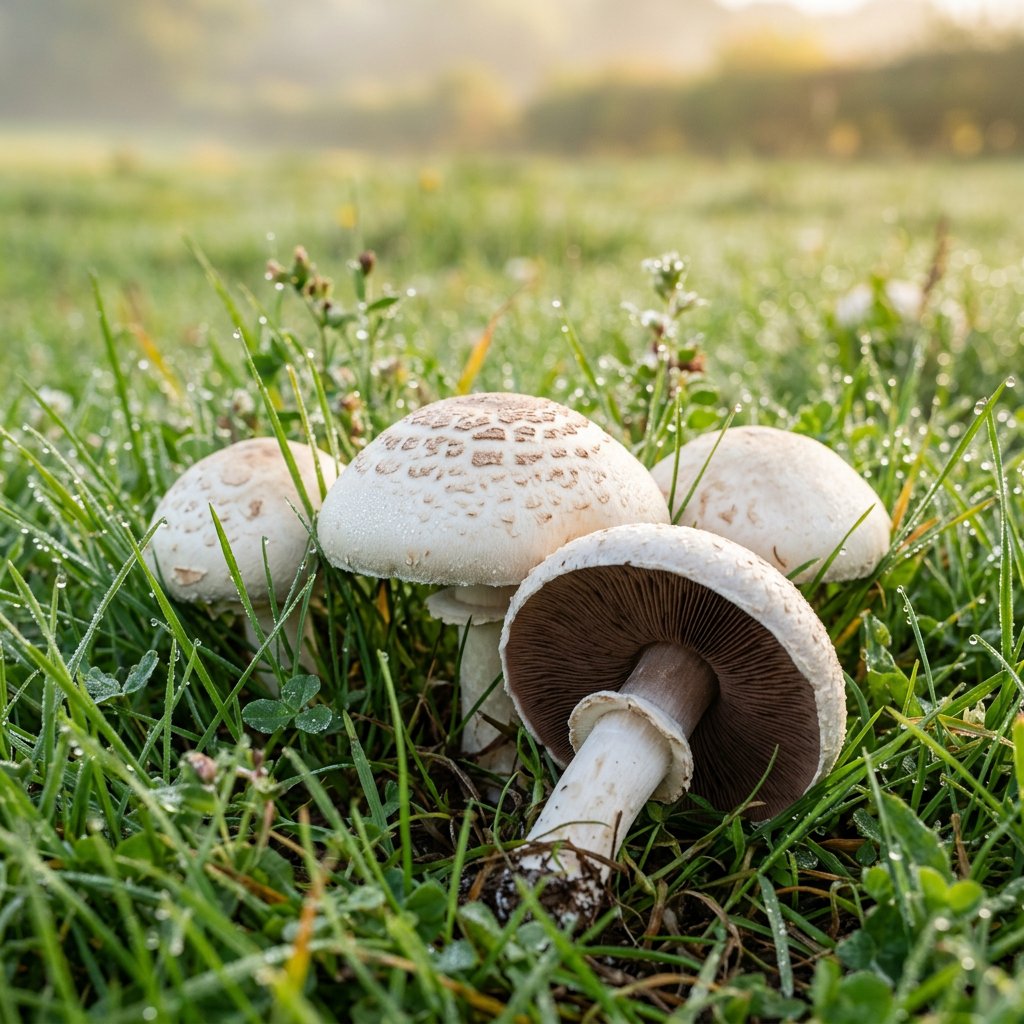
- 🍄 The Cap: Usually 5–10 cm across, the cap is silky white, occasionally maturing into a soft brownish-grey. It starts as a rounded button and flattens out with age.
- 🍥 The Gills: This is the best way to tell its age; the gills start as a delicate "candy-floss" pink, eventually turning a deep, dark chocolate brown as the spores mature.
- 💍 The Stem & Ring: The stem is sturdy and white, featuring a thin, fragile ring (annulus) that may wither or fall off as the mushroom grows.
🌲 Habitat & Ecology
- 🌾 Meadow Specialist: Unlike many mushrooms that rely on trees, the Field Mushroom loves open spaces. Look for it in short-grass environments like pastures, old lawns, and golf courses.
- 🐄 Nutrient Seeker: It thrives in soil enriched by manure, making it a frequent sight in fields where horses or cattle graze, though it rarely grows directly on the dung itself.
- 🌦️ The "Flush": They are famous for appearing suddenly in large numbers (flushes) following heavy rains in late summer or autumn, often forming perfect "fairy rings."
⚠️ Safety & Toxicity
- 🚨 STRICT WARNING: Never consume any wild mushroom unless identified by a professional. While the Field Mushroom is a choice edible, it has deadly lookalikes.
- 💀 The Destroying Angel: It can be confused with the Amanita species, such as the Destroying Angel, which is lethal. Amanitas have white gills and a sac-like cup (volva) at the base of the stem.
- 🤢 The Yellow Stainer: It also resembles the toxic Agaricus xanthodermus. To check, bruise the base of the stem; if it turns bright chrome yellow and smells like ink or chemicals, it is toxic.
✨ Fun Fact
🎨 The Chocolate Print: If you take a mature Field Mushroom cap and place it on a piece of white paper overnight, it will leave a "spore print" that is a rich, dark chocolate brown. This dark spore color is one of the primary ways mycologists distinguish it from toxic white-spored species!
More Details
| Hymenium Type | Lamella |
| Stipe Character | Ring Stipe |
| Spore Print Color | Brown |
| Mushroom Cap Shape | Convex Mushroom Cap |
| Hymenium Attachment | Free Hymenium Attachment |
| Mushroom Ecological Type | Saprobiont |







