Info
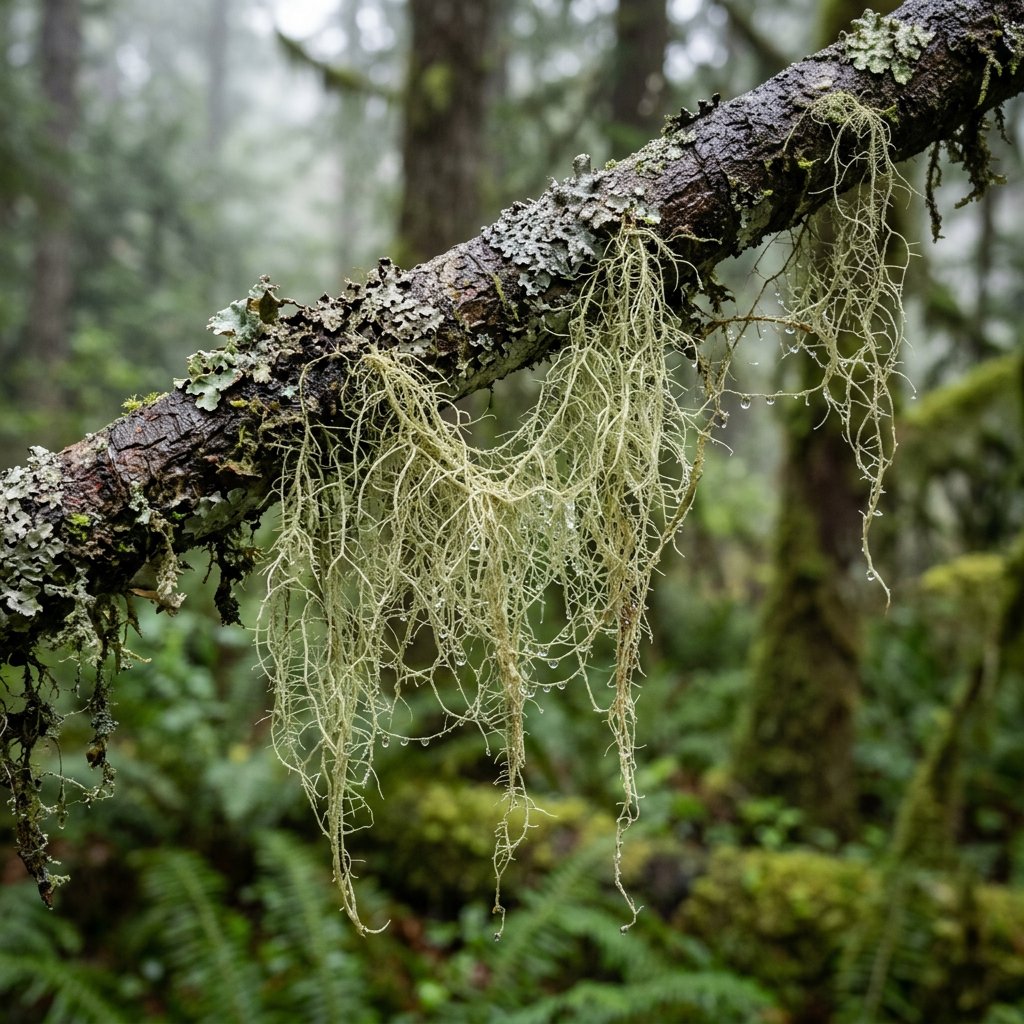
Known as "Witch’s Hair" or "Net Lichen," Alectoria sarmentosa is a striking fruticose lichen that transforms ancient forests into mystical, fairy-tale landscapes. Often mistaken for its cousin, Usnea, this species hangs in long, tangled yellowish-green tresses from the branches of old-growth conifers. It is a true symbol of a healthy, undisturbed ecosystem, as it can only thrive where the air is exceptionally pure.
🔍 How to Identify
- 🧶 Growth Habit: It grows as long, drooping, hair-like tufts that can reach lengths of over 30 centimeters, creating a "shaggy" appearance on tree limbs.
- 🎨 Color Palette: Typically a pale greenish-yellow or a "sickly" chartreuse, which distinguishes it from the deeper greens or grays of other hanging lichens.
- 🌿 Branching Pattern: The branches are often flattened or angular near the base and become more cylindrical and spindly toward the tips, frequently forming a net-like mesh.
- 🔍 The Stretch Test: Unlike Usnea (which has a stretchy white central cord), Alectoria is somewhat brittle and will snap rather than stretch when pulled gently.
🌲 Habitat & Ecology
- ☁️ Atmospheric Specialist: This lichen is a "bioindicator," meaning it acts as a natural air quality monitor. It is highly sensitive to air pollution and will disappear from areas with even moderate levels of sulfur dioxide.
- 🌲 Tree Preferences: You will most often find it draped over the branches of mature conifers, such as Sitka Spruce, Western Hemlock, and Douglas Fir, particularly in cool, moist, coastal or mountainous regions.
- 🦌 Winter Lifeline: In the snowy depths of winter, this lichen serves as a critical food source for mountain caribou and deer, who eat the "hair" that falls to the forest floor during windstorms.
⚠️ Safety & Toxicity
- 🚫 Not for Foraging: While not considered "poisonous" in the same way a deadly mushroom is, Alectoria sarmentosa is not edible for humans. It is extremely high in secondary metabolites (lichen acids) that are difficult for our digestive systems to process.
- 🧤 Skin Sensitivity: While generally safe to touch, some people with sensitive skin may experience "Lichen Planus" or mild irritation when handling large amounts of fruticose lichens.
- 🧼 Cleanliness: Because lichens absorb everything from the air, including heavy metals, they should never be consumed as they concentrate environmental toxins.
✨ Fun Fact
Native American tribes, such as the Nitinaht and Haida, traditionally used Witch's Hair for practical purposes, including stuffing for bedding, wound dressings, and even as a type of "false hair" for ceremonial masks and headdresses!
More Details







