Info
Often found lurking in the dappled sunlight of woodland floors, the Amanita citrina is a master of disguise. Famously known as the "False Death Cap," this mushroom has lived in the shadow of its deadly cousin for centuries. While it carries a beautiful, pale citrus hue, it serves as a stern reminder to foragers that appearances in the fungal kingdom can be intentionally misleading.
🔍 How to Identify
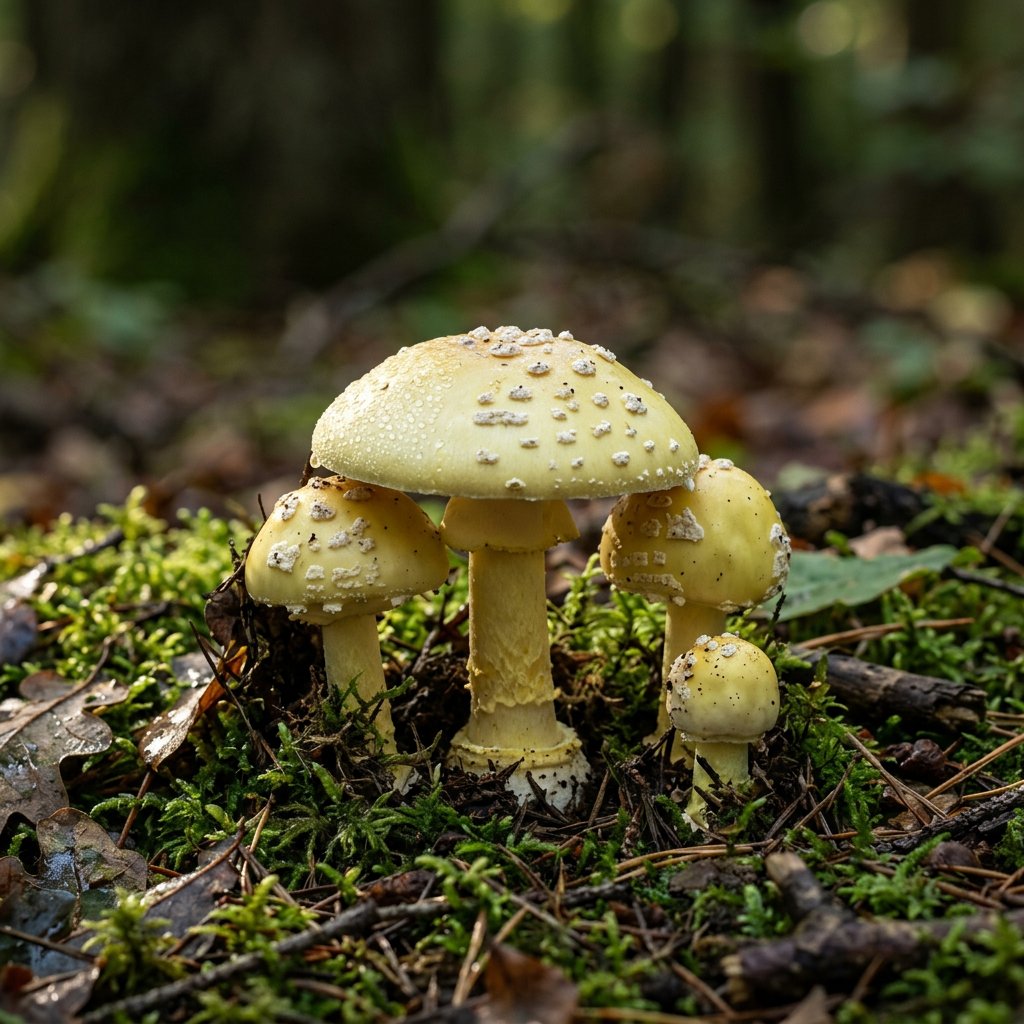
- 🍋 The Cap: Usually a pale citron-yellow or cream color, often dotted with irregular, flat white or brownish "warts" which are remnants of its protective veil.
- ☁️ The Gills: The gills underneath are crowded and white, sometimes developing a slight yellow tint as the mushroom matures.
- 💍 The Stem & Ring: It features a tall, white stem with a delicate, hanging "skirt" or ring near the top.
- 🏺 The Base: The bottom of the stem is very bulbous and sits inside a distinct, fleshy "cup" (volva) that often has a sharp, gutter-like rim.
🌲 Habitat & Ecology
- 🌳 Tree Partners: This mushroom is mycorrhizal, meaning it lives in a symbiotic "handshake" with trees. It is most commonly found near Oak, Beech, and Pine trees.
- 🍂 Acidic Grounds: It prefers acidic soils and is a frequent sight in both broadleaf forests and coniferous plantations during the late summer and autumn months.
- 🥔 The Scent Test: One of its most unique identifying features is its smell; when broken or bruised, it gives off a very strong odor of raw potato skins.
⚠️ Safety & Toxicity
- 🚫 Status: WARNING. While Amanita citrina is not considered "deadly" like some of its relatives, it contains the toxin bufotenine and is classified as inedible.
- 💀 The Great Mimic: The primary danger is its striking resemblance to the Death Cap (Amanita phalloides), which is responsible for the majority of fatal mushroom poisonings worldwide.
- 🐾 Pets & Kids: Keep dogs and children away. Ingestion can cause digestive distress and, in some cases, mild hallucinogenic or neurological effects that are highly unpleasant.
✨ Fun Fact
The Amanita citrina was once thought to be a variety of the deadly Death Cap, but DNA testing has proven it is its own distinct species. Despite its "toxic" reputation, it is actually quite poor at defending itself—it is frequently parasitized by another mushroom, the Parasitic Bolete (Pseudoboletus parasiticus)!
More Details
| Hymenium Type | Lamella |
| Stipe Character | Ring And Volva Stipe |
| Spore Print Color | White |
| Mushroom Cap Shape | Flat Mushroom Cap |
| Hymenium Attachment | Free Hymenium Attachment |
| Mushroom Ecological Type | Mycorrhiza |







