Info
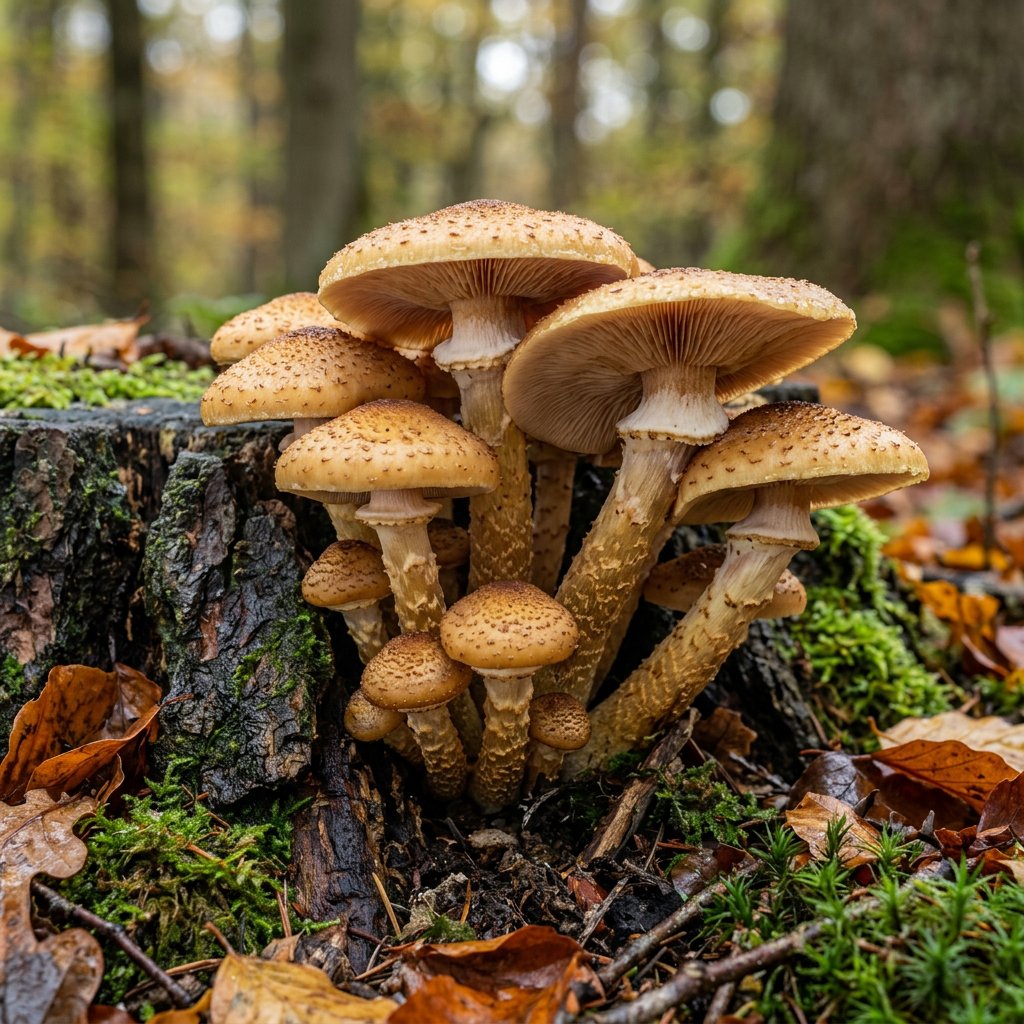
Often called the "Honey Mushroom" for its warm, golden-yellow hue, Armillaria mellea is a dual-natured inhabitant of the forest. To a forager, it is a prized culinary find, but to a gardener, it is the "Tree Slayer"—a relentless parasite capable of taking down massive oaks. It belongs to a family of fungi famous for producing some of the largest and oldest living organisms on Earth.
🔍 How to Identify
- 🍯 The Cap: Ranging from 3 to 15 cm wide, the cap is honey-colored to tawny-brown, often covered in tiny, dark, hair-like scales that are more concentrated toward the center.
- ⚪ The Gills: The gills are creamy-white when young, eventually developing pinkish-brown spots as they age; they are "adnate," meaning they are attached directly to the stem.
- 💍 The Stem & Ring: The stem is sturdy and fibrous, featuring a prominent, thick, and persistent white ring (annulus) near the top, which helps distinguish it from ringless lookalikes.
- ☁️ Spore Print: If you place the cap on a dark surface, it will leave a distinct white spore print.
🌲 Habitat & Ecology
- 🌳 The Silent Invader: Unlike many mushrooms that only eat dead wood, the Honey Mushroom is a necrotrophic parasite. It attacks the roots of living trees—especially broadleaf species like Oak and Beech—eventually killing them and then continuing to feed on the dead stump.
- 🕸️ Shoestring Roots: Beneath the bark of infected trees, you may find "Rhizomorphs." These are thick, black, cord-like fungal strands that look like shoestrings, which the fungus uses to travel through the soil to infect neighboring trees.
⚠️ Safety & Toxicity
- 🚨 WARNING: Never consume this mushroom raw. Armillaria mellea contains heat-labile toxins that cause severe gastrointestinal distress. It must be thoroughly cooked before eating.
- 🚫 Deadly Lookalikes: Extreme caution is required to avoid the Galerina marginata (Funeral Bell), a deadly toxic mushroom that also grows on wood. The key difference is the Galerina’s brown spore print versus the Honey Mushroom’s white print.
- 🤢 Individual Sensitivity: Some people are sensitive to Honey Mushrooms even when cooked. It is recommended to try a very small amount first.
✨ Fun Fact
- 💡 Foxfire Glow: The mycelium (the underground "root" system) of the Honey Mushroom is bioluminescent. In the middle of a dark, damp forest, wood infected by this fungus can emit a faint, ghostly green glow known in folklore as "foxfire."
More Details







