Info
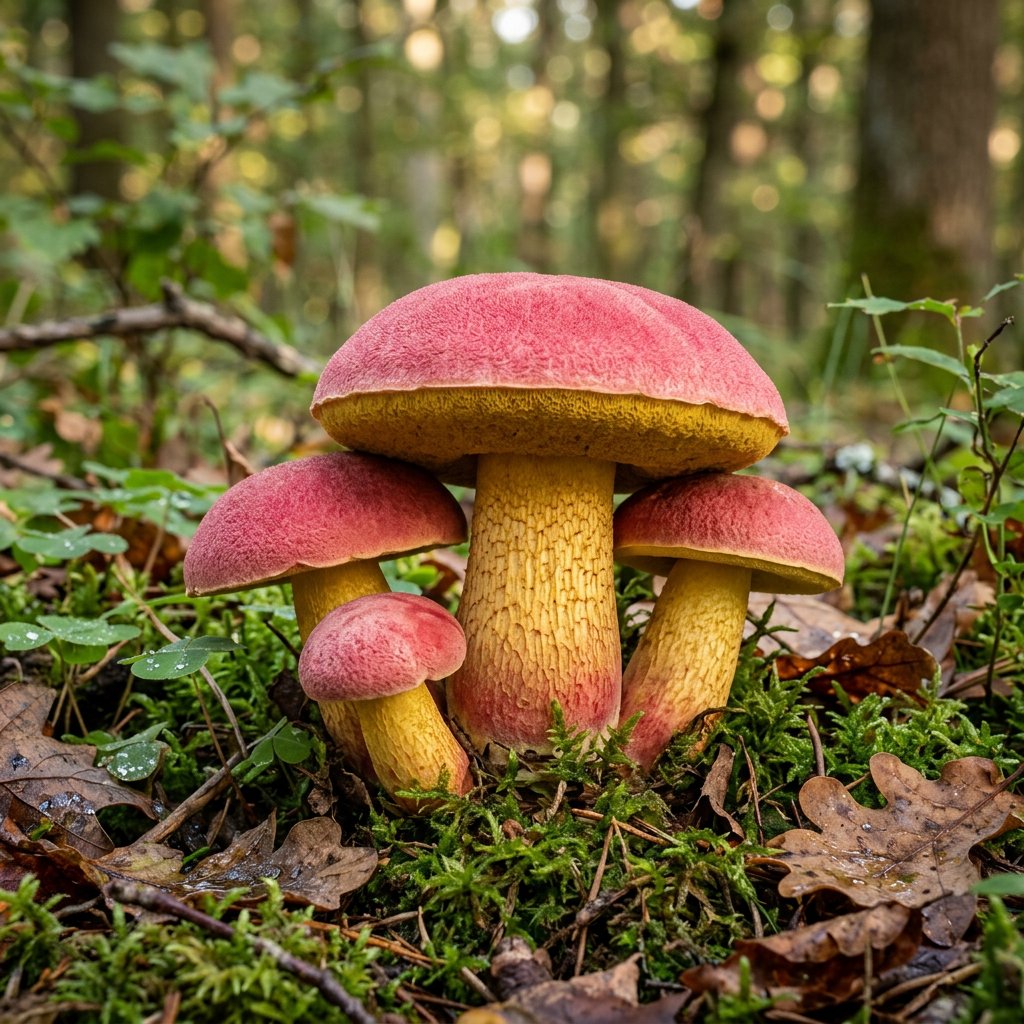
Often called the Royal Bolete, this mushroom is a true aristocrat of the forest floor. With its regal rose-pink cap and brilliant "butter-yellow" stem, it stands out like a jewel against the leaf litter. While it is a prized find for mushroom hunters, its beauty is matched by its rarity in many regions, where it is often protected by conservation laws.
🔍 How to Identify
- 👑 The Cap: Displays a striking rose-red, pinkish, or reddish-brown color. The surface is initially slightly velvety but becomes smoother and may crack as it matures.
- 🧽 The Pores: Unlike many common mushrooms, it has no gills. Instead, the underside features a sponge-like layer of tiny, bright yellow pores that do not change color significantly when bruised.
- 🟡 The Stem: Thick and club-shaped, the stem is a vibrant yellow. If you look closely, you’ll see a fine, net-like pattern called "reticulation" near the top.
- 🔪 The Flesh: When sliced, the firm, pale-yellow flesh remains stable or may show only a very faint, slow blue tint, distinguishing it from "staining" boletes.
🌲 Habitat & Ecology
- 🌳 The Oak Connection: This mushroom is mycorrhizal, meaning it lives in a symbiotic "handshake" with tree roots. It is most commonly found snuggled near the roots of Oak and Beech trees.
- ⛰️ Soil Preference: It has a "refined" palate, preferring warm, sunny spots with lime-rich (calcareous) soil, often appearing in late summer or early autumn after heavy rains.
- 🍄 The Butter Boletes: It belongs to the genus Butyriboletus, a group known as "Butter Boletes" because of the rich, buttery yellow color of their stems and pores.
⚠️ Safety & Toxicity
- 🚨 WARNING: While the Royal Bolete is considered a "choice" edible by experts, never consume any wild mushroom unless you are 100% certain of its identity.
- 👯 Lookalikes: It can be easily confused with other red-capped boletes, such as the Rubroboletus satanas (Devil’s Bolete), which is toxic and causes severe gastrointestinal distress. The key difference is that toxic lookalikes usually have red pores and stain deep blue instantly when cut.
- 🛡️ Conservation: Because it is rare in many parts of Europe, it is often on "Red Lists." Picking it may be illegal in certain countries to protect the local ecosystem.
✨ Fun Fact
The name Butyriboletus is derived from the Latin word butyrum, meaning "butter." This doesn't refer to its taste, but rather the vivid, fatty-yellow color of its stem and pore surface that looks just like a block of fresh farm butter!
More Details
| Hymenium Type | Pores |
| Stipe Character | Bare Stipe |
| Spore Print Color | Olive |
| Mushroom Cap Shape | Semi-Spherical Mushroom Cap |
| Hymenium Attachment | Free Hymenium Attachment |
| Mushroom Ecological Type | Mycorrhiza |