Info
Known as the "California Giant Chanterelle," this golden treasure is the heavy-hitter of the fungal world. Exclusive to the West Coast, it holds the title of the largest chanterelle species on the planet, with single specimens sometimes weighing over two pounds. Foragers often refer to it as a "Mud Puppy" because of its habit of pushing through the forest floor, often staying partially buried under the soil and leaf litter.
🔍 How to Identify
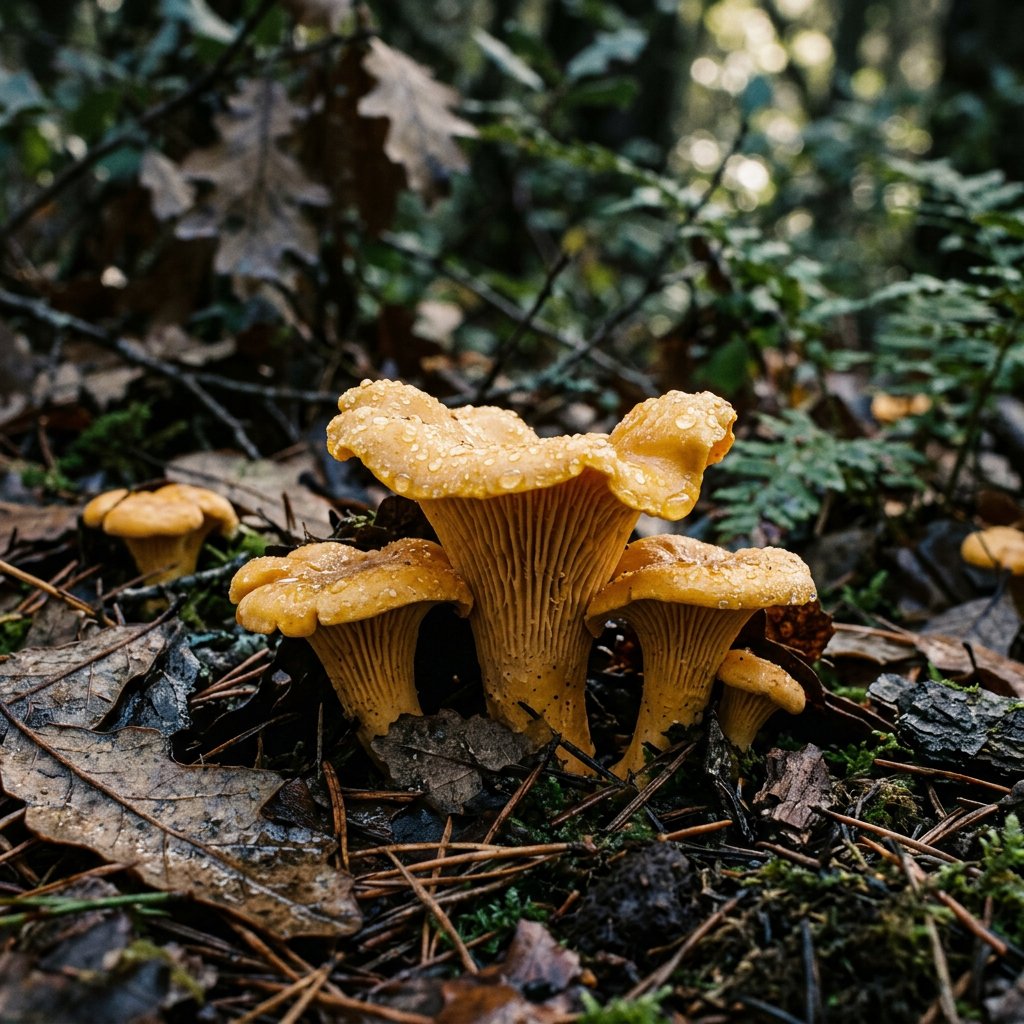
- 🍄 The Cap: Massive, wavy-edged, and vibrant golden-orange. As it matures, the center often becomes depressed, giving it a thick, funnel-like appearance.
- 🧶 False Gills: Instead of thin, blade-like gills, the underside features shallow, blunt ridges that look like veins. These "false gills" run partway down the stem and cannot be easily scraped off.
- 🍗 The Flesh: Solid, dense, and white on the inside. When torn, the texture resembles string cheese and emits a distinct, pleasant aroma of fresh apricots.
🌲 Habitat & Ecology
- 🌳 The Oak Connection: This mushroom is mycorrhizal, meaning it lives in a symbiotic "buddy system" with tree roots. It is almost exclusively found growing on the ground near Coast Live Oaks and Tanoaks.
- 🌧️ Winter Specialist: Unlike many other chanterelles that prefer summer heat, the California Giant is a winter specialist. It typically emerges after the first significant autumn rains and can continue fruiting through early spring.
⚠️ Safety & Toxicity
- 🛑 WARNING: While considered a "choice" edible, never consume a wild mushroom unless you have confirmed the identity with a local expert.
- 🔦 The Dangerous Double: It is often confused with the toxic Omphalotus olivascens (Western Jack-o'-Lantern). The Jack-o'-Lantern has true, sharp gills, grows in clusters on wood (not soil), and—strangely enough—can glow faintly in the dark.
- 🍳 Preparation: Never eat these raw. They contain chitin that must be broken down by heat to prevent stomach upset. Because they are so dense, they require a longer cooking time than most mushrooms.
✨ Fun Fact
Until 2008, scientists didn't realize this was a unique species! For decades, Californians thought they were just finding unusually large versions of the common Golden Chanterelle, until DNA testing proved that these Pacific giants were a distinct species found nowhere else in the world.
More Details
| Hymenium Type | Ridges |
| Stipe Character | Bare Stipe |
| Spore Print Color | Yellow |
| Mushroom Cap Shape | Infundibuliform Mushroom Cap |
| Hymenium Attachment | Decurrent Hymenium Attachment |
| Mushroom Ecological Type | Mycorrhiza |







