Info
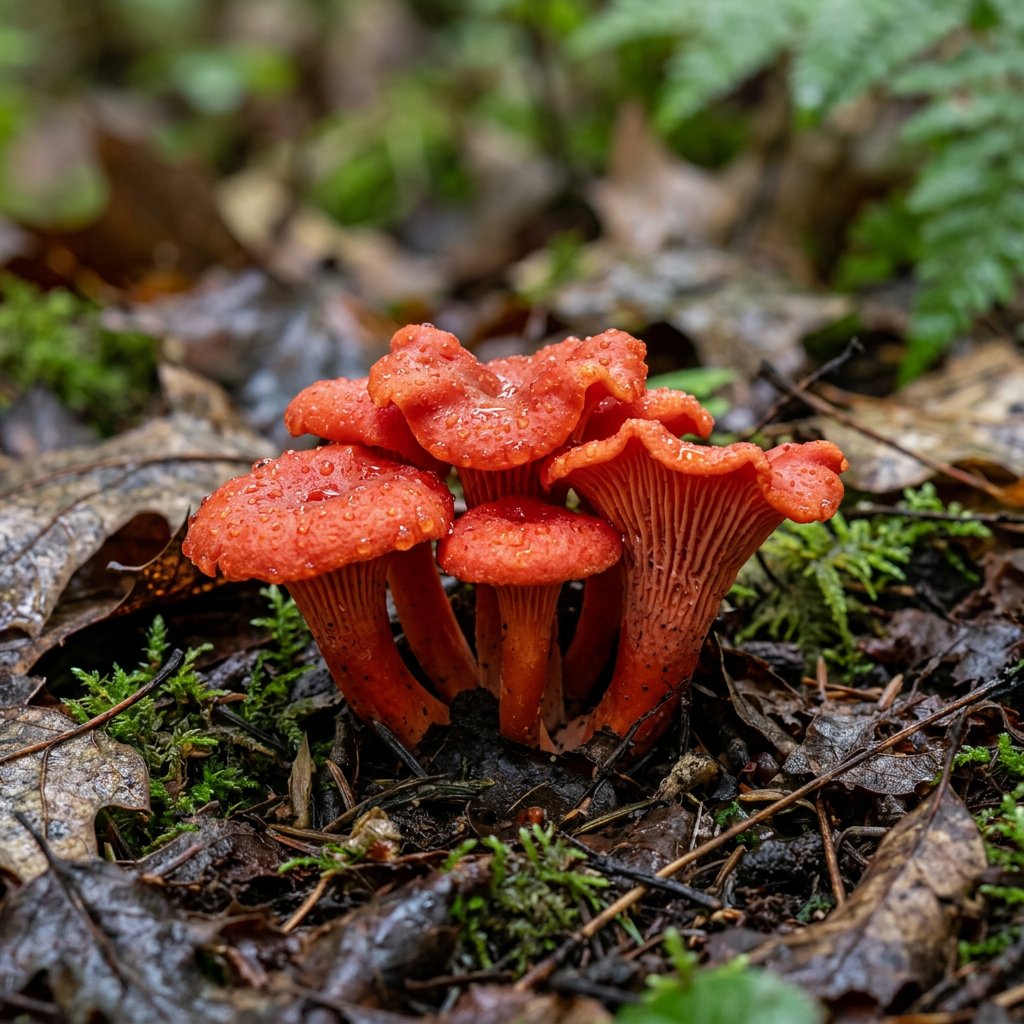
Imagine walking through a humid, mossy forest and spotting a splash of neon pink-orange glowing against the dark earth. This is the Cinnabar Chanterelle, often called the "Flamingo of the Forest." While smaller than its famous golden cousins, its vibrant cinnabar-red hue makes it one of the most beautiful and easily spotted mushrooms in the wild woods of North America.
🔍 How to Identify
- 🍄 The Cap: Typically small (1–4 cm), the cap starts out convex but quickly develops a central dip, eventually becoming vase-shaped with a delicate, wavy edge.
- 🧶 False Gills: Unlike many mushrooms, this species has "false gills"—blunt, vein-like ridges that run down the stem (decurrent). These ridges often fork or interconnect like a tiny web.
- 🎨 The Color: The entire mushroom is a uniform, brilliant cinnabar-red or deep flamingo pink. The flesh inside is firm and pale, lacking the bright orange intensity of the exterior.
🌲 Habitat & Ecology
- 🌳 Hardwood Friendships: These fungi are mycorrhizal, meaning they live in a symbiotic relationship with tree roots. You will almost always find them growing near hardwood trees, particularly Oak and Beech.
- 🌦️ The Summer Flush: They are lovers of warmth and moisture. Look for them appearing in scattered groups on the forest floor during the humid peaks of summer and early autumn, especially after heavy rainfall.
⚠️ Safety & Toxicity
- 🛑 WARNING: Never eat a mushroom unless you are 100% certain of its identity. While the Cinnabar Chanterelle is a prized edible, it has dangerous "lookalikes" that can cause severe distress.
- 🧪 The Jack-o'-Lantern: The toxic Jack-o'-Lantern mushroom (Omphalotus illudens) is also orange, but it is much larger, grows in big clusters on wood (not soil), and has true, knife-like gills rather than blunt ridges.
- 👨👩👧 General Caution: Always keep wild mushrooms out of reach of unsupervised children and pets, as many forest-floor species can cause stomach upset if ingested raw.
✨ Fun Fact
- 🥕 Carrot Power: The brilliant red color of the Cinnabar Chanterelle is produced by carotenoids—the very same organic pigments that give carrots their orange color and flamingos their iconic pink feathers!
More Details
| Hymenium Type | Ridges |
| Stipe Character | Bare Stipe |
| Spore Print Color | White |
| Hymenium Attachment | Decurrent Hymenium Attachment |
| Mushroom Ecological Type | Mycorrhiza |







