Info
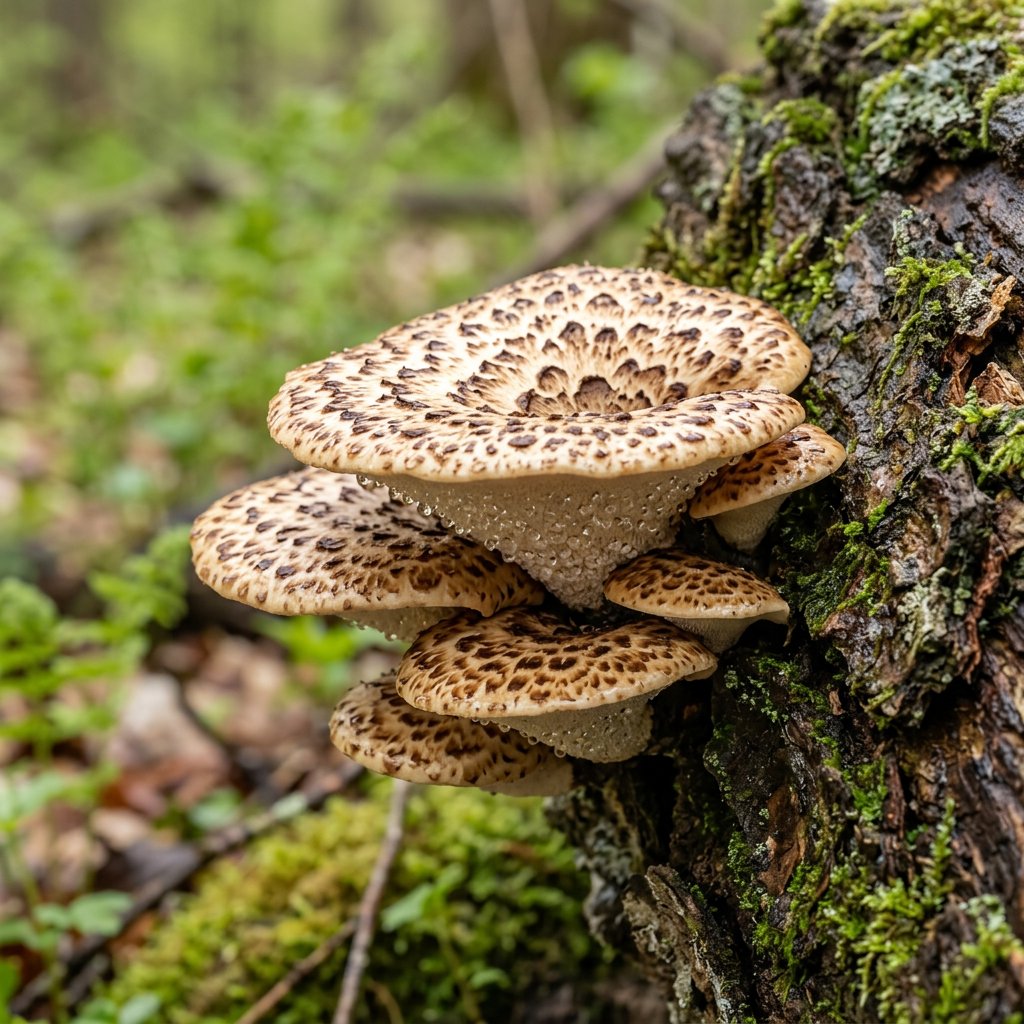
Known famously as the Dryad’s Saddle, this striking mushroom gets its name from Greek mythology—the idea that wood nymphs (dryads) would use these sturdy, fan-shaped brackets as seats. Its other common name, Pheasant’s Back, perfectly captures the beautiful pattern of dark, overlapping scales that mimic the feathers of a game bird. It is one of the most reliable and easy-to-spot treasures for spring foragers.
🔍 How to Identify
- 🍄 The Cap: Large, fan-shaped or kidney-shaped, ranging from 10 to 30 cm across. It features distinctive dark brown scales (squamules) on a pale tan or creamy background.
- 🧽 The Underside: This is a "polypore," meaning it has tiny, angular white to cream-colored pores instead of gills. The pores are visible to the naked eye and run slightly down the short, thick stem.
- 🥒 The Aroma: One of its most famous traits is its scent; when sliced or bruised, it smells remarkably like fresh cucumber or watermelon rind.
🌲 Habitat & Ecology
- 🌳 The Wood Worker: It grows on living or dead deciduous trees, acting as both a parasite and a decomposer. It is particularly fond of Elm trees, but you will often find it on Maple, Beech, or Willow.
- 📅 A Spring Herald: While it can occasionally appear in the autumn, it is most common in late spring and early summer. It often pops up just as the Morel season is winding down, ensuring forest wanderers always have something to find.
⚠️ Safety & Toxicity
- ⚠️ WARNING: While Cerioporus squamosus is considered a safe edible for beginners because it lacks deadly look-alikes, never consume a wild mushroom without 100% positive identification.
- 🍽️ Texture Issues: It is non-toxic, but older specimens become extremely tough, leathery, and "woody." To enjoy them, foragers only harvest the tender outer edges of young mushrooms. If a knife doesn't slide through it like butter, it’s too old to eat!
- 🐶 Pets: Generally not toxic to dogs, but like most wild mushrooms, it can cause digestive upset or blockages if a pet consumes the tough, indigestible mature flesh.
✨ Fun Fact
- 🧚 Mythic Proportions: In some ancient European folklore, it was believed that these mushrooms appeared only on trees that held a "spirit of the woods," and sitting on one (if you were small enough!) would allow you to hear the secrets of the forest.
More Details
| Hymenium Type | Pores |
| Stipe Character | Bare Stipe |
| Spore Print Color | White |
| Mushroom Cap Shape | Depressed Mushroom Cap |
| Hymenium Attachment | Decurrent Hymenium Attachment |
| Mushroom Ecological Type | Saprobiont |