Info
Often called the Shaggy Parasol, Chlorophyllum brunneum is a robust, eye-catching fungus that looks like it stepped right out of a woodland fairy tale. Frequently appearing in suburban gardens and backyard compost piles, it is a master of disguise that bridges the gap between the forest and the front lawn. While it is admired for its impressive size, it is a mushroom that demands a high level of respect and careful observation due to its "toxic twins."
🔍 How to Identify
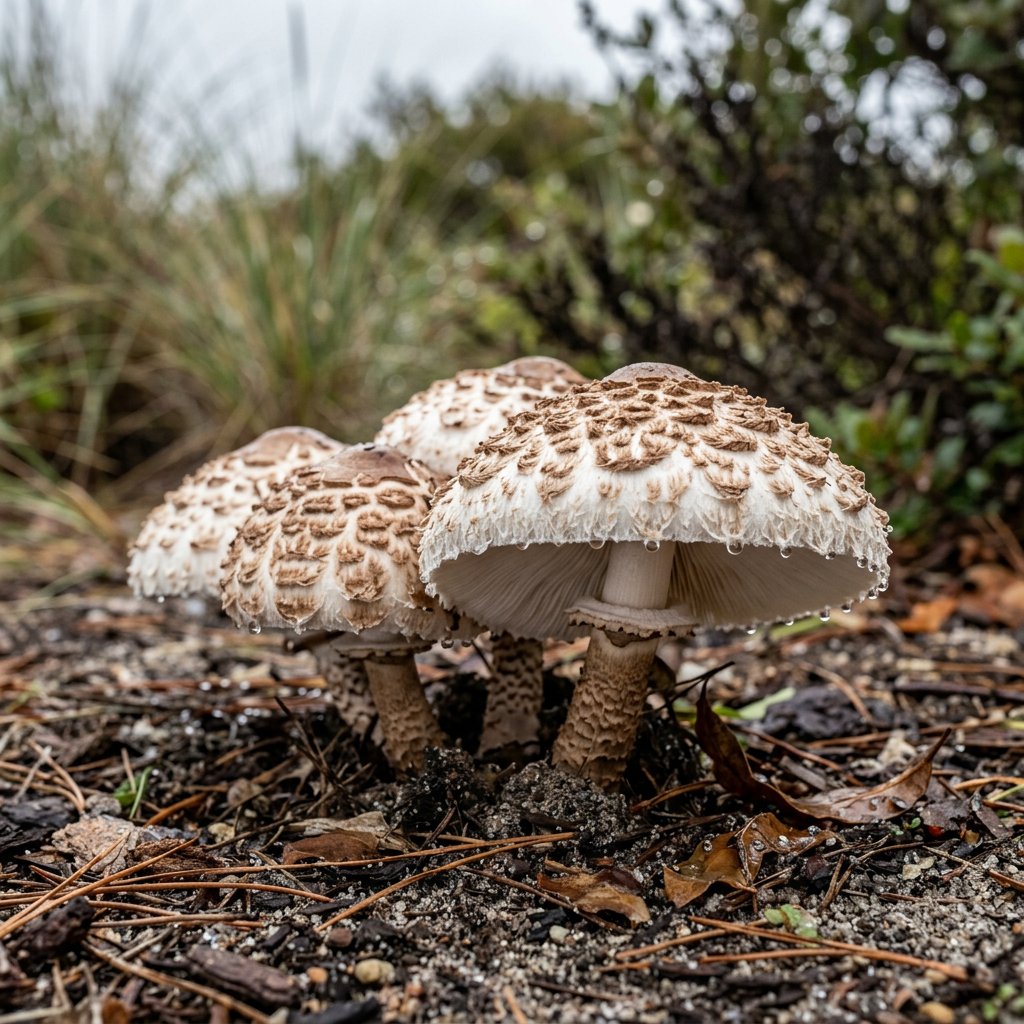
- 🍄 The Scaly Cap: The cap begins as a brown, rounded "drumstick" before expanding into a broad, flat parasol. As it grows, the brown outer skin breaks apart into thick, shaggy scales that stand out against the white flesh beneath.
- 🍦 The Gills & Ring: The gills are crowded and white, turning slightly brownish with age. On the stem, you will find a thick, brownish, movable ring (annulus) that can often be slid up and down like a wedding band.
- 🧅 The Bulbous Base: The stem is relatively short and thick, ending in a very distinct, abruptly enlarged bulb at the base. Unlike some of its relatives, the stem of this species is usually smooth rather than patterned.
🌲 Habitat & Ecology
- 🏡 The Suburban Forager: This species loves nitrogen-rich environments. You are most likely to find it in "man-made" habitats like garden mulch, compost heaps, leaf litter, and even inside greenhouses.
- 🍂 Nature's Recycler: As a saprobic fungus, its primary job is decomposition. It spends its life underground or inside mulch, breaking down complex organic matter and returning vital nutrients to the soil.
⚠️ Safety & Toxicity
- 🚨 WARNING: Never consume this mushroom based on a visual ID alone. It is a "lookalike" species. It looks nearly identical to Chlorophyllum molybdites (The False Parasol), which is the most common cause of mushroom poisoning in North America and features green spores.
- 🤢 Individual Sensitivity: Even when correctly identified, Chlorophyllum brunneum causes severe gastrointestinal distress (vomiting and cramping) in a significant percentage of the population.
- 🐾 Pet Health: This mushroom is known to be toxic to dogs. If you find them popping up in a yard where pets play, it is safest to remove and discard them.
✨ Fun Fact
When the white flesh of the Shaggy Parasol is cut or bruised, it performs a magic trick: it rapidly oxidizes, turning a vivid saffron-orange or reddish-pink before eventually fading to brown!
More Details







