Info
Often referred to as the "False Parasol" or more bluntly, "The Vomiter," this mushroom is the most common cause of mushroom poisoning in North America. It is a master of disguise, frequently popping up in suburban lawns in enchanting "fairy rings" that look like they belong in a storybook. While its large, stately appearance might tempt the hungry forager, it hides a sickly secret beneath its cap.
🔍 How to Identify
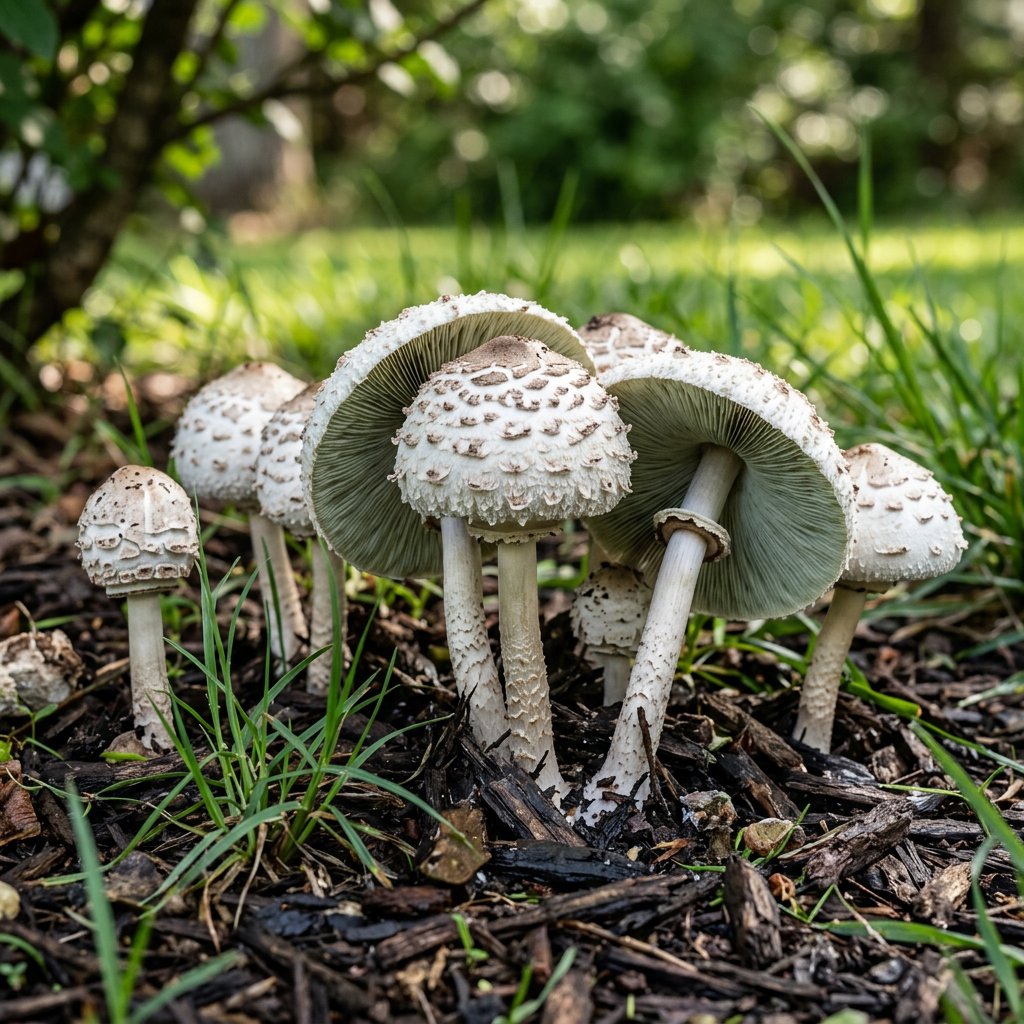
- 🧢 The Cap: Large and fleshy, it starts out shaped like a drumstick before expanding into a broad, flat umbrella. The surface is white but decorated with brownish, shaggy scales that concentrate near the center.
- 📗 The Gills: This is the most critical feature. While the gills start out white, they turn a distinctive olive-green or grayish-green as the mushroom matures and produces its spores.
- 💍 The Stem: A tall, sturdy stalk that features a thick, double-edged ring (annulus). In mature specimens, this ring can often be slid up and down the stem like a piece of jewelry.
🌲 Habitat & Ecology
- 🏡 The Suburban Resident: Unlike many wild mushrooms that require deep forests, this species thrives in man-made environments. You’ll most likely find it in well-watered lawns, parks, and golf courses after a heavy summer rain.
- 🍄 Fairy Rings: It is famous for growing in large, conspicuous circles. Folklore once claimed these rings were scorched into the grass by the feet of dancing fairies or spirits, but they are actually just the mushroom's underground network expanding outward.
⚠️ Safety & Toxicity
- 🚨 WARNING: TOXIC. This mushroom is strictly non-edible. It is the number one cause of mushroom poisonings because it is easily confused with the edible Shaggy Mane or the true Parasol mushroom.
- 🤢 The Symptoms: True to its nickname "The Vomiter," ingestion leads to severe gastrointestinal distress, including violent vomiting, cramping, and diarrhea.
- 🐾 Pets & Children: Because it grows where we play, it is a high risk for curious toddlers and dogs. Always remove these from your lawn if you have pets or children who might "taste-test" the local flora.
✨ Fun Fact
To be 100% sure of its identity, mycologists perform a "spore print." By placing the cap on a piece of paper, Chlorophyllum molybdites will leave a unique, dull-green dusty print—a color almost never seen in the world of edible mushrooms!
More Details







