Info
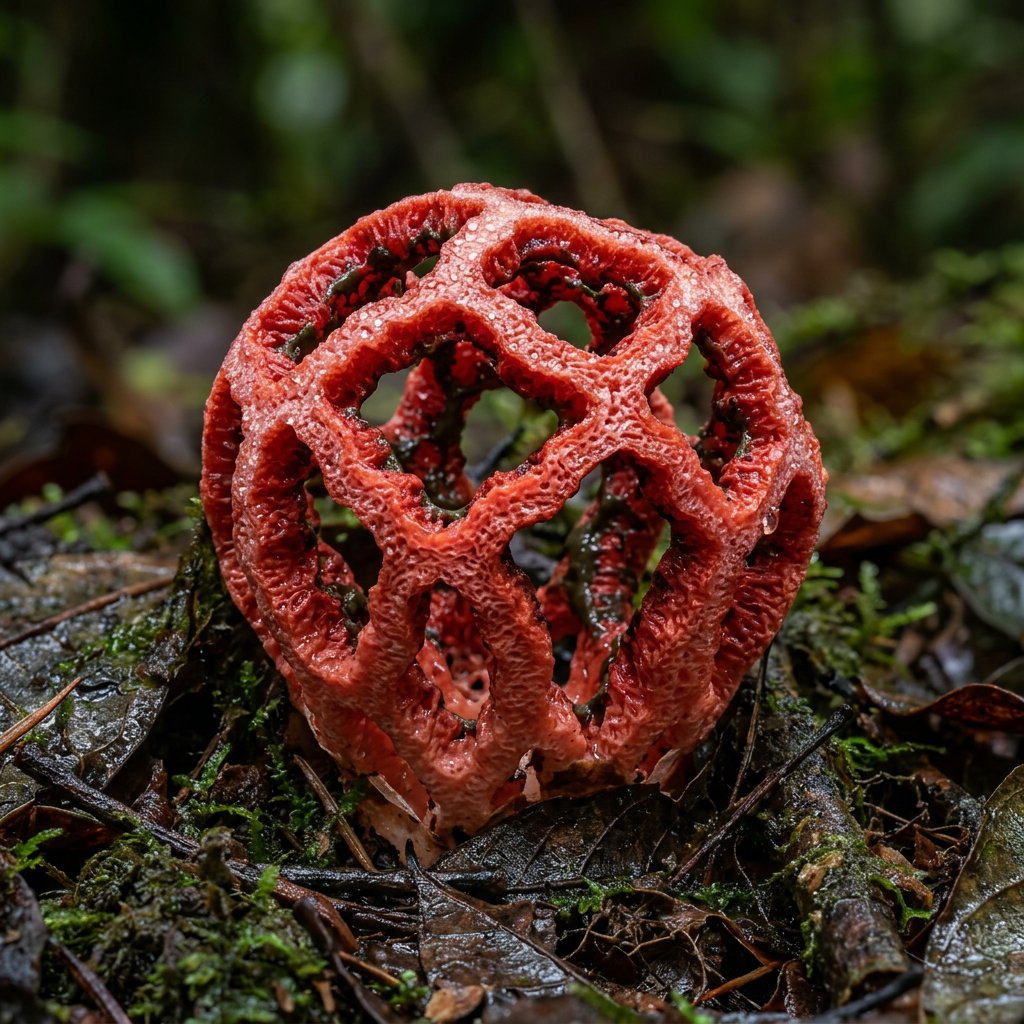
Often called the Crimson Lattice or the Red Cage Fungus, Clathrus crispatus looks more like an alien artifact or a piece of intricate coral than a traditional mushroom. It is a member of the "stinkhorn" family, a group of fungi that has traded the traditional cap-and-stem look for a geometric "cage" designed to attract flies. If this bizarre structure appears in your garden, you will likely smell its signature scent of rotting meat long before you spot its vibrant red color.
🔍 How to Identify
- 🕸️ The Lattice Structure: Instead of a cap, it forms a hollow, spherical cage or "basket" made of interconnected red or pinkish arms. These arms are often deeply wrinkled or "crisped" along the edges.
- 🥚 The "Egg" Phase: Before the cage bursts out, the fungus lives as a soft, white, leathery "egg" partially buried in the soil or mulch.
- 💩 The Gleba (Spore Slime): The inner surfaces of the red arms are coated in a thick, olive-brown, foul-smelling slime that contains the mushroom’s spores.
🌲 Habitat & Ecology
- 🍂 Mulch & Debris: This mushroom loves "disturbed" ground. You will most often find it in suburban garden beds, heavily mulched areas, or rotting wood chips where it breaks down organic matter.
- 🪰 The Fly Strategy: Unlike most mushrooms that use the wind to carry spores, Clathrus crispatus uses chemistry. The smell of decay attracts flies and beetles, who crawl over the slime and fly away with spores attached to their legs and bodies.
⚠️ Safety & Toxicity
- 🚫 WARNING: Generally considered inedible. While not known to be "deadly" in the way some Amanitas are, the chemical compounds in stinkhorns can cause severe gastrointestinal distress if consumed.
- 🤢 The "Yuck" Factor: The overwhelming smell of rotting meat and the slimy texture make this mushroom naturally unappealing to humans and most pets. However, curious dogs should be kept away, as ingestion may lead to vomiting or lethargy.
✨ Fun Fact
The geometric complexity of the Clathrus genus is so perfect that mathematicians have used these mushrooms as biological models for studying "minimal surfaces"—the most efficient way to enclose a space with the least amount of material!
More Details
| Hymenium Type | Gleba |
| Spore Print Color | Olive Brown |
| Hymenium Attachment | No Hymenium Attachment |
| Mushroom Ecological Type | Saprobiont |