Info
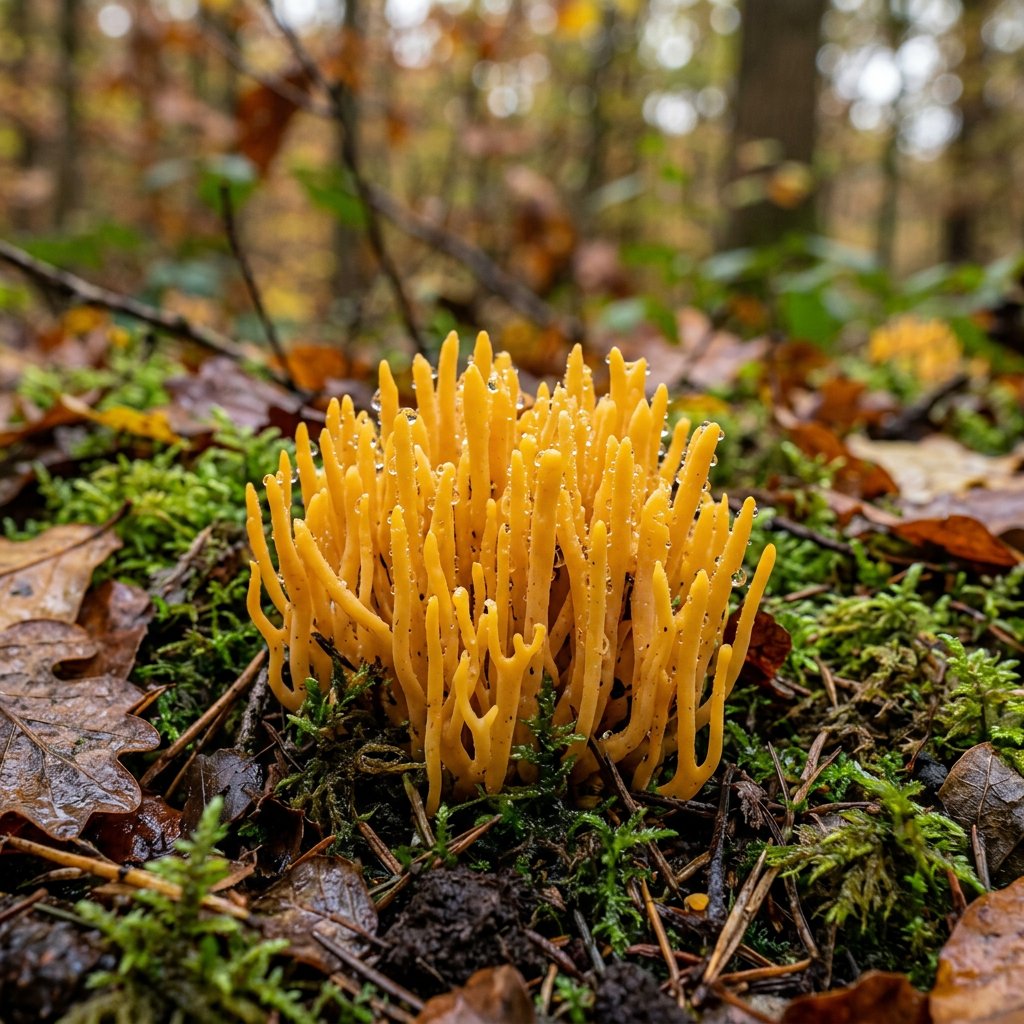
Imagine walking through a dew-covered meadow and spotting a cluster of vibrant, neon-yellow fingers poking through the grass. Known as the Golden Spindle or Spindle-shaped Coral, this fungus looks more like a piece of undersea coral than a traditional forest mushroom. It is a favorite for nature photographers because its electric color provides a stunning contrast against green moss and dark soil.
🔍 How to Identify
- 🍌 The Shape: These mushrooms lack a traditional cap and stem. Instead, they grow as upright, cylindrical, or slightly flattened "spindles" that often taper to a sharp point at the top.
- ☀️ The Color: They are a brilliant, uniform golden-yellow. As the mushroom ages, the very tips may turn brownish or black, but the body usually retains its sunny hue.
- 🤝 The Clumps: A key identifying feature is that they almost always grow in tight, dense clusters where the bases of the spindles are fused together, unlike other "club" fungi that grow singly.
🌲 Habitat & Ecology
- 🌱 Meadow Dwellers: You won’t usually find these deep in heavy forest floor litter. They prefer mossy grasslands, old pastures, and the grassy edges of woodlands where they can peak through the turf.
- 🍂 Autumn Glow: They are most prolific during late summer and autumn. They tend to appear in great numbers after heavy rainfall when the ground is saturated and the humidity is high.
- 🍄 The Decomposers: These fungi are saprobic, meaning they survive by breaking down organic matter in the soil, helping to recycle nutrients back into the grassland ecosystem.
⚠️ Safety & Toxicity
- 🛑 WARNING: While Clavulinopsis fusiformis is technically listed as edible in some guides, it is not recommended for consumption. Many similar-looking coral fungi are toxic and cause severe digestive upset.
- 👅 Bitter Profile: Even if you identify it correctly, it is considered "inedible" by most due to its extremely bitter taste and fragile, watery texture.
- 🐾 Pet Safety: While not known to be high-risk, it is best to keep curious dogs away from these clusters, as wild fungi can cause unpredictable stomach distress in pets.
✨ Fun Fact
- 🧬 The Name Game: The species name fusiformis comes from the Latin word for "spindle-shaped." If you look closely at a single strand, it perfectly mimics the shape of an old-fashioned wooden spindle used for spinning wool!
More Details