Info
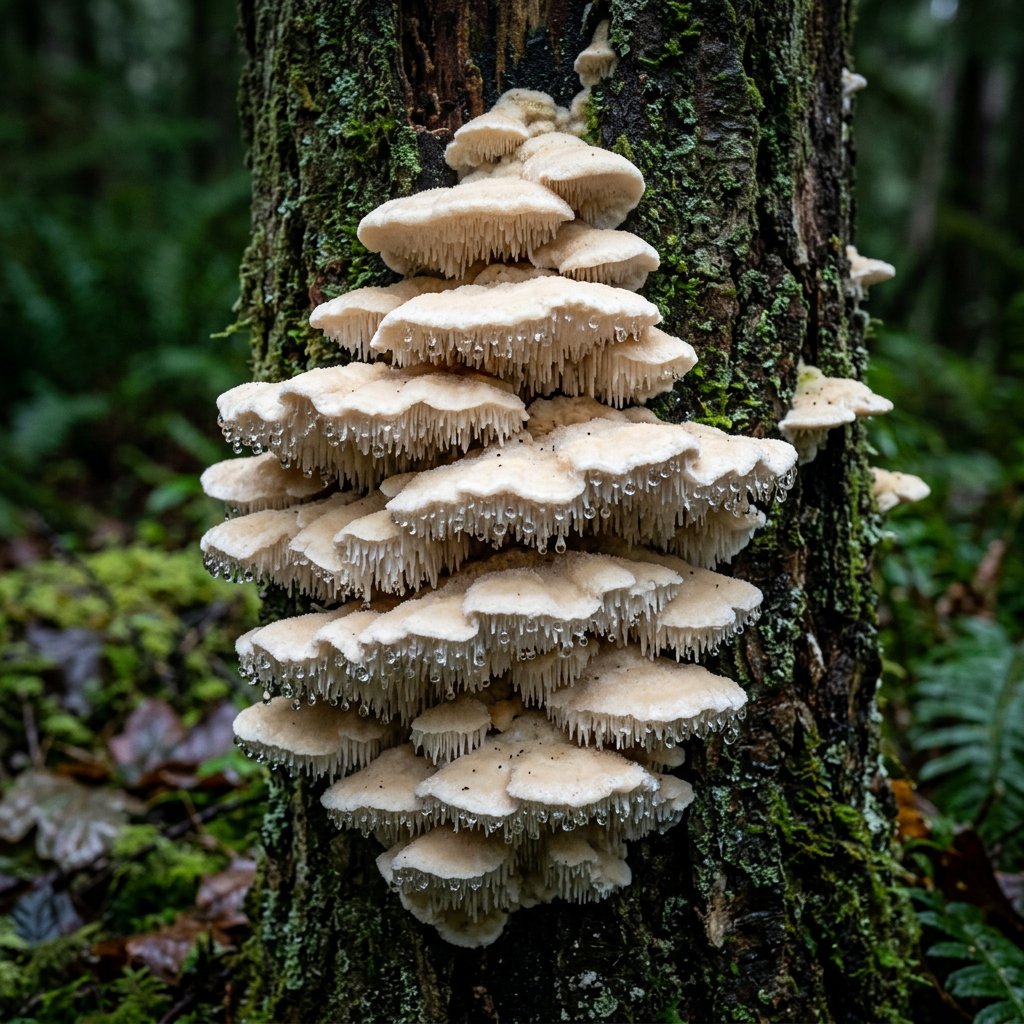
Often resembling a stack of thick, overlapping pancakes clinging to a tree trunk, the Northern Tooth Fungus is a formidable sight in the forest. Known scientifically as Climacodon septentrionalis, this mushroom is a master of structural growth, often forming massive clusters that can weigh as much as a small dog. In woodland lore, these shelf-like protrusions are sometimes called "troll ears" or "spirit steps" due to their tiered, staircase appearance.
🔍 How to Identify
- 🦷 The "Teeth": Unlike common mushrooms with gills or pores, the underside of this fungus is covered in thousands of tiny, icicle-like spines or "teeth" that hang downward.
- 🥞 Shelving Habit: It grows in a dense, vertical stack of semi-circular caps. These caps are usually creamy white when fresh but turn a dull yellowish-tan as they age.
- 📏 Size and Texture: Individual shelves can be up to 12 inches wide. The top surface feels slightly hairy or velvety to the touch, often becoming roughened over time.
🌲 Habitat & Ecology
- 🌳 The Maple Specialist: This fungus is a "heart rot" pathogen, meaning it decays the inner wood of living hardwood trees. It is most commonly found on Sugar Maples and Beech trees in North America and Europe.
- 🏚️ Structural Impact: While the mushroom itself appears on the outside, its mycelium is busy hollowing out the tree's center. Seeing this mushroom is a sign that the host tree’s internal structure is compromised and may eventually fall.
⚠️ Safety & Toxicity
- 🚫 WARNING: While not considered "deadly" like some forest fungi, the Northern Tooth Fungus is widely classified as inedible.
- 👅 Palatability: It has an incredibly tough, cork-like texture and a very bitter, unpleasant taste. It is not recommended for foraging or cooking, as it is impossible to chew and can cause mild stomach upset in sensitive individuals.
✨ Fun Fact
A single cluster of Northern Tooth Fungus can produce billions of spores, and a large specimen can weigh over 50 pounds! Because it is a perennial-style grower, it may reappear on the same tree for several years until the host finally succumbs to the rot.
More Details
| Hymenium Type | Teeth |