Info
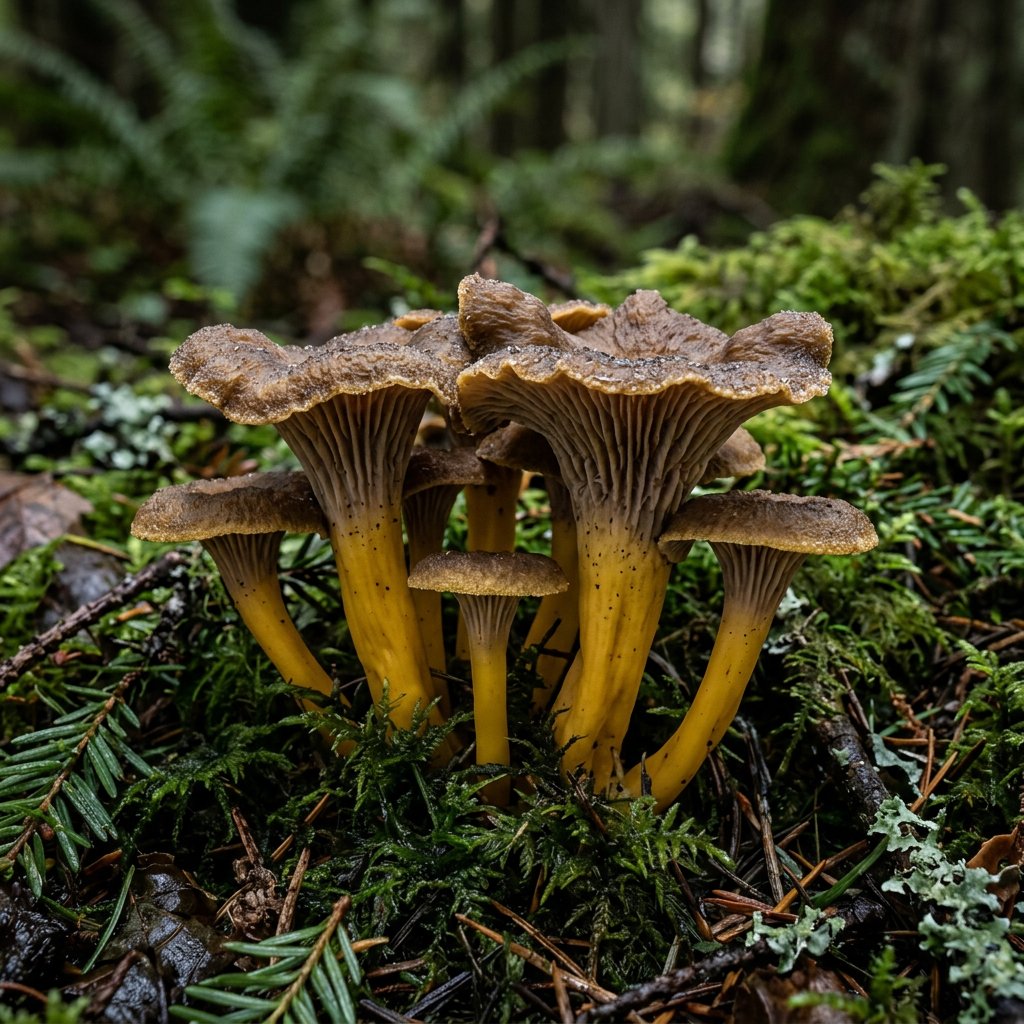
Known fondly as the Yellowfoot or the Winter Chanterelle, this little fungus is the resilient survivor of the mushroom world. While most mushrooms vanish at the first sign of frost, the Craterellus tubaeformis often waits for the chilly, damp late-autumn air to make its grand appearance. It is a favorite among foragers for its earthy, peppery flavor and its ability to stay firm even after a light freeze.
🔍 How to Identify
- 🍄 The Cap: Small and funnel-shaped (like a tiny trumpet) with a wavy edge. The top is usually a modest brownish-grey, which helps it blend perfectly into dead leaves.
- 💛 The Stem: The most striking feature! The stem is a bright, waxy yellow or orange and is notably hollow, feeling almost like a straw between your fingers.
- 🕸️ The "Gills": It doesn't have true gills. Instead, the underside features blunt, shallow ridges or "veins" that are greyish-yellow and run slightly down the stem.
🌲 Habitat & Ecology
- 🌲 The Mossy Floor: You’ll almost always find them in damp, acidic soil, tucked deep within carpets of green moss under coniferous trees like Pine and Spruce.
- 🕵️ Masters of Disguise: Because their caps look like dead leaves, they are notoriously hard to spot from a distance. However, they are highly social; where you find one Yellowfoot, there are usually hundreds more hidden nearby.
⚠️ Safety & Toxicity
- 🛑 WARNING: While the Yellowfoot is a choice edible, never consume a mushroom unless you are 100% certain of its identity.
- ⚠️ The Look-Alike: Be careful not to confuse it with the "Jelly Baby" (Leotia lubrica), which has a similar shape but feels slimy and gelatinous rather than waxy, and can cause stomach upset.
- 🍳 Preparation: Like most wild fungi, they should never be eaten raw. Cooking breaks down tough cell walls and ensures they are safe for digestion.
✨ Fun Fact
The Yellowfoot is a "sunshine" mushroom! It is one of the few fungi that contains significant amounts of Vitamin D, which it continues to synthesize even as the days get shorter and darker in the winter months.
More Details
| Hymenium Type | Ridges |
| Stipe Character | Bare Stipe |
| Spore Print Color | Cream |
| Mushroom Cap Shape | Infundibuliform Mushroom Cap |
| Hymenium Attachment | Decurrent Hymenium Attachment |
| Mushroom Ecological Type | Saprobiont |







