Info
Commonly known as the White Pine Blister Rust, this fungus is less of a "mushroom" in the traditional sense and more of a masterful, forest-altering parasite. Unlike the friendly toadstools of fairy tales, Cronartium ribicola is a "rust" fungus that leads a double life, requiring two completely different hosts—five-needle pines and currant bushes—to complete its complex life cycle. It is famous for its devastating impact on North American forests, where it has played the role of a silent invader for over a century.
🔍 How to Identify
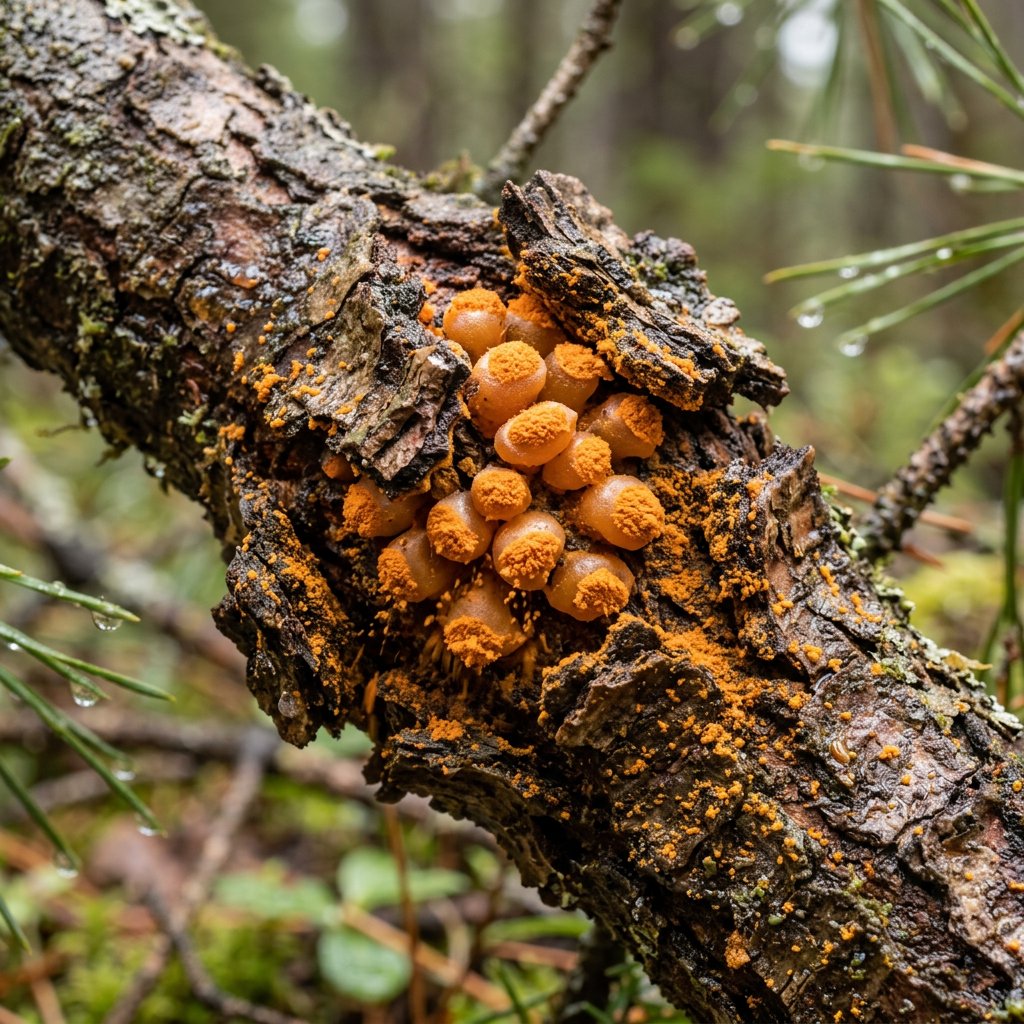
- 🍄 The "Blister" Cankers: On pine trees, look for swollen, spindle-shaped "cankers" on the branches or trunk. In spring, these rupture to reveal bright white blisters filled with brilliant orange spores.
- 🍃 Currant Leaf Spots: On its alternate hosts (Ribes species like gooseberries), the fungus appears as tiny, yellow-to-orange pustules on the undersides of the leaves, often looking like a dusting of cinnamon or rust.
- 💧 Resin "Bleeding": Infected pine trees often exhibit heavy resin flow around the site of the infection, looking as though the tree is "crying" or bleeding sap down its bark.
🌲 Habitat & Ecology
- 🔄 The Two-Host Cycle: This fungus is "heteroecious," meaning it cannot survive on pine trees alone. It must leap from a pine tree to a currant or gooseberry bush (Ribes) to complete its life cycle before jumping back to another pine.
- 🌬️ Wind-Borne Invader: The spores are incredibly light and can be carried by the wind for many miles. It thrives in cool, moist conditions, which help the spores germinate on the needles of white pines.
- 🌲 Forest Impact: It specifically targets "five-needle" pines (like the Eastern White Pine or the high-altitude Whitebark Pine), often girdling branches and killing the tree by cutting off its nutrient flow.
⚠️ Safety & Toxicity
- 🚫 WARNING: While not "toxic" in the sense of being poisonous to touch, Cronartium ribicola is not edible. It is a woody, parasitic growth with no culinary or medicinal value.
- 🧼 Biosecurity Risk: The primary danger of this fungus is ecological. If you find it, avoid touching the orange spores and then touching healthy trees, as you can inadvertently act as a vector for the disease.
- 🐾 Pet Safety: It is generally harmless to pets and humans, though it can destroy the ornamental pines or currant bushes in your backyard.
✨ Fun Fact
In the early 20th century, the U.S. government was so terrified of this fungus destroying the timber industry that they banned the cultivation of currants and gooseberries nationwide. For decades, "Ribes Eradication" crews roamed the forests, pulling millions of bushes by hand to try and stop the rust's spread!
More Details







