Info
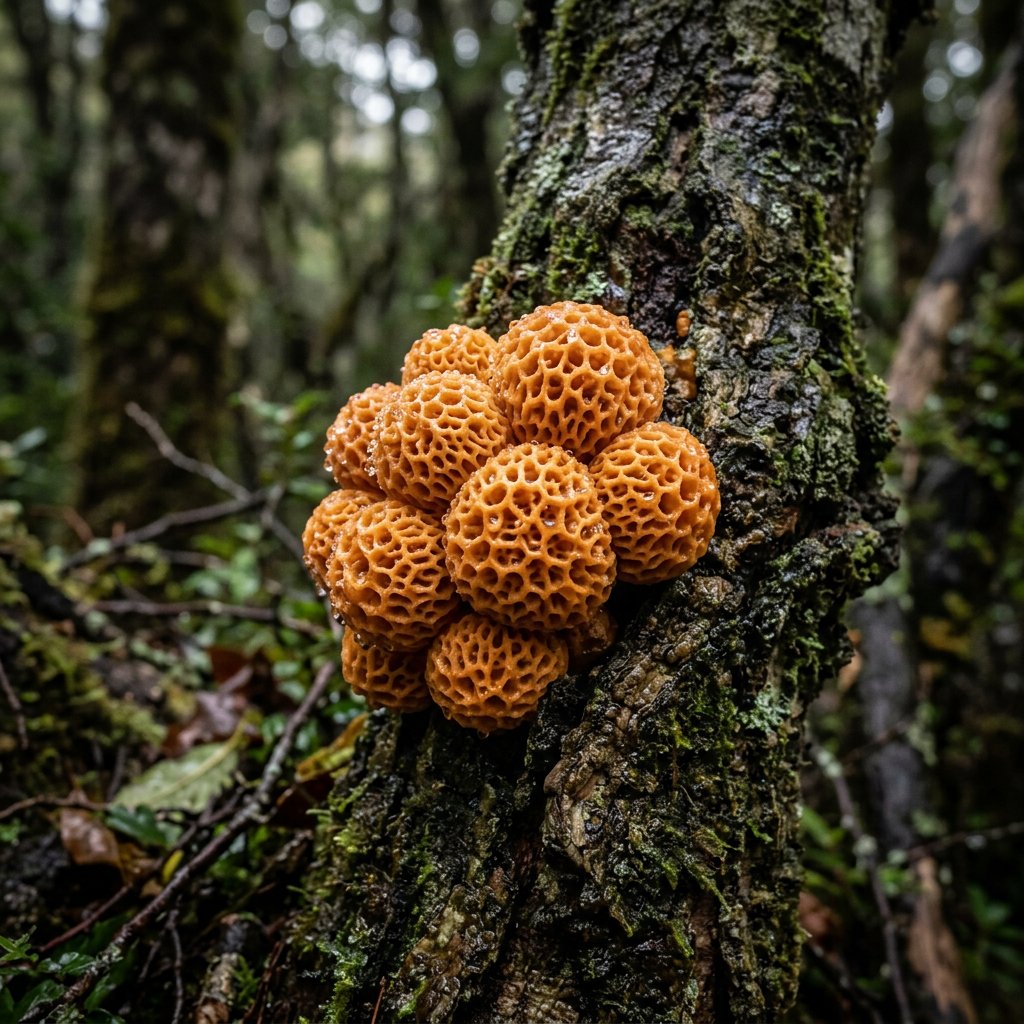
Named after the legendary naturalist Charles Darwin, who first documented it in 1832 during his voyage on the HMS Beagle, Cyttaria darwinii is one of the most alien-looking fungi in the Southern Hemisphere. Commonly known as "Darwin’s Bread," these bright orange, golf-ball-shaped clusters don't grow from the soil but erupt directly from the branches of Southern Beech trees. In the forests of Patagonia, they appear like vibrant ornaments hanging against the deep green foliage.
🔍 How to Identify
- ⚽ The "Golf Ball" Shape: The fruiting body is globose (spherical) and usually measures about 1 to 2 inches in diameter.
- 🍯 Honeycomb Surface: As it matures, the smooth surface develops deep, pitted craters, giving it a texture strikingly similar to a honeycomb or a sponge.
- 🎨 Vibrant Color: It transitions from a pale, creamy yellow to a brilliant, waxy orange as it reaches maturity.
- 🪵 The "Galls": Look at the tree branch itself; the fungus causes the tree to develop large, woody swellings or "galls" from which the mushrooms sprout.
🌲 Habitat & Ecology
- 🏔️ Specific Host: This fungus is a "specialist." It grows exclusively on trees of the genus Nothofagus (Southern Beech), particularly in the cold, damp forests of southern Chile and Argentina.
- 🍄 Parasitic Relationship: While it looks beautiful, it is technically a parasite. It draws nutrients from its host tree, though it rarely kills the tree, often living in a slow-moving balance for decades.
⚠️ Safety & Toxicity
- 🚨 WARNING: Never consume any wild mushroom unless you have identified it with 100% certainty alongside a local expert.
- 🍽️ Status: Historically, Cyttaria darwinii is considered edible. It has a slightly sweet, mucilaginous texture and a mild flavor.
- 🗺️ Traditional Use: The indigenous Yaghan people of Tierra del Fuego once used these as a staple food source, eating them raw or occasionally fermenting them.
✨ Fun Fact
Charles Darwin was fascinated by this fungus, noting in his diary that it tasted "like a very sweet cold pudding." He was surprised to find that in Tierra del Fuego, this mushroom was the only vegetable matter (other than a few berries) that the local people consumed as a regular part of their diet.
More Details