Info
Often referred to as the "Dung-loving Deconica," this humble little fungus is a specialist of the pasture. While its cousins in the Psilocybe genus often grab the headlines for their psychoactive properties, Deconica coprophila is the sober relative that stays focused on its job: breaking down organic waste. In the world of "Little Brown Mushrooms" (LBMs), it is a common sight for hikers and farmers, acting as a tiny, umbrella-shaped signpost for where livestock have recently roamed.
🔍 How to Identify
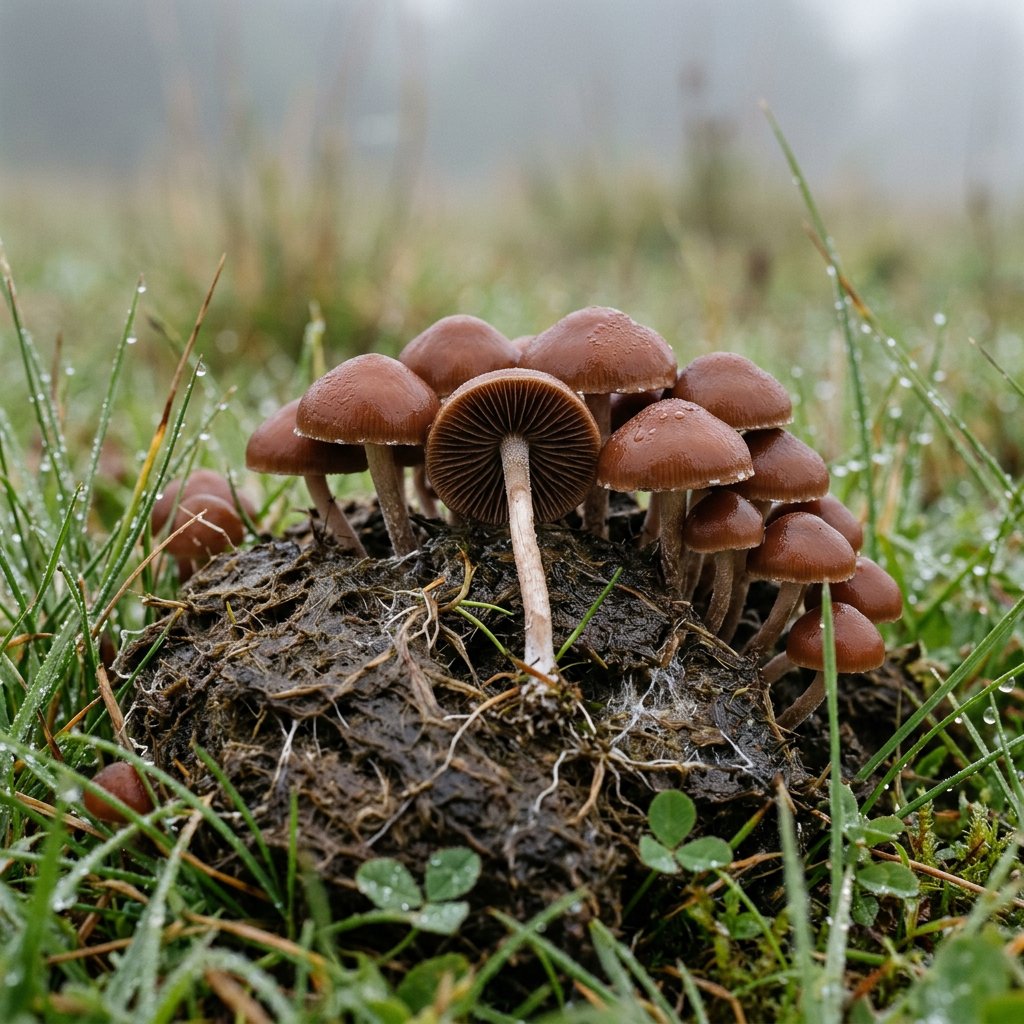
- 🤎 The Cap: Small and hemispherical (1–2 cm), the cap is a warm reddish-brown that fades to a tan color as it dries. When moist, it has a slightly sticky or greasy texture and faint lines (striations) around the edge.
- 🍫 The Gills: Look underneath to find broad, closely spaced gills. They start out a greyish-brown but turn a deep, dark chocolate or purplish-brown as the spores mature.
- 🏗️ The Stem: The stem is slender, pale brownish, and quite brittle. Unlike many of its relatives, it notably lacks a ring (annulus) and does not "bruise" blue when handled.
- 👣 Spore Print: If you place the cap on a piece of paper, it will leave a distinct dark purplish-brown spore print.
🌲 Habitat & Ecology
- 💩 The Substrate: As the name suggests, this mushroom is strictly "coprophilous," meaning it grows directly on the dung of herbivores, particularly horses, cows, and sheep.
- ♻️ Nature’s Recycler: It plays a vital ecological role by accelerating the decomposition of animal waste, returning essential nutrients back into the soil to help the grass grow for the next generation of grazers.
- 🌍 Distribution: It is a cosmopolitan species, meaning you can find it almost anywhere in the world where livestock are raised, from the rolling hills of Europe to the plains of North America.
⚠️ Safety & Toxicity
- 🚫 WARNING: Do not consume this mushroom. While it is not traditionally listed as "deadly toxic," it is classified as inedible.
- 🧪 Identification Risks: The primary danger lies in "look-alike" confusion. Many small brown mushrooms (LBMs) that grow in similar environments are highly toxic or contain powerful hallucinogens.
- 🐾 Hygiene: Because it grows directly on animal waste, handling these mushrooms carries a risk of exposure to harmful bacteria or parasites found in dung. Always wash your hands after a foraging session.
✨ Fun Fact
The name coprophila is derived from the Greek words kopros (dung) and philos (loving). It literally translates to "dung-lover," perfectly describing this mushroom's very specific choice of home!
More Details







