Info
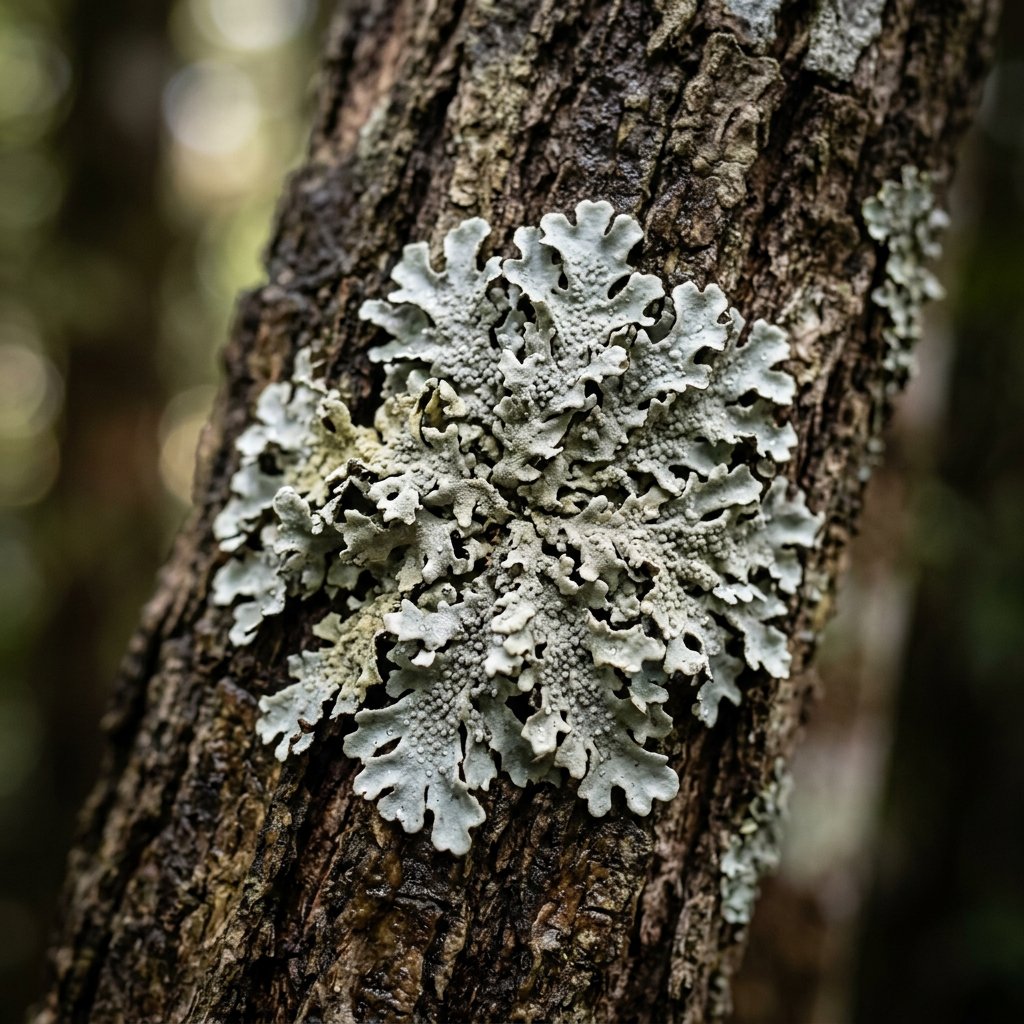
While often mistaken for a common mushroom, Dirinaria is actually a lichen—a fascinating biological "partnership" between a fungus and an alga. Often called the "Medallion Lichen," it looks like a frosted piece of lace or a silvery coin stuck firmly to the bark of trees. In many cultures, these resilient organisms are seen as symbols of endurance, surviving in harsh sun where other plants would wither.
🔍 How to Identify
- 🎨 The "Rosette" Pattern: It grows in distinct circular or star-shaped patches that radiate outward, looking like a decorative medallion pressed flat against a surface.
- ❄️ Frosted Texture: The upper surface is usually a pale, powdery gray or greenish-white. This "frosted" look is actually a protective layer that reflects intense UV rays.
- 🧁 Tiny "Jam Tarts": Near the center of older specimens, you may see small, dark, cup-shaped discs called apothecia. These are the reproductive structures of the fungal partner.
🌲 Habitat & Ecology
- ☀️ Sun Lovers: Unlike many mushrooms that crave the dark, Dirinaria thrives in bright, open areas. You’ll most commonly find them on the trunks of palms or hardwood trees in tropical and subtropical regions.
- 🌬️ Pollution Survivors: These lichens are incredibly "tough." While many lichens die off in cities, some species of Dirinaria are remarkably resistant to urban air pollution, acting as hardy green anchors in concrete jungles.
- 🤝 The Symbiotic Life: It doesn't "eat" the tree it lives on. Instead, the fungal part provides the structure and protection, while the internal algae produce food through photosynthesis.
⚠️ Safety & Toxicity
- 🟢 Non-Toxic to Touch: Dirinaria is safe to handle and observe. It is not a parasite and will not harm the health of the trees in your garden.
- 🚫 Not Edible: While not considered "deadly" like certain wild mushrooms, lichens contain complex secondary compounds and acids that can cause severe digestive distress if eaten. They are best left on the bark to be admired.
✨ Fun Fact
Lichens like Dirinaria are essentially "miniature ecosystems." They grow so slowly—sometimes only a few millimeters a year—that a patch the size of your palm could easily be older than the person looking at it!
More Details







