Info
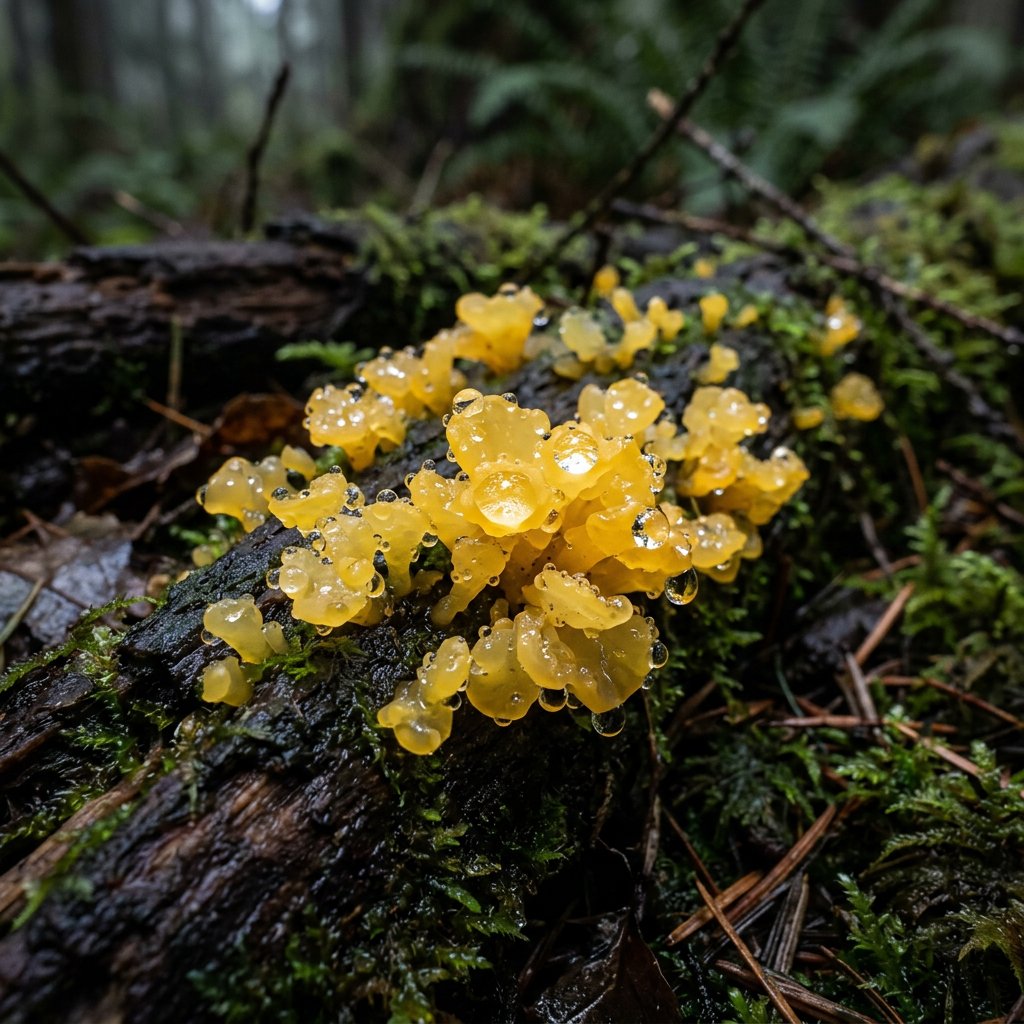
Known as the Rooting Ditiola, these tiny, sun-bright buttons often dot the surface of old conifer logs like scattered gold coins. While they might look like dropped jelly sweets, they belong to a hardy group of wood-decaying fungi that play a vital role in recycling forest nutrients. Their vibrant yellow hue makes them a cheerful find for hikers exploring damp, evergreen woodlands.
🔍 How to Identify
- 🟡 The Disc: A bright yellow to orange-yellow "cap" that is very small (usually 3–10mm). It starts as a tiny sphere and flattens into a disc with a slightly sunken center as it matures.
- 🦷 The Root: Unlike many jelly fungi that sit flat on the surface, this species has a distinct, tough, pale stem (pseudorhiza) that "roots" deeply into the cracks of decaying wood.
- 💧 Texture: It is gelatinous but surprisingly firm—more like a piece of stiff rubber than a soft jelly. The surface is smooth and lacks gills or pores.
🌲 Habitat & Ecology
- 🌲 Wood Choice: You will almost exclusively find them on the dead, often debarked wood of coniferous trees, such as Pine, Spruce, and Fir.
- 🪵 The Recycler: It is a saprobic fungus, meaning it feeds on dead organic matter. It specialized in breaking down the tough lignin and cellulose in softwoods, helping clear the forest floor for new growth.
⚠️ Safety & Toxicity
- 🛑 WARNING: Never consume any wild fungus unless you have had it identified in person by a professional mycologist.
- 🍄 Status: Ditiola radicata is generally considered inedible. While it is not known to contain deadly toxins, its tiny size and rubbery, tough consistency make it worthless for the kitchen.
- 🐾 Pets & Kids: Because they grow on rotting logs, they are usually out of the way of toddlers, but keep an eye on curious pets. While not high-risk, ingestion could cause mild stomach upset.
✨ Fun Fact
- ✨ The Resurrection Act: These fungi are masters of dehydration. During dry spells, they shrink into tiny, inconspicuous crusts that are nearly invisible. As soon as it rains, they "re-inflate" and return to their bright, rubbery state within hours!
More Details







