Info
Often called the "Willow Powdery Mildew," Erysiphe capreae is a fascinating micro-fungus that trades the traditional mushroom shape for a ghostly, frosted appearance. Rather than sprouting from the ground, it drapes itself across the leaves of willow trees like a delicate dusting of powdered sugar. In folklore, such mildews were often thought to be the result of "honey-dew" falling from the stars or the breath of spirits passing through the grove.
🔍 How to Identify
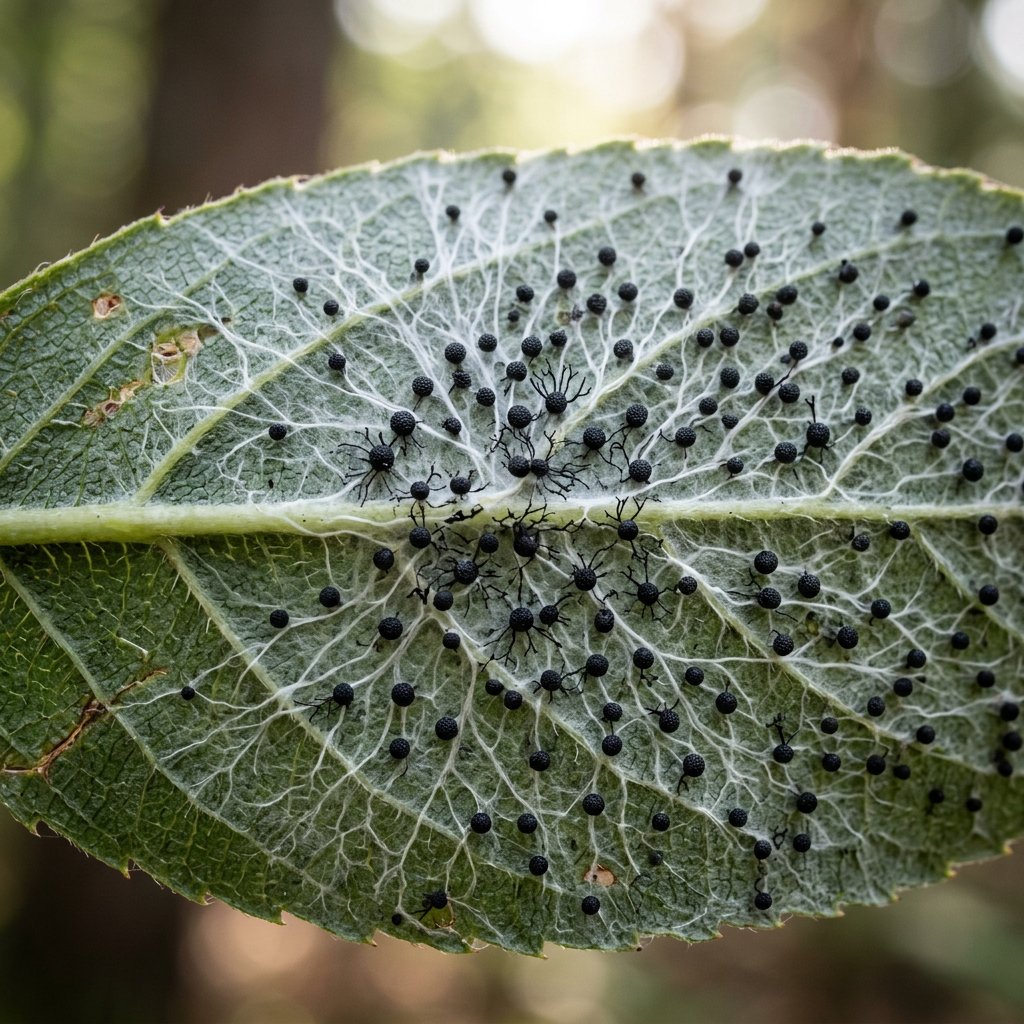
- ❄️ The "Frost" Layer: Look for a thin, white, cobweb-like coating (mycelium) that covers the surface of leaves, typically appearing in mid to late summer.
- 🌑 Black "Pepper" Specks: As the fungus matures, look for tiny, dark brown to black spheres called chasmothecia. These are the "fruit" of the fungus, though they are barely the size of a pinhead.
- 🍃 Leaf Reaction: While it doesn't usually kill the tree, infected leaves may curl slightly, turn yellow prematurely, or look dull compared to healthy, glossy foliage.
🌲 Habitat & Ecology
- 🌳 The Willow Connection: This fungus is a specialist. You will almost exclusively find it on Salix species (Willows) and occasionally on Populus (Poplars), usually in damp riverside areas or gardens with high humidity.
- 🌬️ Airborne Travelers: It spreads via microscopic spores that hitch a ride on summer breezes. Unlike many fungi that love rain, this one thrives in high humidity but can actually be "washed away" by heavy, direct downpours.
⚠️ Safety & Toxicity
- 🟢 Non-Toxic: Erysiphe capreae is not known to be poisonous to humans, dogs, or cats. It is a plant pathogen, meaning it only "eats" the nutrients from the leaf surface.
- 🚫 Plant Health: While safe for you, it can weaken a young tree by blocking sunlight from the leaves (reducing photosynthesis). It is best to prune heavily infected branches to keep the tree vigorous.
✨ Fun Fact
Under a powerful microscope, the tiny black specks (chasmothecia) on the leaf look like alien spacecraft; they feature long, hook-like "arms" or appendages that help them anchor onto the rough surface of the willow leaf so they don't get blown away during winter!
More Details







