Info
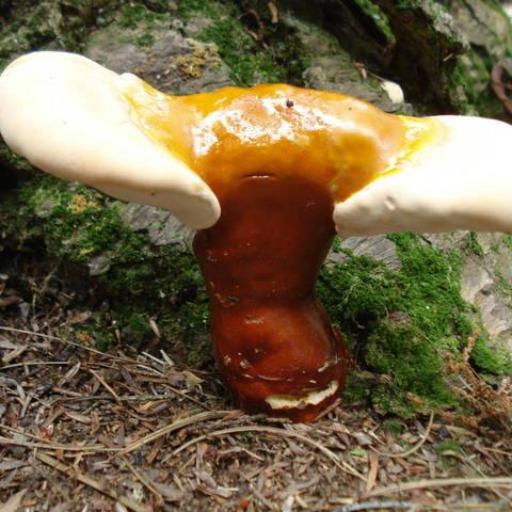
Known as the "Hemlock Varnish Shelf," Ganoderma tsugae is the chilly northern cousin of the legendary Reishi mushroom. To the casual hiker, it looks as though someone took a paintbrush and applied a high-gloss, mahogany-colored lacquer to a shelf protruding from a tree. In many eastern traditions, its close relatives are revered as the "Mushroom of Immortality," symbolizing health and longevity for over two millennia.
🔍 How to Identify
- 🎨 The Cap: It features a stunning, kidney-shaped cap with a high-gloss finish. When young, the edges are white and yellow, maturing into a deep, "varnished" reddish-brown or burgundy.
- 🕳️ The Pores: Instead of gills, the underside is a smooth, creamy white surface covered in microscopic pores. If you press your finger into the white underside, it will bruise a dark brown.
- 🪵 The Texture: This isn't a soft, squishy mushroom. It is tough, corky, and woody to the touch, feeling more like a piece of forest furniture than a typical fungus.
🌲 Habitat & Ecology
- 🌲 The Hemlock Host: As the name tsugae suggests, this mushroom is almost exclusively found growing on the wood of Hemlock trees. It acts as a saprobe, meaning it helps decompose dead or dying stumps and logs, recycling nutrients back into the forest floor.
- ☁️ Cooler Climates: It is most common in the moist, shaded forests of the Northeastern United States and Canada. You will typically see the fresh, shiny "conks" appearing in late spring and throughout the summer months.
⚠️ Safety & Toxicity
- 🛑 WARNING: While Ganoderma tsugae is not considered poisonous, it is strictly "inedible" in the culinary sense. It is far too woody and tough to chew or digest; attempting to eat it like a standard mushroom would be like eating a piece of cork.
- ☕ Foraging Note: While many people harvest this species to create medicinal teas or tinctures, never consume any wild mushroom unless you have confirmed the ID with a local expert. It can be easily confused with other "shelf" fungi by an untrained eye.
✨ Fun Fact
[🖌️] Nature’s Sketchpad: If you find a fresh specimen, you can use a small stick to "draw" on the white underside. The bruising is permanent, and as the mushroom dries and hardens, your artwork will be preserved forever, which is why it and its relatives are sometimes called "Artist’s Conks."
More Details
| Hymenium Type | Pores |
| Stipe Character | Bare Stipe |
| Spore Print Color | Brown |
| Mushroom Cap Shape | Flat Mushroom Cap |
| Hymenium Attachment | Adnate Hymenium Attachment |
| Mushroom Ecological Type | Saprobiont |