Info
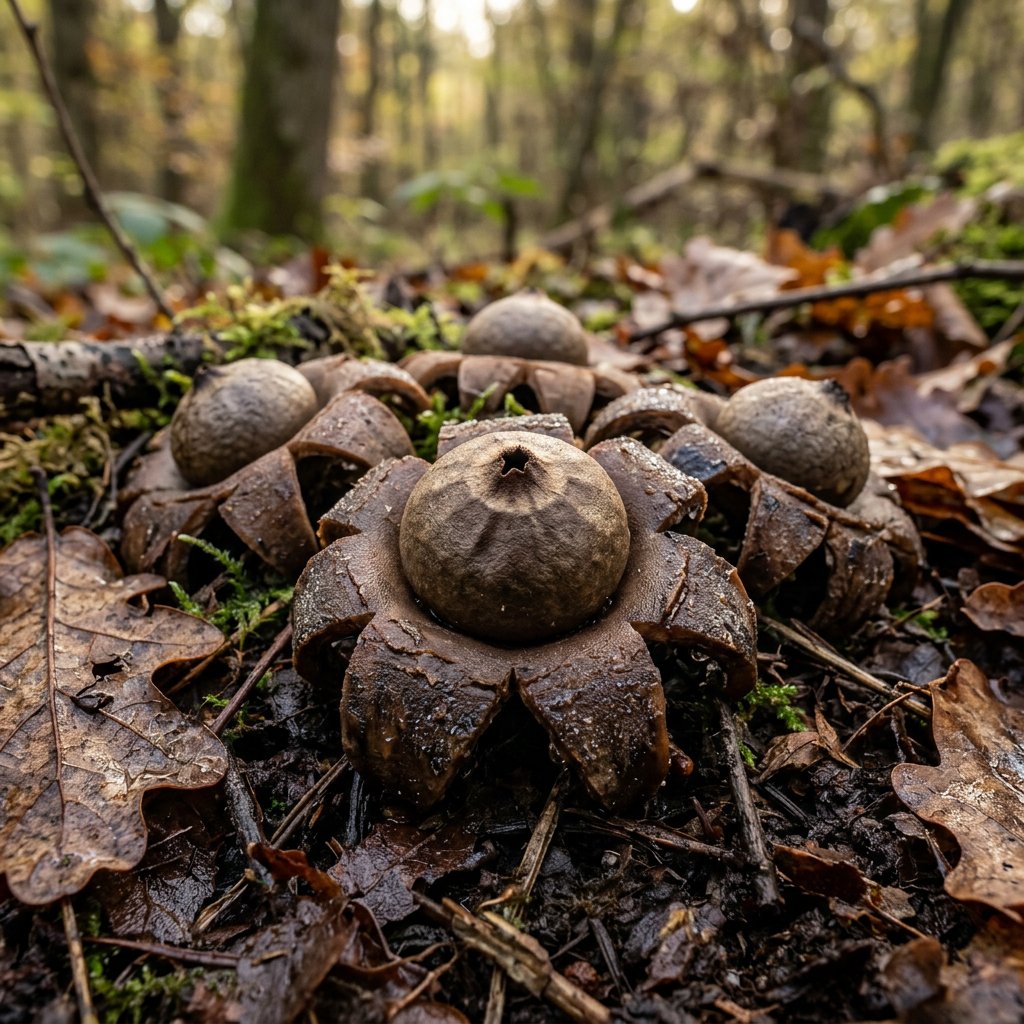
Often called the Blackhead Earthstar, this fungus is one of the most dramatic and "theatrical" members of the Earthstar family. It begins its life as an unassuming, onion-shaped bulb buried in the soil, only to burst forth and peel back its outer skin to reveal a striking, dark-centered star. In European folklore, these were often viewed as fallen stars that had solidified upon touching the earth.
🔍 How to Identify
- 🌟 The Rays: The outer skin (exoperidium) splits into 4 to 8 thick, fleshy rays that arch backward, lifting the central spore ball off the ground. These rays are typically tan or pale brown.
- 🖤 The "Black Head": Unlike most earthstars that have a grey or brown inner ball, this species features a distinct, dark-charcoal to black spore sac (endoperidium).
- 💨 Spore Release: As the mushroom matures, the top of the black ball disintegrates or tears open irregularly, rather than having a neat little "chimney" hole like its cousins.
🌲 Habitat & Ecology
- 🍂 Leaf Litter Lover: You’ll most likely find this earthstar tucked away in the rich humus of deciduous forests, particularly under bushes or near trees like Oak and Beech.
- 🌦️ Hygroscopic Movement: The rays are somewhat sensitive to moisture. In dry weather, they may curl up to protect the spore sac, and in wet weather, they expand to help the wind and rain droplets catch and disperse the spores.
⚠️ Safety & Toxicity
- 🚫 WARNING: Inedible. While most earthstars are not known to be "deadly" in the same way as some Amanitas, they are universally considered inedible due to their tough, leathery texture and bitter taste.
- 🐾 Pets & Kids: There are no specific reports of high toxicity, but consuming wild fungi can cause severe gastrointestinal distress in dogs and small children. It is best enjoyed as a photographic subject only.
✨ Fun Fact
The scientific name melanocephalum is derived from the Greek words melas (black) and kephale (head), a perfect description of its soot-colored center that looks like it has been dusted with coal.
More Details







