Info
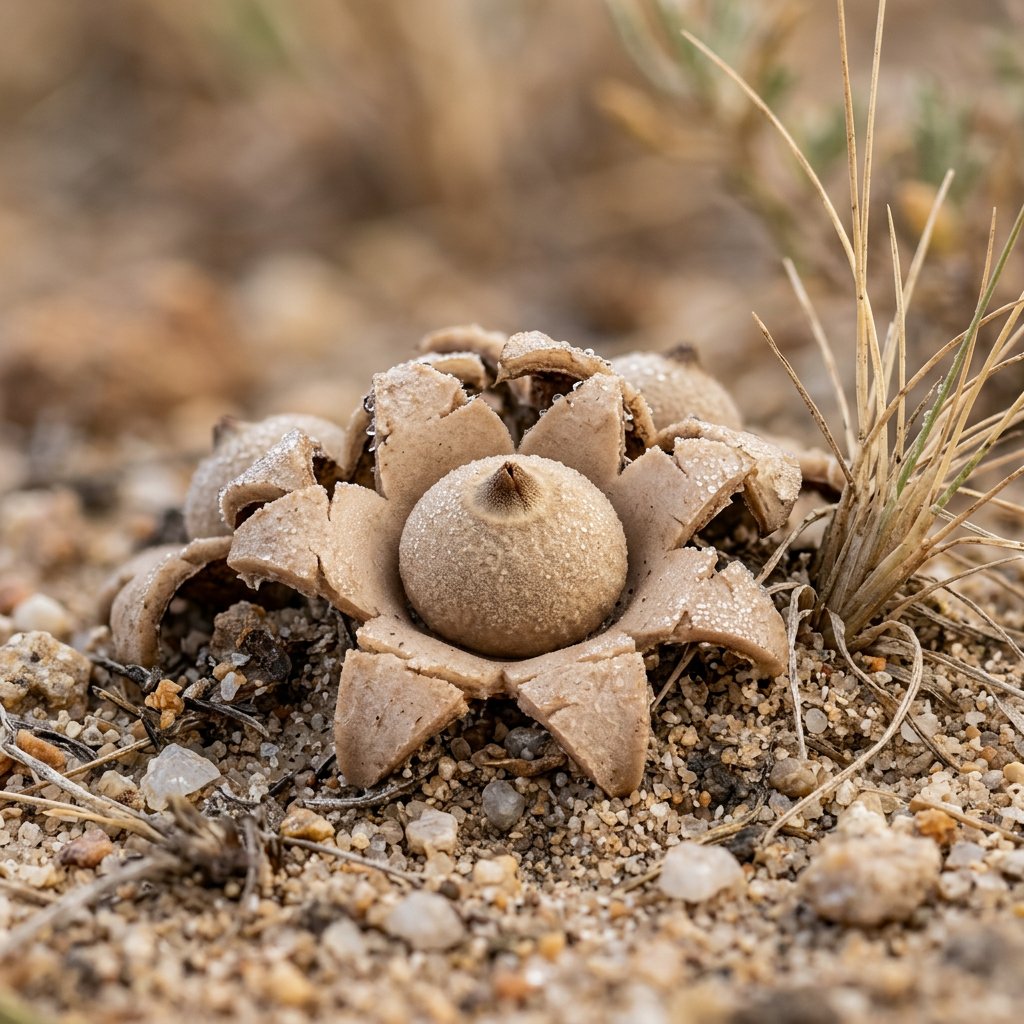
Known as the "Tiny Earthstar," Geastrum minimum is a master of camouflage hidden on the forest floor. These architectural wonders look like miniature celestial bodies that have fallen into the moss, waiting for a raindrop to help them spread their spores. In various folklore traditions, earthstars were often regarded as "fallen stars" that lost their glow the moment they touched the soil.
🔍 How to Identify
- ⭐ The Star Shape: The outer skin (exoperidium) splits into 6 to 11 pointed "rays" that typically curve downward, often lifting the central body slightly off the ground.
- 🎈 The Spore Sac: A small, globe-shaped puffball sits perched in the center of the rays. In this species, the sac is truly "minimum," usually measuring less than 1 centimeter in diameter.
- 👄 The Fringed Beak: At the very top of the sac is a tiny, conical opening called a peristome. It is finely fringed or "fimbriate," looking like a miniature volcano ready to erupt with spores.
🌲 Habitat & Ecology
- 🏜️ Soil Preference: The Tiny Earthstar is a specialist of dry, sandy, or calcareous (lime-rich) soils. You are most likely to find it in coastal dunes, alvars, or short-grass prairies where other mushrooms struggle to grow.
- ☁️ Bellows System: This fungus uses a "bellows" mechanism for reproduction. When a raindrop or a passing animal hits the flexible central sac, it compresses, shooting a puff of spores out of the top hole and into the wind.
⚠️ Safety & Toxicity
- 🛑 WARNING: Non-Edible. While most earthstars are not known to be "poisonous" in the sense of being deadly, they are considered inedible due to their tough, leathery, and woody texture.
- 🐾 Pet Safety: There is no culinary use for this mushroom, and it should be kept away from curious pets. Ingesting wild fungi can lead to severe gastrointestinal distress or unknown allergic reactions in animals.
✨ Fun Fact
The rays of the Tiny Earthstar are somewhat "hygroscopic" in related species—they can actually move! They may open wide during periods of high humidity to expose the spore sac to rain and curl back up during dry spells to protect the internal spores from the elements.
More Details







