Info
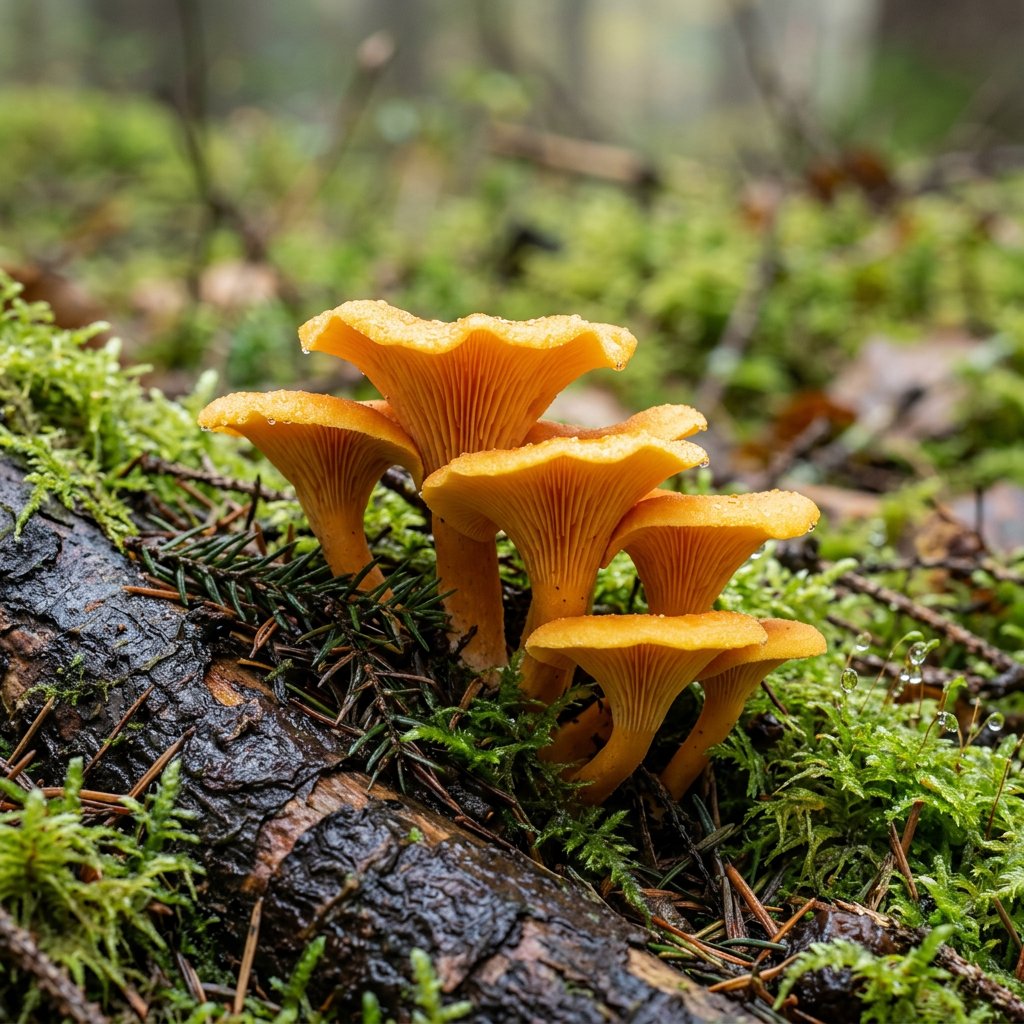
Known as the False Chanterelle, this vibrant orange fungus is the ultimate trickster of the forest floor. Often found nestled in mossy coniferous woods, it mimics the appearance of the prized edible Chanterelle so closely that it has fooled many amateur foragers over the centuries. In folklore, its bright, glowing hue was sometimes said to lead travelers off the path, acting as a "will-o'-the-wisp" of the fungal world.
🔍 How to Identify
- 🍄 The Cap: Starts convex but quickly becomes funnel-shaped with a depressed center. The surface has a soft, almost velvety texture and ranges from bright orange to a pale, brownish-yellow.
- 🍴 The Gills: Unlike true Chanterelles (which have vein-like ridges), this mushroom has "true" gills that are thin, crowded, and repeatedly forked. They are usually a more intense orange than the cap itself.
- 🪵 The Stem: The stalk is relatively thin and flexible, often becoming darker (brownish) toward the base. If you snap it, the flesh inside is soft and yellowish, rather than the solid white "string cheese" texture of a real Chanterelle.
🌲 Habitat & Ecology
- 🌲 Woodland Preference: You will most likely find these in coniferous or mixed forests, often popping up from decaying wood, buried pine needles, or nutrient-rich mulch.
- 🍂 The Decomposition Role: It is a saprobic species, meaning it plays a vital role in the ecosystem by breaking down organic matter and recycling nutrients back into the soil.
⚠️ Safety & Toxicity
- 🚨 WARNING: While not considered "deadly," the False Chanterelle is generally classified as inedible or suspect.
- 🤢 The Risk: Many people experience mild to moderate gastrointestinal distress (nausea and cramps) after eating it. Furthermore, it can be confused with the Jack-o'-Lantern mushroom, which is much more toxic.
- 🐾 Pets: Keep curious dogs away; the toxins that cause stomach upset in humans can be significantly more distressing for smaller animals.
✨ Fun Fact
The easiest way to tell this "imposter" apart from a real Chanterelle is by using your nose! While the real Chanterelle smells distinctly like fresh, sweet apricots, the False Chanterelle has a very faint, mushroomy, or completely neutral scent.
More Details
| Hymenium Type | Lamella |
| Stipe Character | Bare Stipe |
| Spore Print Color | White |
| Mushroom Cap Shape | Depressed Mushroom Cap |
| Hymenium Attachment | Decurrent Hymenium Attachment |
| Mushroom Ecological Type | Mycorrhiza |







