Info
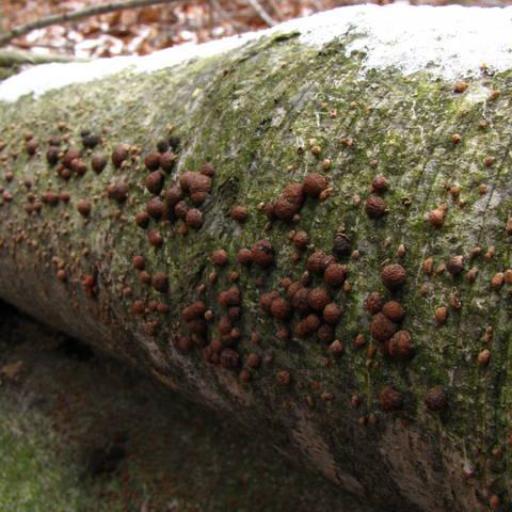
Known as the Beech Woodwart, this curious fungus looks less like a traditional mushroom and more like a cluster of tiny, prehistoric raspberries clinging to a log. In folklore, these dark, charcoal-like bumps were sometimes thought to be the scorched remains of forest fires or "pustules" of the earth itself. It is a master of disguise, shifting from a soft, blushing pink to a hard, jet-black "wart" as it matures.
🔍 How to Identify
- 🔴 The "Berries": It grows in small, rounded, hemispherical cushions (stromata) that look like clusters of warts or tiny berries, usually 5–15mm in diameter.
- 🎨 Color Evolution: When young and fresh (usually in late summer), it is a striking salmon-pink or brick-red. As it ages through winter, it hardens and turns a deep, coal-like black.
- 🕳️ Pitted Surface: If you look closely with a magnifying glass, the surface is covered in tiny "pimples." These are the openings (perithecia) through which the fungus ejects its spores.
🌲 Habitat & Ecology
- 🌳 The Beech Specialist: This fungus is a "host-specific" specialist. It is almost exclusively found on the dead or decaying bark of Beech trees (Fagus). If you see these red warts on a log, there is a very high chance the wood belongs to a Beech tree.
- 🍂 The Recycler: It is a saprobic fungus, meaning it feeds on dead organic matter. It performs a vital service in the forest by breaking down the tough lignin in wood, recycling nutrients back into the forest floor to feed new growth.
⚠️ Safety & Toxicity
- 🚫 WARNING: The Beech Woodwart is strictly inedible.
- 🧱 Inedible Texture: Even if it weren't potentially toxic, its texture is carbonaceous—meaning it is as hard and crunchy as a piece of charcoal. It has no culinary use and should never be consumed.
- 🐾 Pet Safety: While not known to be aggressively toxic to dogs, its hard structure can pose a choking hazard or cause internal irritation if swallowed.
✨ Fun Fact
Unlike many mushrooms that rely on the wind to simply drop their spores, Hypoxylon fragiforme is a tiny "fungal cannon." It uses internal water pressure to actively shoot its spores out of its surface pores into the air to ensure they travel far enough to find a new Beech log!
More Details







