Info
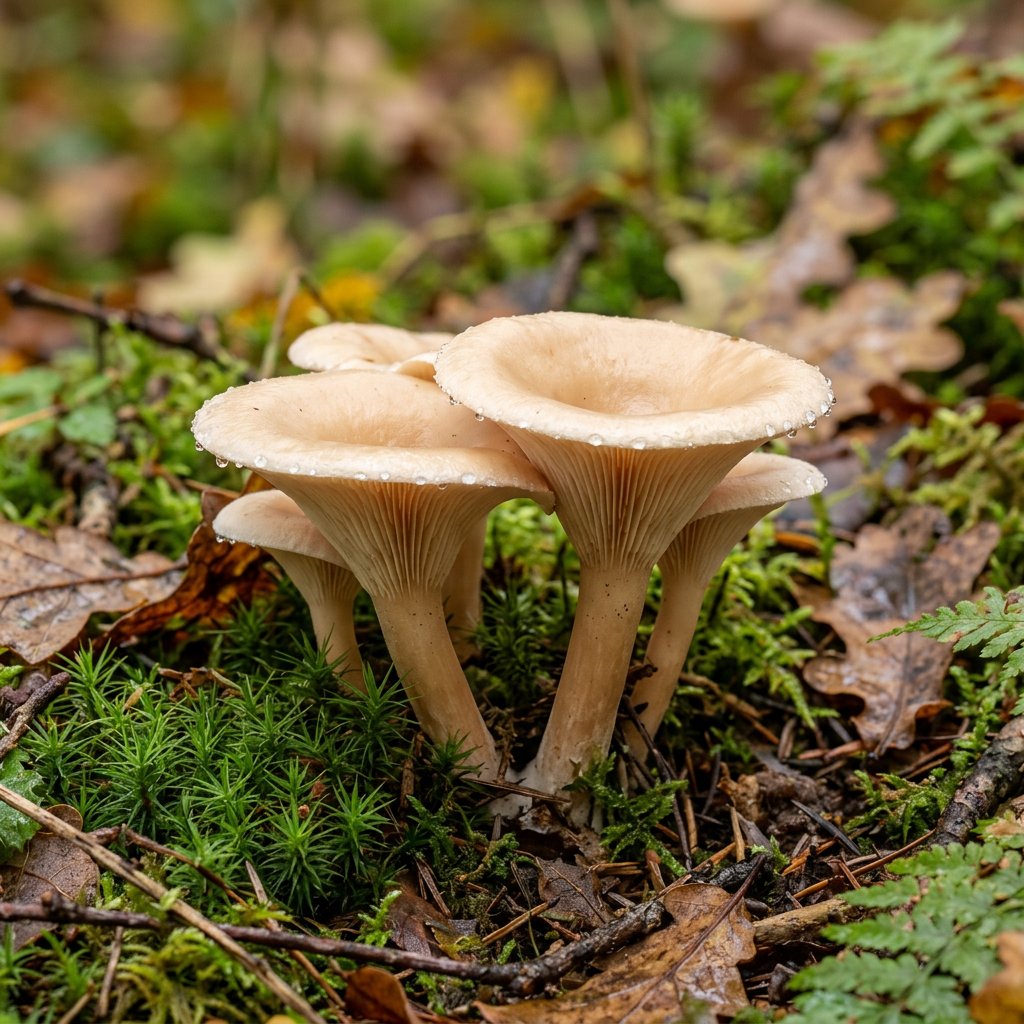
Known affectionately as the Common Funnel, this mushroom looks like a delicate, buff-colored chalice rising from the forest floor. In European folklore, these elegant funnel shapes were sometimes whispered to be the drinking vessels of woodland spirits during midnight feasts. It is one of the most frequent sights for foragers in late summer and autumn, often appearing in playful clusters or sprawling "fairy rings" hidden under the canopy.
🔍 How to Identify
- 🍄 The Cap: Initially convex, it quickly matures into a deep funnel or saucer shape. The color is a soft ochre or pinkish-tan, often described as "biscuit-colored," with a surface that feels like fine suede.
- 📏 The Central Bump: A key identifying feature is the "umbo"—a small, fleshy pimple-like bump located at the very bottom of the funnel's center.
- 🏺 The Gills: The white to cream-colored gills are "decurrent," meaning they travel noticeably down the length of the stem. They are crowded closely together and do not change color when bruised.
- 🌿 The Stem: The stalk is relatively slender, tough, and usually the same color as the cap or slightly paler, often with a white, fuzzy base where it meets the soil.
🌲 Habitat & Ecology
- 🍂 Leaf Litter Lover: You will typically find the Common Funnel nestled in the leaf litter of both broadleaf and coniferous forests. It plays a vital role in the ecosystem by breaking down fallen needles and leaves, recycling nutrients back into the soil.
- 🤝 Social Growth: These mushrooms rarely grow alone. They are highly gregarious, meaning they sprout in large groups, lines, or arcs. Finding one usually means there are dozens more camouflaged nearby in the shadows.
⚠️ Safety & Toxicity
- 🛑 WARNING: While Infundibulicybe gibba is often listed as edible, extreme caution is required. It is notoriously easy for beginners to confuse it with the "Ivory Funnel" (Clitocybe rivulosa) or the "Fool’s Funnel," both of which contain deadly amounts of muscarine.
- 🤢 Risk Assessment: Ingestion of toxic lookalikes causes severe sweating, blurred vision, and respiratory distress. Because the visual differences between the edible Common Funnel and its poisonous cousins are subtle (often just a slight difference in spore print or smell), it is generally recommended that hobbyists admire this species rather than eat it.
✨ Fun Fact
- 💡 The "Hunchback" Name: The specific epithet gibba comes from the Latin word for "humpbacked." This refers to that tiny, characteristic bump (the umbo) found in the center of the cap, which persists even when the rest of the mushroom stretches out into a deep funnel!
More Details







