Info
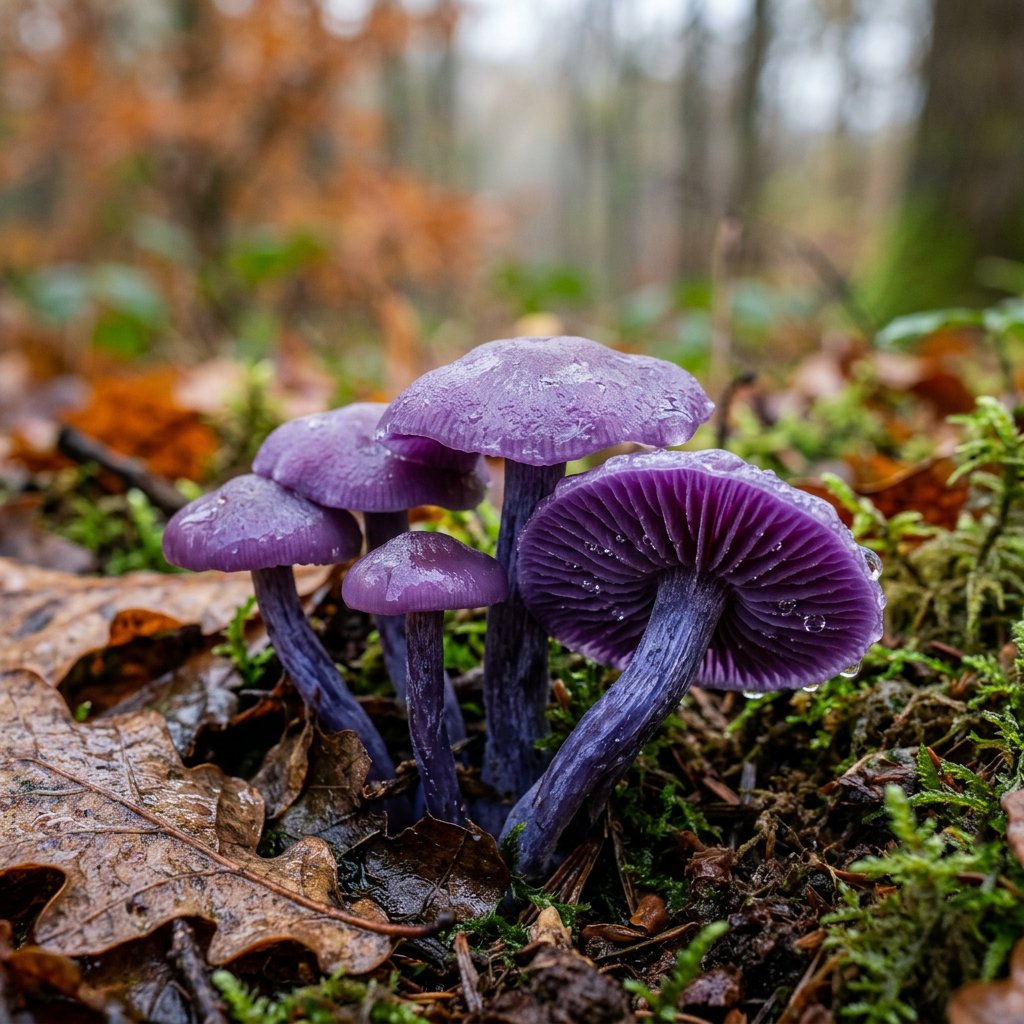
Often called the Amethyst Deceiver, this mushroom looks like a scattered jewel on the forest floor with its vibrant, deep violet hues. It gets its nickname from its "deceitful" nature; while it starts as a brilliant purple, it is hygrophanous, meaning it loses its color and fades to a pale, buff-brown as it dries out or ages. Finding a fresh cluster after a rainfall is like discovering a patch of forest magic.
🔍 How to Identify
- 🍄 The Cap: Small and convex when young, often developing a central dip as it matures. The surface is smooth but can become scurfy or scaly as it dries.
- 🎨 The Gills: Deeply purple and widely spaced. Crucially, the gills stay purple much longer than the cap, which is a key identifying feature when the rest of the mushroom fades.
- 🥢 The Stem: Long, tough, and fibrous. It is often twisted or curved and shares the same striking amethyst color as the cap.
🌲 Habitat & Ecology
- 🌳 Tree Partners: This fungus is mycorrhizal, meaning it lives in a symbiotic "sugar-for-minerals" partnership with trees. It is most commonly found nestled in leaf litter under Beech or Oak trees, though it occasionally pops up in coniferous forests.
- 🍂 Camouflage Artist: Despite its bright color, it can be surprisingly hard to spot among fallen autumn leaves. It prefers damp, shaded areas where the soil is rich in organic matter.
⚠️ Safety & Toxicity
- 🛑 WARNING: While the Amethyst Deceiver is technically considered edible, it is not recommended for beginners.
- 🧪 Toxic Lookalikes: It can be easily confused with the Lilac Fibrecap (Inocybe geophylla var. lilacina), which is poisonous and contains muscarine. The Lilac Fibrecap usually has a silky sheen and a distinct "earthy" or mealy smell.
- ☢️ Bioaccumulation: This species is known to accumulate arsenic from the soil. If you are in an area with high natural arsenic or industrial pollution, the mushroom can become toxic to consume.
✨ Fun Fact
🧬 Arsenic Eater: Scientists have discovered that the Amethyst Deceiver is a "hyperaccumulator" of arsenic. It can store concentrations of this toxic element much higher than the surrounding soil, acting as a natural filter for the forest floor.
More Details
| Hymenium Type | Lamella |







