Info
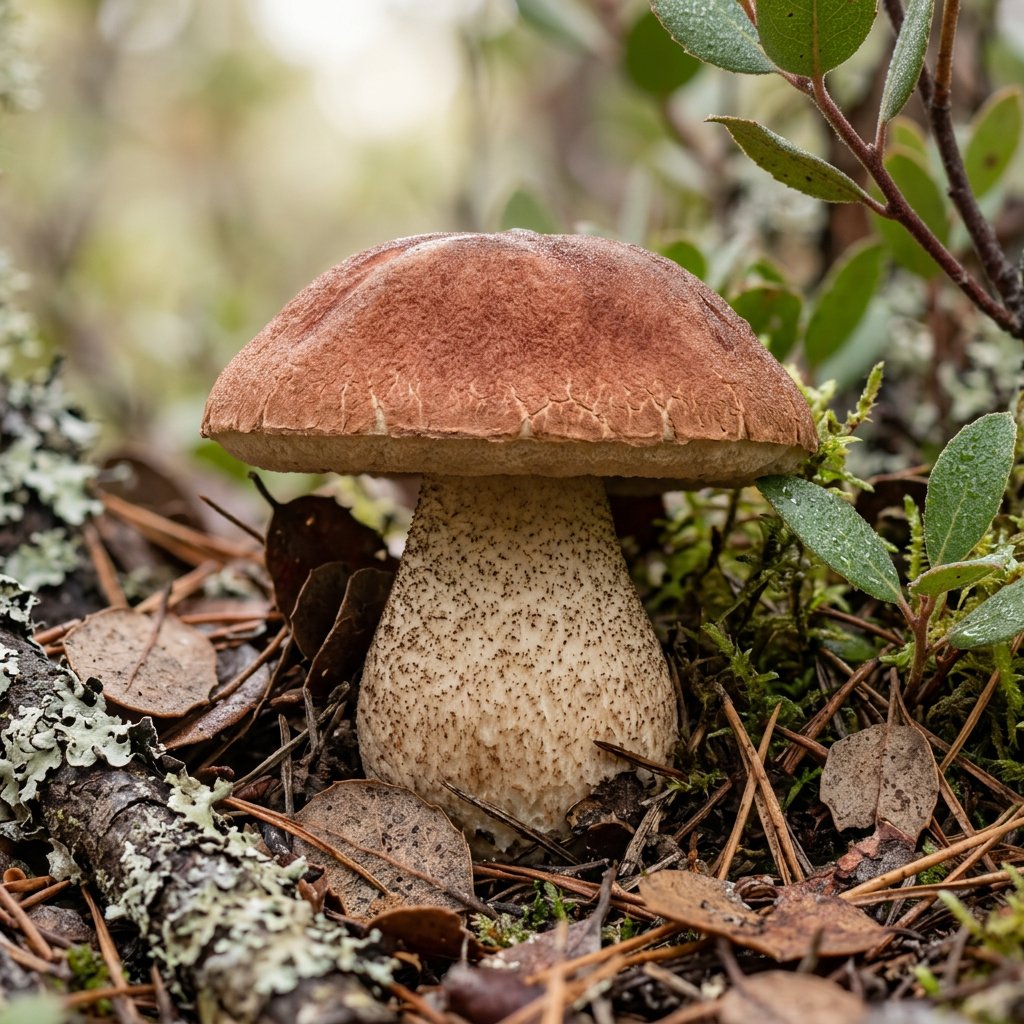
Often found hiding under the peeling bark of its namesake trees, the Manzanita Bolete is a striking member of the Western North American landscape. Known for its distinct "shaggy" stem and deep russet cap, it is a favorite for coastal foragers who enjoy the complexity of the Leccinum family. This mushroom forms a secret, subterranean partnership with specific evergreen shrubs, making it a true symbol of Pacific forest synergy.
🔍 How to Identify
- 🍄 The Cap: A broad, convex top that ranges from a warm cinnamon to a dark, burnt orange or reddish-brown. The surface is typically smooth but can feel slightly tacky or "viscid" after a rainfall.
- 🕳️ The Pores: Like all boletes, it lacks gills. Instead, the underside features a thick, spongy layer of tiny white pores that slowly turn a dingy olive-brown as the mushroom matures.
- 🦵 The Stalk (Scabers): The most defining feature is the stem, which is covered in "scabers"—tiny, dark brownish-black tufts or scales that look like coarse salt-and-pepper seasoning against a pale background.
- 🔪 Staining Reaction: When the white inner flesh is cut or bruised, it undergoes a dramatic color shift, often blushing pink or lilac before eventually fading to a dark, charcoal gray.
🌲 Habitat & Ecology
- 🤝 Tree Partnerships: This fungus is "mycorrhizal," meaning it trades nutrients with tree roots. It is strictly associated with Manzanita (Arctostaphylos) and Madrone (Arbutus) trees, so if those trees aren't nearby, you're likely looking at a different species.
- 🌧️ Seasonal Timing: It is a lover of the "second spring." In Mediterranean climates like California, it emerges during the cool, wet months of late autumn and winter.
⚠️ Safety & Toxicity
- 🛑 WARNING: While traditionally listed as edible, the Leccinum genus is controversial. Many people experience moderate to severe gastrointestinal distress (nausea, vomiting, cramping) after eating them.
- 🍳 Preparation: If consumption is attempted, it must be cooked thoroughly; raw or undercooked Manzanita Boletes are significantly more likely to cause illness.
- 🕵️ Look-alikes: Always beware of toxic "Red-Capped Boletes" which may look similar to the untrained eye but lack the specific scaber-stalk of the Manzanita Bolete.
✨ Fun Fact
The word "scaber" in the description of its stalk comes from the Latin word scabrosus, meaning "rough" or "scurfy." It’s the same root word used in medicine for skin conditions, referring to that unique, sandpaper-like texture on the mushroom's stem!
More Details
| Hymenium Type | Pores |
| Stipe Character | Bare Stipe |
| Spore Print Color | Brown |
| Mushroom Cap Shape | Convex Mushroom Cap |
| Hymenium Attachment | Adnate Hymenium Attachment |
| Mushroom Ecological Type | Mycorrhiza |







