Info
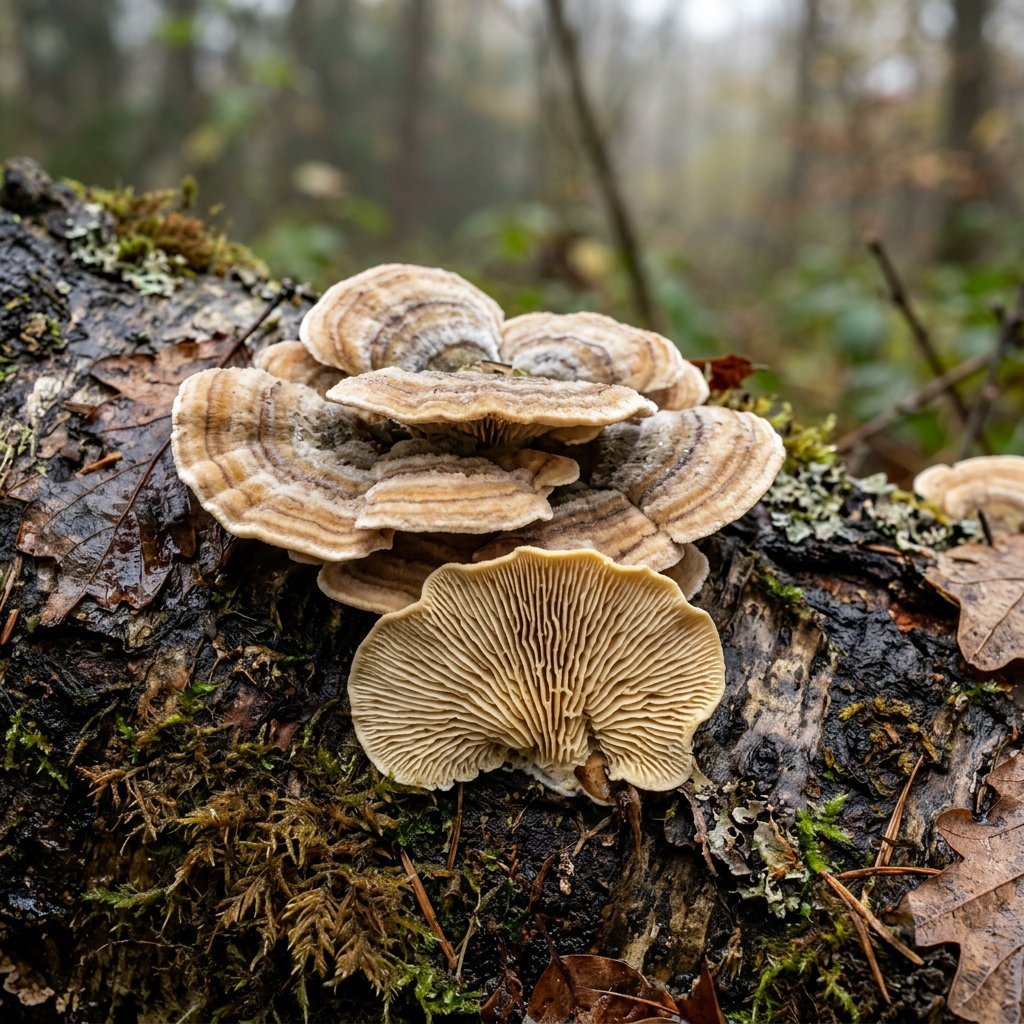
Often mistaken for the colorful Turkey Tail, Lenzites betulinus, commonly known as the Gilled Polypore, is a master of disguise. It clings to fallen logs like a collection of fuzzy, velvet shelves, displaying concentric rings of gray, white, and tan. While it looks like many other bracket fungi from above, it hides a surprising secret underneath its cap that sets it apart from its cousins.
🔍 How to Identify
- 🎨 The Cap: A semicircular, shelf-like bracket with distinct concentric zones of color. The surface is densely "tomentose," meaning it feels like soft velvet or fine felt to the touch.
- 🌿 The "Gills": Flip it over to see its defining feature. Unlike most bracket fungi which have tiny pores, this species has tough, leathery, gill-like structures that radiate from the base.
- ☁️ The Flesh: The interior is white and very corky. Even when young, it is tough and flexible rather than soft or brittle.
- 🚫 The Stem: This mushroom is "sessile," meaning it lacks a stem entirely and attaches directly to the wood like a tiny, fuzzy balcony.
🌲 Habitat & Ecology
- 🪵 Hardwood Specialist: You will almost always find it growing on the dead wood of deciduous trees. While its name betulinus refers to Birch trees, it is equally happy colonizing Oak, Beech, and Maple.
- 🍄 The White Rotter: It plays a vital role in the forest ecosystem by causing "white rot." It breaks down the tough lignin in wood, recycling nutrients back into the soil to feed the next generation of trees.
- ❄️ Year-Round Presence: While it produces spores in the summer and fall, the tough, leathery brackets can persist through the winter, often turning green as tiny algae begin to grow in their velvet fur.
⚠️ Safety & Toxicity
- 🚨 WARNING: This mushroom is classified as Inedible.
- 🦷 Texture: While not known to be dangerously toxic to humans, it is far too tough and corky to be chewed or digested. It has a bitter, woody taste that offers no culinary value.
- 🐾 Pets: Keep curious dogs away; while not a "death cap," the woody texture can cause gastrointestinal blockage or distress if swallowed in large chunks.
✨ Fun Fact
Evolutionarily, Lenzites betulinus is a bit of a rebel. Most "gilled" mushrooms belong to one family, while "polypores" (with pores) belong to another. This mushroom is technically a polypore that evolved to look like it has gills, likely to increase the surface area for releasing its spores!
More Details







