Info
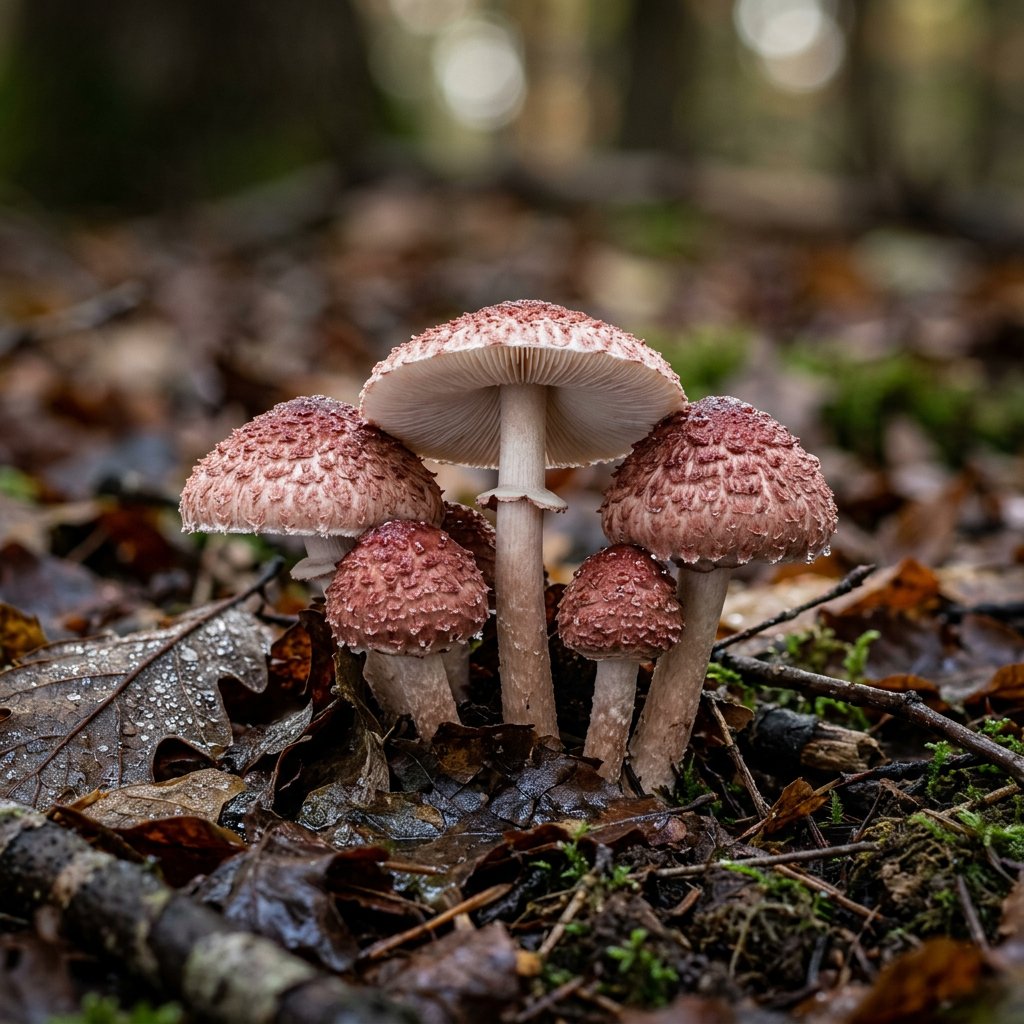
Commonly known as the Ruby-tinted Lepiota, this elegant fungus looks like a tiny, Victorian parasol that has been lightly dusted with rouge. Found frequently in the leaf litter of North American forests, its striking red-to-pink center makes it a favorite for woodland photographers. While it appears delicate and charming, it belongs to a group of mushrooms that requires a very cautious eye and should never be considered for the plate.
🔍 How to Identify
- 🍄 The Cap: Measuring 2–6 cm, the cap starts bell-shaped and flattens with age. It features a distinct reddish-brown or "ruby" center that breaks into small, radiating scales against a white background.
- ⚪ The Gills: Underneath, you will find white, crowded gills that are "free" from the stem, meaning they do not physically attach to the stalk.
- 💍 The Stem & Ring: The stem is slender, white, and hollow. It usually sports a fragile, skirt-like ring (annulus) that may slide up and down or disappear entirely as the mushroom matures.
🌲 Habitat & Ecology
- 🍂 Leaf Litter Lover: This species is a saprobe, meaning it feeds on dead organic matter. You’ll most likely spot it popping up from decomposing leaves under hardwood trees or occasionally in well-mulched garden beds.
- ☁️ Seasonal Appearance: It is a fan of humidity and warmth, usually making its debut in late summer through autumn, appearing shortly after heavy rains have soaked the forest floor.
⚠️ Safety & Toxicity
- 🚫 WARNING: This mushroom is considered inedible and potentially toxic. It should never be consumed under any circumstances.
- 🧪 Dangerous Look-alikes: It bears a striking resemblance to several deadly species in the Lepiota genus which contain amatoxins (the same poisons found in the Death Cap). Because of the high risk of lethal misidentification, mycologists treat this entire group with extreme caution.
- 🐾 Pets & Kids: Because it often grows in gardens or suburban parks, keep a close watch on curious pets and toddlers. Ingestion can lead to severe gastrointestinal distress or worse.
✨ Fun Fact
- 🎨 Watercolor Name: Its scientific name rubrotinctus literally translates to "dyed red," which is a perfect description of how the pigment looks—as if a drop of red ink was placed in the center of the cap and allowed to bleed outward.
More Details







