Info
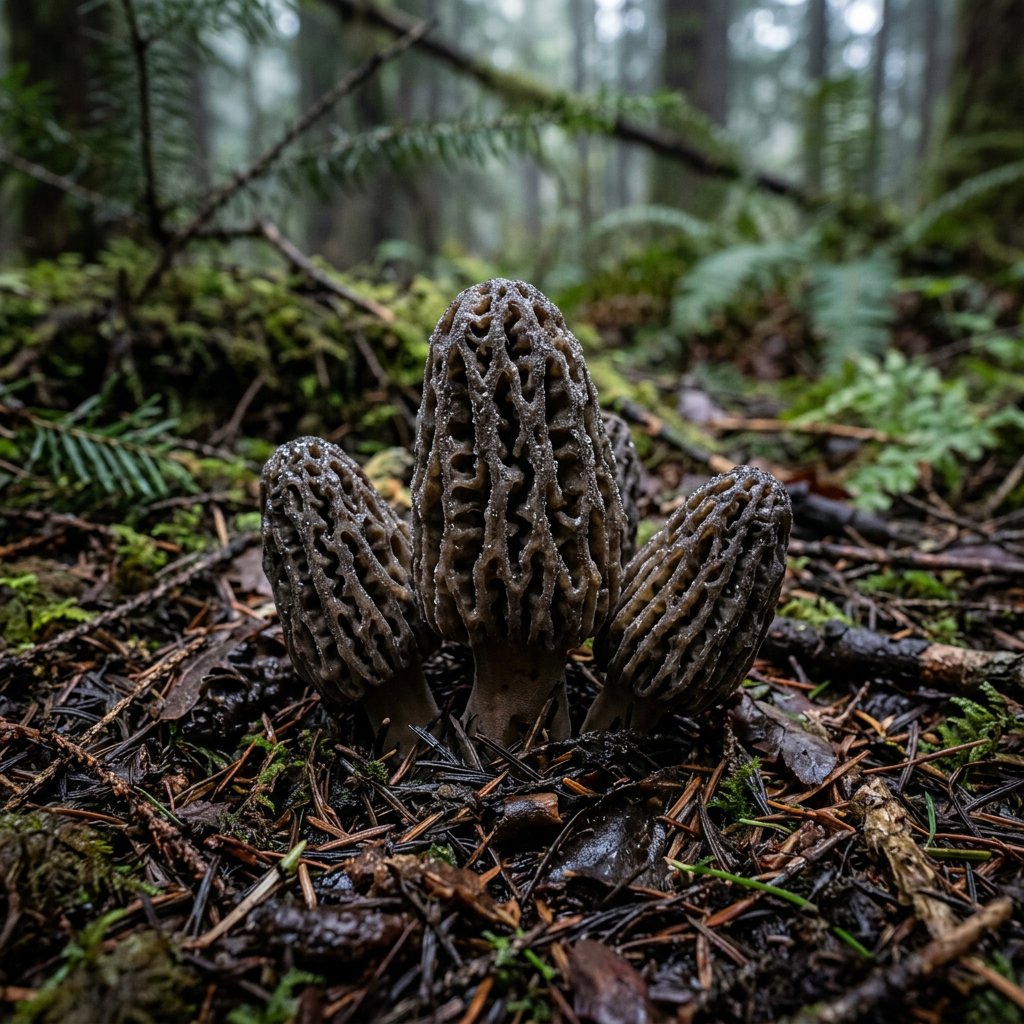
Often called the Black Morel, this mushroom is the "holy grail" for spring foragers. With its dark, honeycomb-like ridges and mysterious appearance, it looks more like a weathered pinecone or a woodland artifact than a typical fungus. In folklore, finding a patch of these is often considered a sign of good luck and the true arrival of spring.
🔍 How to Identify
- 🍄 The Cap: Conical or elongated with deep, hollow pits. The most striking feature is its vertical, parallel ridges that darken to charcoal-grey or black as the mushroom matures.
- 🦴 The Stem: Pale, yellowish-white, and slightly grainy or "mealy" to the touch. Crucially, the cap is fused directly to the stem at the base, rather than hanging over like a skirt.
- 🕳️ The Interior: If you slice it vertically, the entire mushroom—from the tip of the cap to the base of the stem—is a single, continuous hollow chamber.
🌲 Habitat & Ecology
- 🌲 Conifer Connections: You’ll most likely find them lurking near conifers, particularly pine, fir, and spruce trees. They have a mysterious "mycorrhizal" relationship with these trees, exchanging nutrients underground.
- 🔥 The Fire Follower: This species is famous for being a "burn specialist." They often appear in massive flushes the first or second spring following a forest fire, thriving in the nutrient-rich, charred soil.
- ⏳ Fleeting Season: They are masters of timing, appearing only for a few weeks when the ground begins to warm but remains damp from spring rains.
⚠️ Safety & Toxicity
- 🛑 WARNING: Never eat this mushroom raw. Raw morels contain a mild toxin that causes severe stomach upset. They must be thoroughly cooked (sauteed or boiled) to be safe for consumption.
- ⚠️ The "False" Lookalike: Always beware of the "False Morel" (Gyromitra). You can tell the difference by cutting them open: True morels are completely hollow, while False morels are filled with cottony fibers or "brain-like" folds.
- 🤢 Alcohol Sensitivity: Some individuals experience nausea if they consume morels alongside alcoholic beverages. It is best to test a small amount first.
✨ Fun Fact
Black Morels are notoriously difficult to cultivate commercially. Unlike button mushrooms that grow easily on compost, Morchella elata requires a complex, secret dance with tree roots and soil bacteria, making them one of the most expensive and sought-after wild treats in the world!
More Details