Info
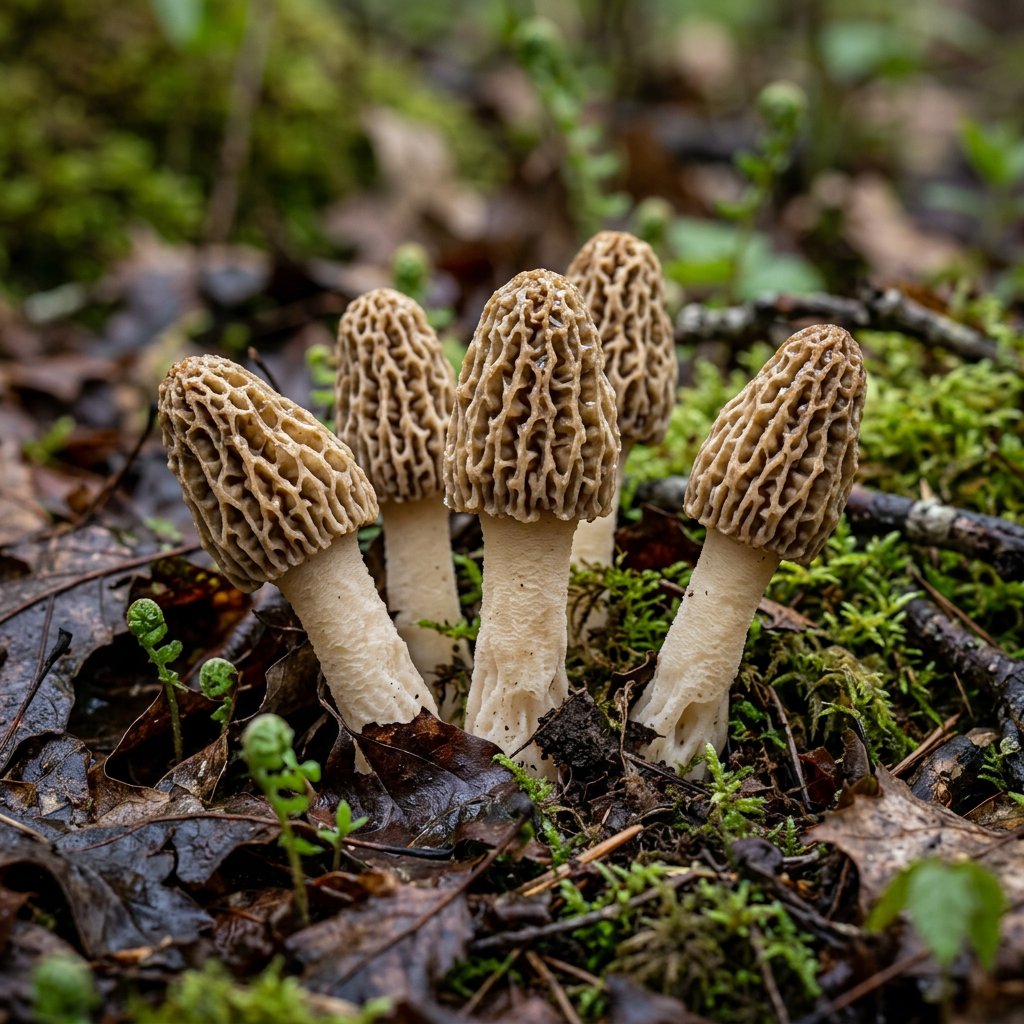
Known to foragers as the "Semi-free Morel" or the "Half-free Morel," Morchella punctipes is a harbinger of spring that often signals the true start of the mushroom hunting season. Unlike its cousin, the Yellow Morel, this mushroom looks a bit like a tiny, wrinkled umbrella that was caught in a gust of wind, with its cap hanging partially loose from the stem. In folklore, finding these is often considered a "scout" mission, as they usually appear a week or two before the larger morels emerge.
🔍 How to Identify
- 🍄 The Cap: Features a conical or honeycomb-like surface with brownish ridges and yellowish pits. The most distinguishing feature is that the bottom half of the cap hangs free from the stem, creating a "skirt" effect.
- 🦴 The Stem: Typically tall, fragile, and hollow. The name punctipes literally means "dotted foot," referring to the tiny, mealy white granules or bumps that cover the stem’s surface.
- 📐 The Interior: When sliced vertically, the entire mushroom is hollow from the very top of the cap down to the base of the stem.
🌲 Habitat & Ecology
- 🌳 Tree Partners: These mushrooms are often found in hardwood forests, showing a particular fondness for Old Growth forests, specifically near White Ash, American Elm, and occasionally Sycamore trees.
- 💧 The Riverbank Life: They thrive in rich, moist soil. You are most likely to spot them hiding under leaf litter near river bottomlands or in loamy soil during the damp days of April and May.
⚠️ Safety & Toxicity
- 🚨 WARNING: Never eat any morel raw. Like all true morels, Morchella punctipes contains small amounts of hydrazine toxins that are destroyed by thorough cooking but can cause severe stomach upset if eaten raw.
- 🎭 The Look-alike: Be careful not to confuse this with the "False Morel" (Verpa bohemica). In Verpa, the cap is attached only at the very top of the stem (like a thimble on a finger), whereas the Semi-free Morel is attached halfway down.
- 🤢 Sensitivity: Some individuals experience gastrointestinal distress with "Half-free" morels even when cooked, so it is wise to try a small amount first.
✨ Fun Fact
The specific epithet punctipes comes from the Latin words punctus (point/dot) and pes (foot). If you look closely at the stem with a magnifying glass, it looks like it has been lightly dusted with fine white sugar or sand!
More Details