Info
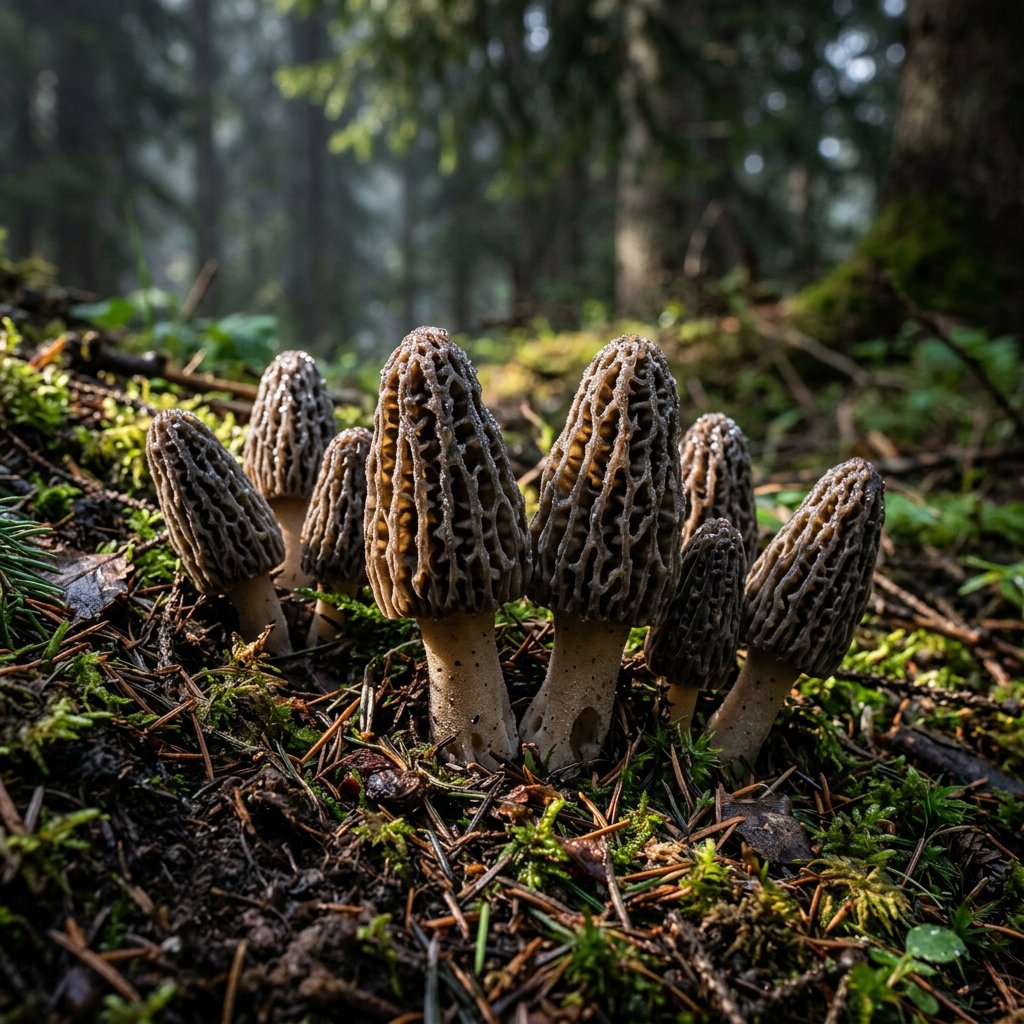
Known as the "Mountain Morel" or "Trento Morel," Morchella tridentina is a prized find for mushroom foragers across Europe and North America. This elusive fungus belongs to the "Black Morel" clade and is often considered a hidden gem of the forest floor due to its incredible camouflage. Its name honors the Trento region of Italy, where it was famously documented, adding a touch of Alpine mystery to its reputation.
🔍 How to Identify
- 📐 The Cap: Distinctly conical or triangular, featuring a network of vertical ridges that turn dark grey or blackish as it matures, while the interior pits remain a lighter cream or tan color.
- 🪵 The Stem: The stem is pale, slightly wrinkled at the base, and—crucially—fuses directly to the bottom of the cap without any "overhang" or skirt.
- 🐚 The Hollow Core: If sliced vertically from top to bottom, the entire mushroom is a single, continuous hollow chamber. This is a primary way to distinguish "True Morels" from dangerous lookalikes.
🌲 Habitat & Ecology
- 🏔️ The Limestone Lover: This species is "calcicolous," meaning it has a strong preference for alkaline, lime-rich soils. It is frequently found in the dappled shade of Ash, Hawthorn, or even Olive trees in Mediterranean climates.
- 🎭 Seasonal Vanishing Act: It is a spring specialist. It appears shortly after the first warm rains of the season, often popping up in the same secret locations year after year, provided the soil remains undisturbed.
⚠️ Safety & Toxicity
- 🛑 WARNING: Never consume this mushroom raw. Like all morels, Morchella tridentina contains heat-sensitive toxins that cause severe stomach upset and neurological symptoms unless neutralized by thorough cooking.
- 👺 The False Morel Trap: Be wary of "False Morels" (Gyromitra species). These have "brain-like" or wavy caps rather than the structured, honeycombed pits of the true morel, and they can be deadly.
- 🐾 Pets and Kids: Raw morels are toxic to dogs and can cause "Morel poisoning," leading to vomiting and loss of coordination. Always store your harvest out of reach of curious paws.
✨ Fun Fact
🧬 A Global Traveler: For a long time, scientists thought this was strictly a European species. However, DNA "fingerprinting" recently revealed that this exact mushroom also grows in the mountains of the Western United States, proving that this fungal traveler has been crossing borders for millennia!
More Details







