Info
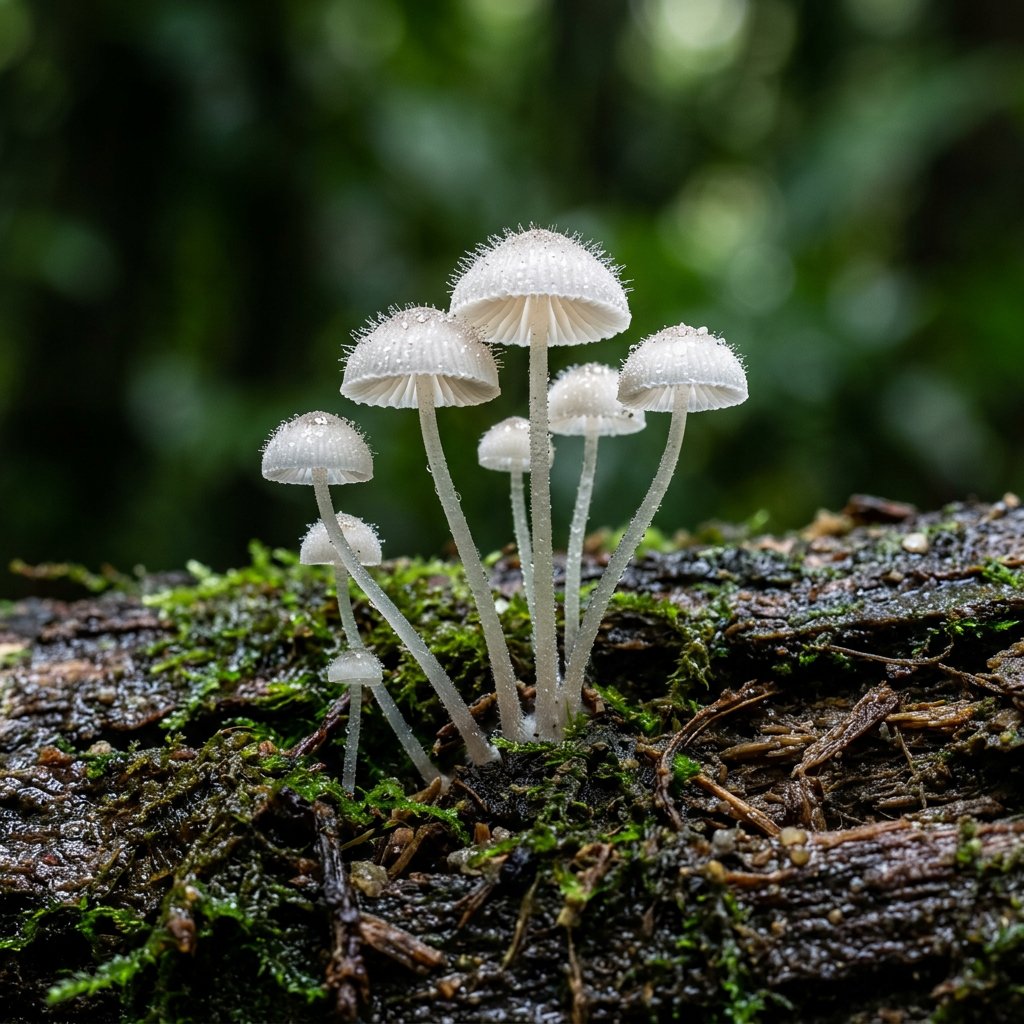
Often referred to as the "White-Haired Bonnet," Mycena albidocapillaris is a tiny, ethereal fungus that looks like a miniature umbrella lost on the forest floor. These delicate mushrooms are the "clean-up crew" of the woods, spending their short lives breaking down fallen leaves and twigs into nutrient-rich soil. In folklore, such small, pale mushrooms were often thought to be the stepping stones for forest sprites and woodland spirits.
🔍 How to Identify
- 🍄 The Cap: Very small (usually less than 1cm), bell-shaped or conical, and translucent-white. The edges are often slightly "striate," meaning you can see the lines of the gills through the thin flesh.
- ❄️ The Gills: Pale white and relatively distant from one another. They are typically attached directly to the stem (adnate), giving the underside a neat, organized look.
- 🧵 The Stem: Exceptionally thin—almost like a strand of coarse hair. It is fragile, hollow, and usually has a slightly fuzzy or hairy base where it meets the ground.
🌲 Habitat & Ecology
- 🍂 Leaf Litter Specialist: You won’t usually find these growing on living trees. Instead, they sprout directly from decaying leaves, small twigs, or mossy debris, particularly in oak and beech forests.
- 💧 Moisture Seeker: Because they are so thin and fragile, they dry out quickly. You are most likely to spot them in the morning dew or after a heavy autumn rain when the forest floor is saturated.
⚠️ Safety & Toxicity
- 🛑 WARNING: Do not consume. While many Mycena species are not necessarily "deadly" in the way some Amanitas are, they are far too small to be of culinary interest and many contain unknown or minor toxins like muscarine.
- 🐾 Pet Safety: Because they are so small, they are often overlooked by larger pets, but ingestion can cause gastrointestinal upset in curious puppies or kittens.
- 🔬 Identification Risk: They are part of a group called "LBMs" (Little Brown/Bony Mushrooms), many of which look identical to the untrained eye and can be toxic.
✨ Fun Fact
The genus name Mycena comes from the Ancient Greek word "mykes," meaning mushroom, but it is also the namesake of the Mycenaean civilization. Some believe the ancient city of Mycenae was named after the founder found a mushroom on the site!
More Details







