Info
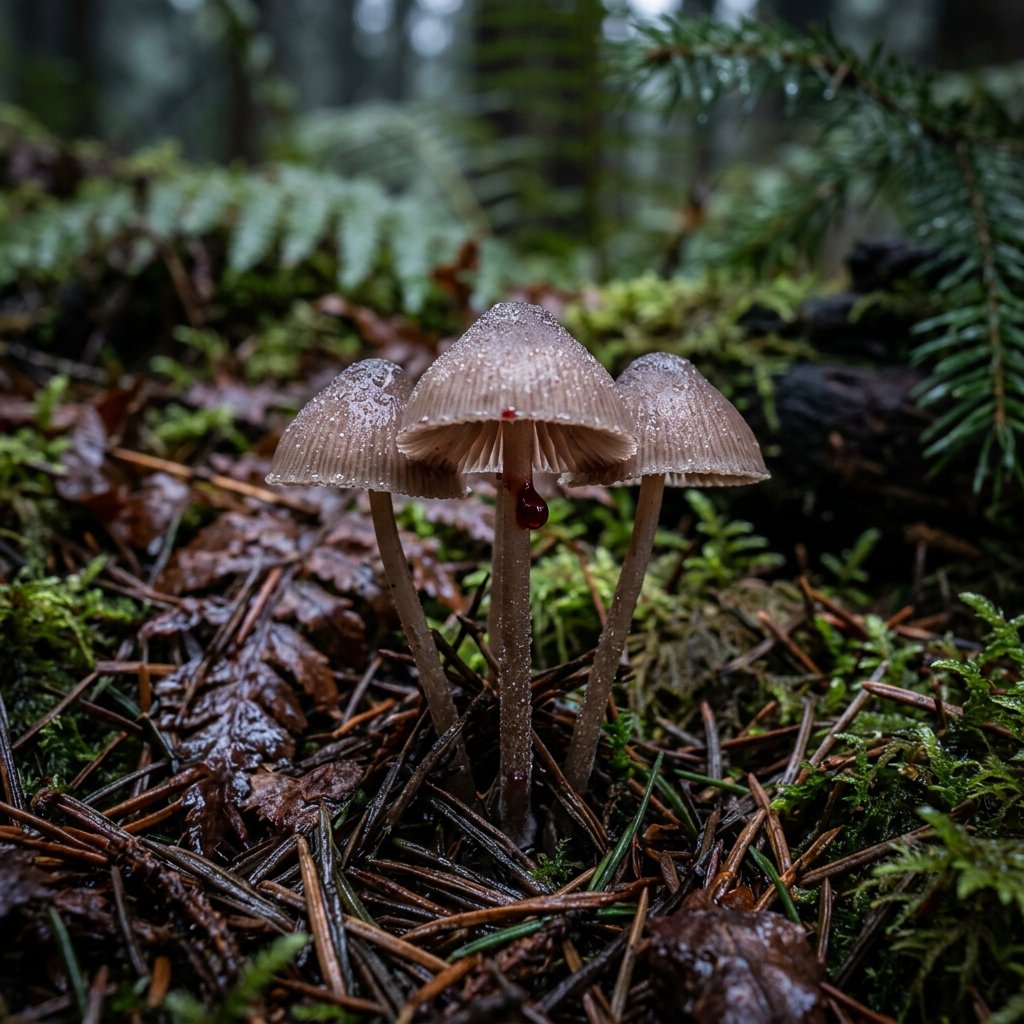
Often called the Bleeding Bonnet, this tiny woodland treasure looks like something out of a Victorian fairy tale. It belongs to the Mycena family—a group known for their delicate, bell-shaped caps and "pixie-like" appearance. What sets this specific mushroom apart is its dramatic "weeping" habit; when its slender stem is snapped, it releases a dark, blood-red juice that gives it a slightly macabre charm.
🔍 How to Identify
- 🍄 The Cap: Small (usually less than 2cm), conical or bell-shaped, with a pale reddish-brown color that fades toward the edges.
- 🩸 The Stem: Very thin, fragile, and hollow. If bruised or broken, it immediately oozes a distinctive burgundy-red latex.
- 🧶 The Gills: Look closely at the underside; the gills are pale but have a very thin, dark reddish-purple "fringe" on the edges, which is a key identifying feature.
🌲 Habitat & Ecology
- 🍂 Woodland Floors: You’ll most likely find the Bleeding Bonnet hiding in the leaf litter, needles, or moss of both coniferous and deciduous forests.
- 🍄 Growth Habit: Unlike some mushrooms that grow in massive clusters, these usually appear in small, scattered groups or "troops" during the late summer and autumn.
- 🪵 Decomposer's Role: It is a saprobic species, meaning it performs the vital job of breaking down dead organic matter, recycling nutrients back into the forest soil.
⚠️ Safety & Toxicity
- 🚫 Status: STRICT WARNING: INEDIBLE.
- 🧪 Details: While not documented as a "deadly" fungus, the Bleeding Bonnet is far too small and fragile to have any culinary value. Many Mycena species contain unstudied chemical compounds or trace amounts of toxins like muscarine. To stay safe, treat this mushroom as a "look but don't touch" botanical curiosity.
✨ Fun Fact
The dark red "blood" inside the stem isn't just for show! Scientists believe this pigmented latex contains antifungal compounds that protect the mushroom from being eaten by molds or infected by bacteria before it has a chance to release its spores.
More Details
| Hymenium Type | Lamella |
| Stipe Character | Bare Stipe |
| Spore Print Color | White |
| Mushroom Cap Shape | Conical Mushroom Cap |
| Hymenium Attachment | Adnate Hymenium Attachment |
| Mushroom Ecological Type | Saprobiont |







