Info
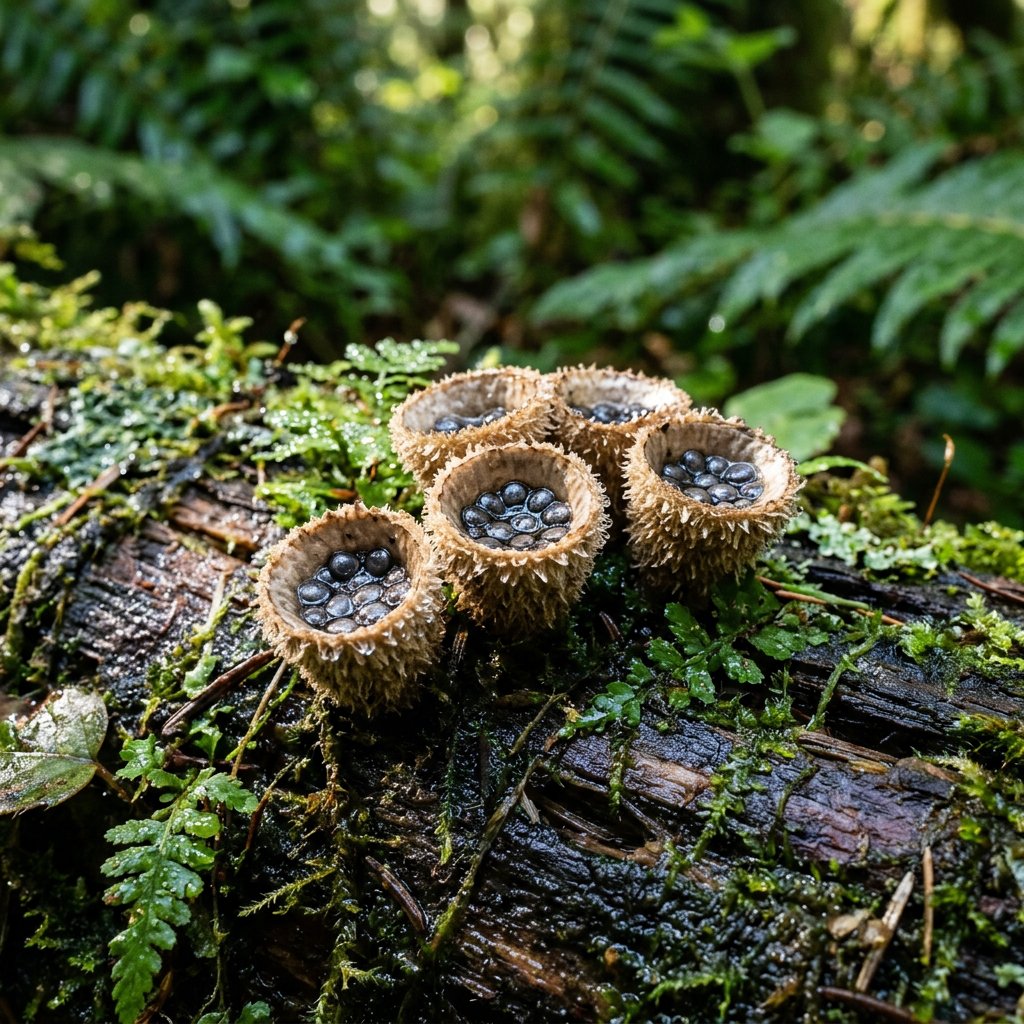
Imagine walking through a damp garden and stumbling upon a tiny, perfect bird's nest resting on a fallen twig, complete with microscopic "eggs." These are Nidula candida, nature's master miniaturists. Often called the Common Bird's Nest Fungus, they have long sparked the imagination of forest-goers, looking like a prop from a fairy tale or a secret woodland village.
🔍 How to Identify
- 🥣 The Cup: These fungi grow as small, urn-shaped structures (peridia) that are typically only 5–15 mm tall. The exterior is usually whitish to grayish-tan and is covered in fine, shaggy hairs that give it a "fuzzy" appearance.
- 🥚 The "Eggs": Inside the cup are several small, flattened discs called peridioles. In Nidula candida, these are usually brownish-black or dark gray and look exactly like miniature bird eggs tucked away in a nest.
- 🕸️ The Membrane: When the fungus is young, a thin, white "lid" (epiphragm) covers the top of the cup to protect the developing eggs from the elements. This lid eventually tears open as the mushroom matures.
🌲 Habitat & Ecology
- 🍂 Nature's Recycler: This fungus is saprobic, meaning it survives by breaking down dead organic matter. You’ll most likely find them growing in crowded clusters on rotting twigs, branches, or wood-chip mulch in damp, shaded garden beds or forest floors.
- ☔ Rain-Powered Launch: Their shape is a marvel of biological engineering. When a raindrop hits the angled interior of the cup, the force launches the "eggs" (spore cases) several feet away, allowing the fungus to spread to new locations.
⚠️ Safety & Toxicity
- 🚫 Status: NOT EDIBLE. While Nidula candida is not considered poisonous or toxic, it is classified as "inedible."
- 🐾 Details: Because they are tiny, tough, and leathery, they have no culinary value. They pose no significant threat to curious pets or children, though it is always best practice to prevent the ingestion of any wild mushroom.
✨ Fun Fact
The "eggs" of the Bird's Nest fungus are coated in a sticky substance. When they are splashed out of their nest by rain, this natural glue helps them stick firmly to whatever surface they land on—be it a leaf or a twig—ensuring they stay put while they release their spores!
More Details







