Info
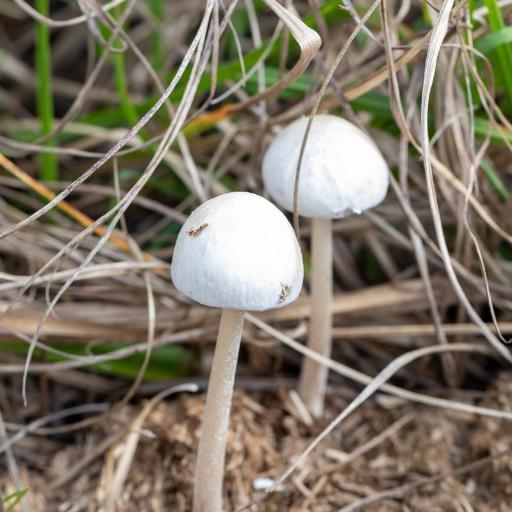
Often called the Large White Dung Mushroom, this species stands like a pale, sturdy sentinel in open pastures. While it lacks the psychedelic properties of its famous cousins, it is a master of its niche, turning livestock waste into life across tropical and temperate regions worldwide. It is one of the more "substantial" members of its genus, appearing much meatier than the fragile, wispy mushrooms usually found in the grass.
🔍 How to Identify
- 🍄 The Cap: Smooth, thick, and hemispherical, maturing into a broad bell shape. It features a distinct "satin" sheen, transitioning from creamy white to a metallic silvery-grey as it ages.
- 🌑 The Gills: Close and broad, the gills start a pale grayish-brown and eventually turn a mottled, patchy black as the spores mature.
- 🦒 The Stem: Unlike many of its thinner relatives, the stem is solid and sturdy. It is typically white, straight, and lacks a "ring" or "skirt" around the middle.
🌲 Habitat & Ecology
- 🐎 The Substrate: This is a strictly "coprophilous" fungus, meaning it grows almost exclusively on well-weathered horse or cow manure in sun-drenched grassy fields.
- 🗺️ A Global Traveler: Though its name suggests a Caribbean origin, this mushroom has followed livestock across the globe, flourishing anywhere with high humidity and grazing animals.
⚠️ Safety & Toxicity
- 🛑 WARNING: Do not ingest. While Panaeolus antillarum is generally considered non-toxic and technically "edible" in some texts, it is categorized as "inedible" by most foragers due to its unappealing habitat and lack of culinary value.
- 🎭 The "Blue" Test: It is frequently confused with Panaeolus cyanescens, a potent psychoactive mushroom. However, P. antillarum is much larger, thicker, and never bruises blue when bruised or sliced. If you see blue staining, you are looking at a different species entirely.
✨ Fun Fact
Its species name, antillarum, literally translates to "of the Antilles." This is a nod to the Caribbean islands where the mushroom was first scientifically documented before it was realized how common it is worldwide!
More Details
| Hymenium Type | Lamella |
| Stipe Character | Bare Stipe |
| Spore Print Color | Black |
| Mushroom Cap Shape | Convex Mushroom Cap |
| Hymenium Attachment | Adnexed Hymenium Attachment |
| Mushroom Ecological Type | Saprobiont |







