Info
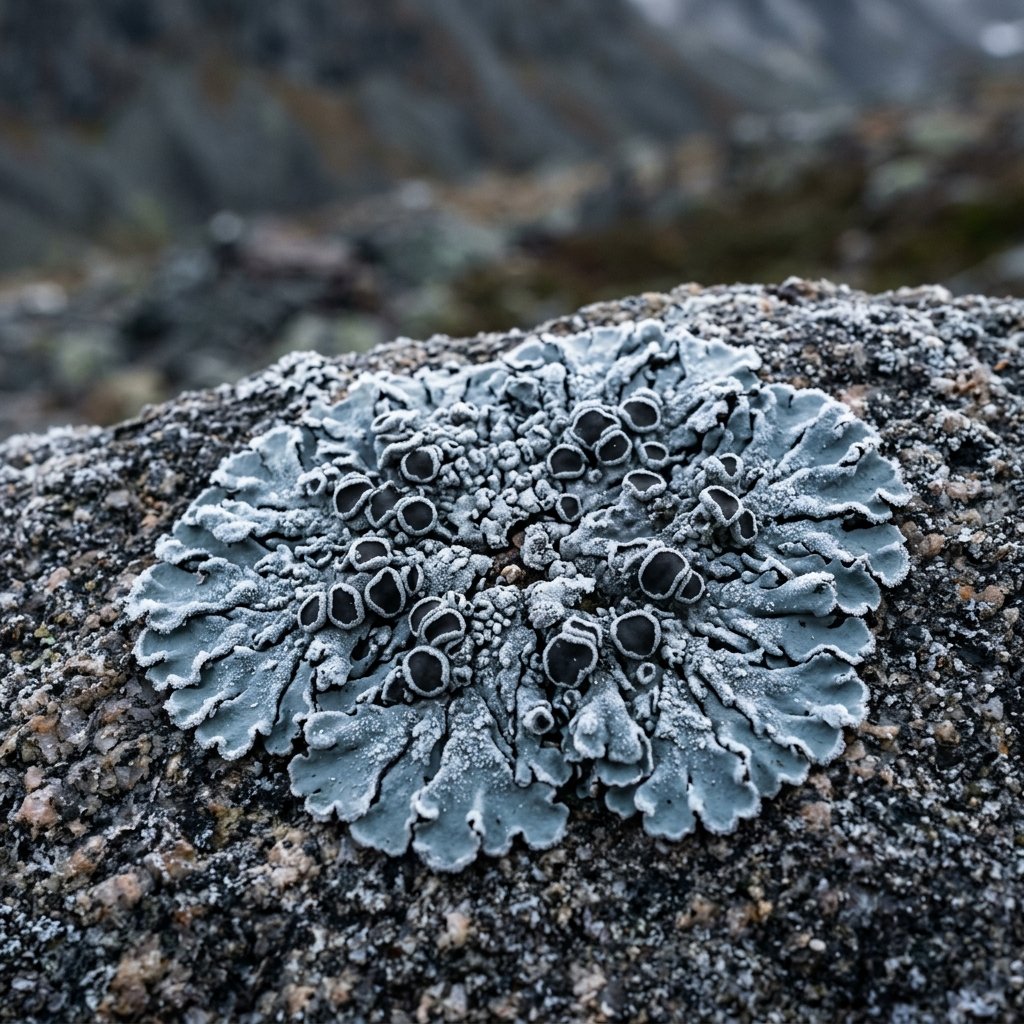
Known as the Blue-gray Rosette Lichen, this species looks like a tiny, frosty explosion frozen in time. While it is technically a lichen (a symbiotic partnership between a fungus and algae), it is often sought out by mushroom hunters and nature hikers for its striking, starburst patterns on stone. It is a hardy survivor, often acting as a pioneer species that brings life to bare, cold rocks.
🔍 How to Identify
- 🔵 The Rosette Form: It grows in distinct circular patterns, or "rosettes," that radiate outward from a central point, hugging the surface tightly.
- ❄️ Frosty Coloring: The body (thallus) is typically a pale blue-gray or ash-white, often looking like it has been dusted with a fine layer of powdered sugar or hoarfrost.
- 🌫️ Powdery Spots: Look for "soralia"—small, mounded, grainy spots near the center of the lobes. These are used for reproduction and give the lichen a textured, bumpy appearance.
🌲 Habitat & Ecology
- 🪨 The Stone Dweller: You won’t find this on a tree; it is "saxicolous," meaning it grows almost exclusively on rocks. It particularly loves nutrient-rich surfaces like limestone, concrete walls, and old gravestones.
- 🏙️ City Slicker: Unlike many sensitive lichens that wither in smog, Physcia caesia is remarkably tolerant of air pollution. It is one of the few species that thrives in urban environments and near busy roads.
⚠️ Safety & Toxicity
- 🚫 Not Edible: Lichens are not mushrooms in the culinary sense. Physcia caesia contains secondary metabolites (lichen acids) that are unpalatable and can cause digestive distress if consumed.
- 🧼 Touch & Hygiene: It is perfectly safe to touch or photograph. However, because it often grows on concrete or old masonry, it can accumulate heavy metals or minerals from its environment, so always wash your hands after handling wild specimens.
✨ Fun Fact
Lichens like the Blue-gray Rosette are used by scientists as "bio-indicators." Because they absorb everything from the air, researchers can analyze their tissues to map out the history of air quality in a specific city over several decades!
More Details