Info
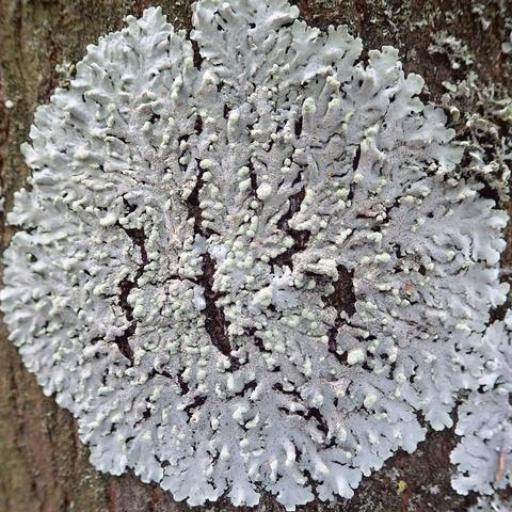
Often mistaken for a simple moss or a flat fungus, Physcia tribacioides is actually a "Rosette Lichen" that looks like nature’s own silver embroidery. It forms delicate, circular patches on tree trunks, often appearing as if a Victorian lace doily was pressed into the bark. While it belongs to the fungal kingdom, it is a master of cooperation, functioning as a complex partnership between a fungus and an alga.
🔍 How to Identify
- 🎨 The Thallus: The main body is "foliose" (leaf-like) and grows in neat, circular rosettes. It is typically a pale mineral-grey or silvery-white, which turns a duller green when wet.
- ❄️ Powdery Surface: Look closely for tiny, flour-like grains on the surface or edges of the lobes. These are called soredia, which are essentially "starter kits" the lichen releases to grow new colonies nearby.
- 🕸️ Lobe Shape: The individual "leaves" or lobes are narrow and slightly overlapping, often giving the entire organism a crowded, textured appearance.
🌲 Habitat & Ecology
- 🌳 The Tree Hugger: This species is epiphytic, meaning it lives on the surface of plants. It specifically favors the bark of broad-leaved trees (like Oak or Ash) in sun-drenched but humid environments.
- 🌬️ Air Quality Indicator: Lichens are the "canaries in the coal mine" for the environment. Physcia tribacioides is sensitive to sulfur dioxide; finding it in your woods is a gold star for the local air quality.
- 🤝 The Symbiotic Team: It doesn't have roots to suck up nutrients. Instead, the fungal part provides the sturdy "house," while the internal algae act as a "chef," creating food from sunlight through photosynthesis.
⚠️ Safety & Toxicity
- 🛑 WARNING: Although it belongs to the Fungi kingdom, this is not a mushroom and is not edible. Lichens can bioaccumulate heavy metals and toxins from the atmosphere.
- 🐾 Pets & Humans: It is generally safe to touch and does not possess stinging hairs or thorns. However, keep curious pets and children from grazing on it, as it can cause mild stomach upset if ingested.
✨ Fun Fact
Lichens like Physcia tribacioides are considered "pioneer species." They are often the very first organisms to settle on bare, inhospitable surfaces, slowly breaking down minerals and paving the way for mosses and plants to follow!
More Details







