Info
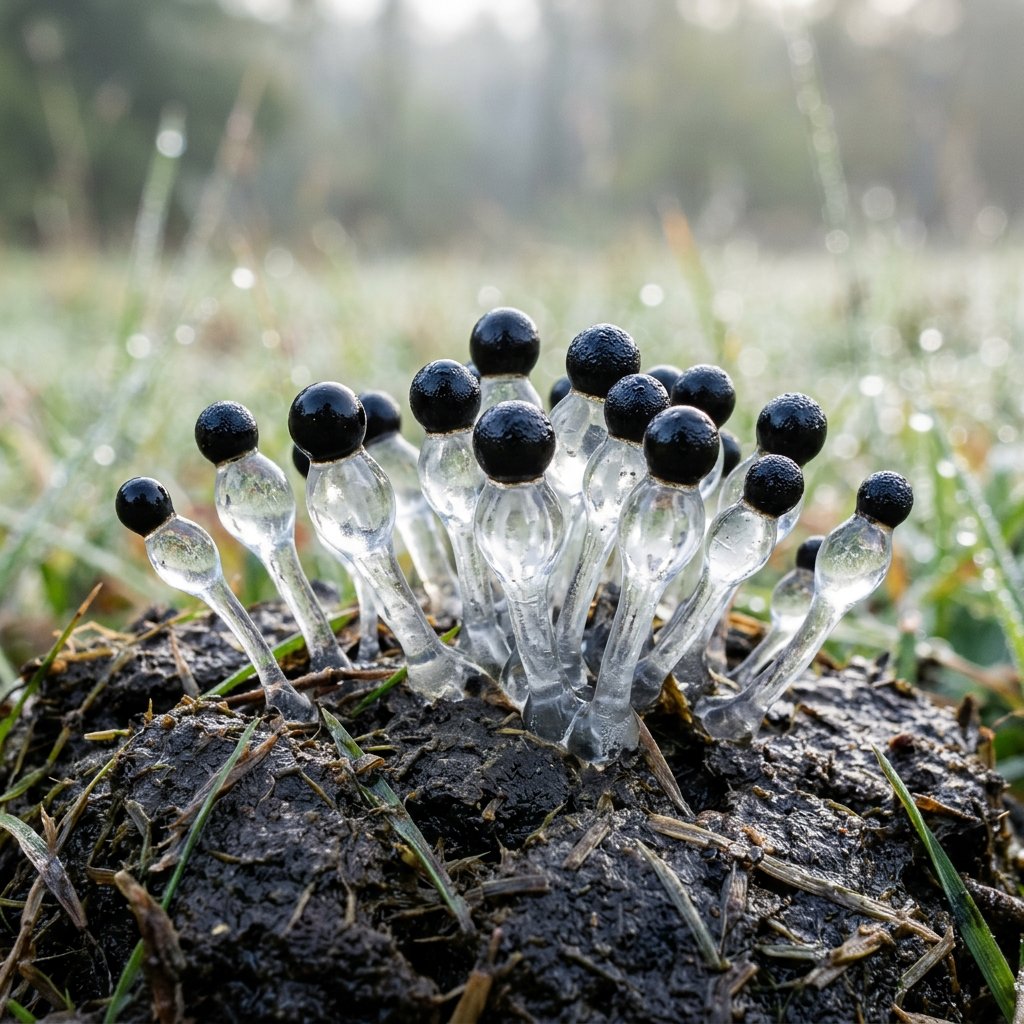
Often called the "Dung Cannon" or the "Hat-thrower," Pilobolus crystallinus is a tiny, crystal-clear fungus with a flair for the dramatic. While it barely reaches the size of a fingernail, it holds a record that puts sports cars to shame: it is the fastest-accelerating organism in the natural world. This microscopic marvel lives a specialized life, relying on the digestive systems of grazing animals to complete its journey across the pasture.
🔍 How to Identify
- 💎 The Crystal Stalk: It looks like a miniature glass sculpture, featuring a transparent, water-filled stalk (sporangiophore) that glistens brightly in the morning light.
- 🎈 The Pressure Bulb: Just below the black tip is a bulbous, fluid-filled swelling. This acts as both a pressure tank and a light-sensing "eye" to aim the fungus.
- 🎯 The Black "Hat": At the very top sits a tiny, jet-black cap called the sporangium. This is the "cannonball" that contains the spores, ready to be launched.
🌲 Habitat & Ecology
- 🐎 Dung Specialist: You won't find this in a flower bed; it grows exclusively on the dung of herbivores, particularly horses, cows, and sheep. It plays a vital role in breaking down waste.
- ☀️ Solar Guidance: The fungus is phototropic, meaning it follows the sun. The bulbous lens focuses sunlight to aim the stalk toward the brightest part of the sky, ensuring the spores are fired into an open area where grass is likely to grow.
- 🚀 The Great Leap: To avoid being "stuck" on its current pile of dung, it launches its spores up to 8 feet away. It lands on fresh grass, where it is eaten by a grazing animal, passes through their gut, and starts the cycle over in a fresh pile.
⚠️ Safety & Toxicity
- ⚠️ WARNING: While Pilobolus itself is not known to be toxic or poisonous, its habitat is a health hazard.
- 🦠 Bacterial Risk: Because this fungus grows on animal feces, it is surrounded by harmful bacteria like E. coli or Salmonella. Never touch or ingest mushrooms found on dung, and keep pets and children away from these areas.
✨ Fun Fact
When the "Dung Cannon" fires, the spore cap accelerates from 0 to 45 mph in the first millimeter of flight. This produces a force of 20,000 Gs—by comparison, a space shuttle launch only subjects astronauts to about 3 Gs!
More Details







