Info
Known as the "Willow Shield," this unassuming mushroom is a master of disguise in the damp woodlands of Europe and North America. While it may look like many other drab, wood-rotting fungi, it holds a secret that has fascinated mycologists for decades: it is one of the rare species outside the Psilocybe genus to contain psychoactive compounds. Often found clinging to fallen branches, it serves as a ghostly sentinel of the forest floor's recycling process.
🔍 How to Identify
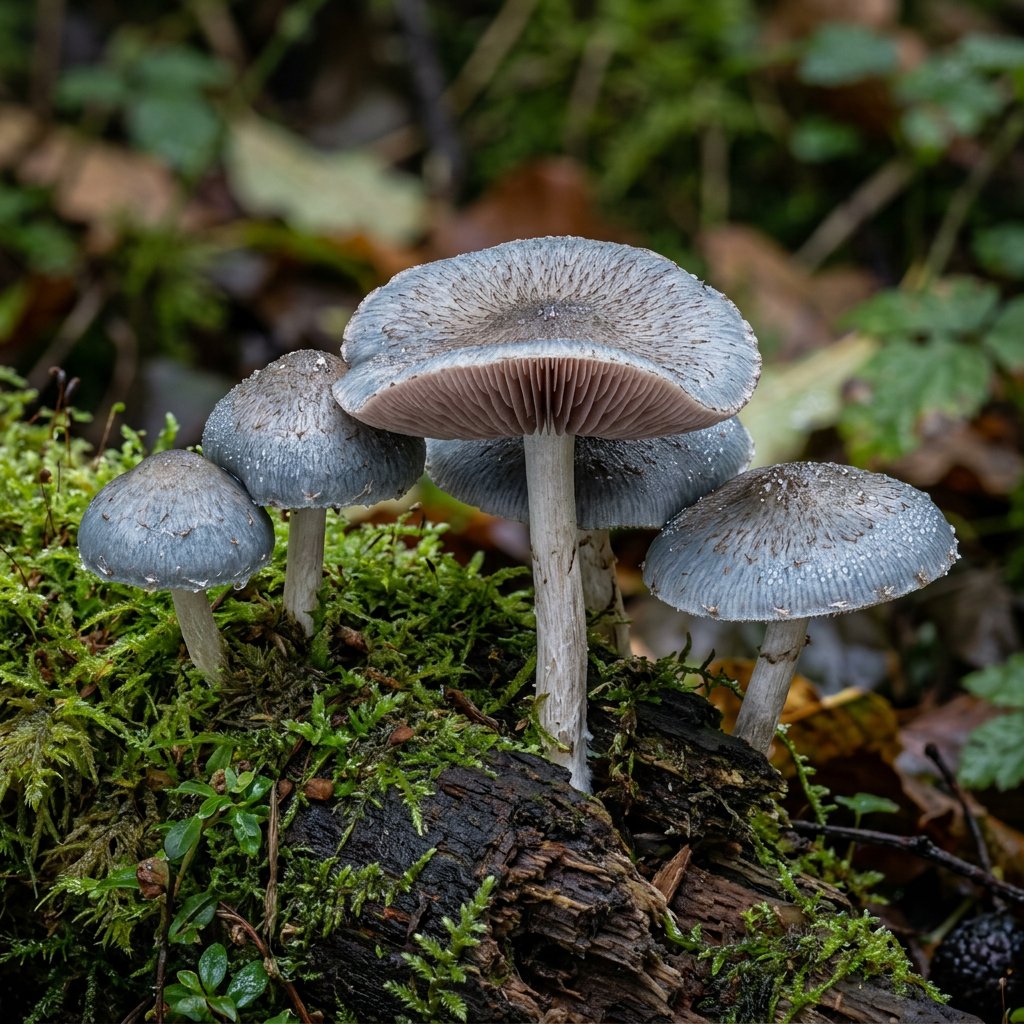
- 🍄 The Cap: Usually 2–5 cm wide, the cap is convex to flat with a slight central bump. Its color ranges from silvery-grey to mouse-brown, often featuring tiny, dark scales or fibers near the center.
- 💗 The Gills: A key identifying feature is that the gills are "free" (not attached to the stem). They start out white but turn a distinct salmon-pink color as the spores mature.
- 🟦 The Stem & Staining: The stem is slender, brittle, and white. Crucially, the base of the stem often develops subtle blue or greenish stains when bruised or handled, indicating the presence of psilocybin.
🌲 Habitat & Ecology
- 🍂 Woodland Recycler: This is a saprobic fungus, meaning it feeds on dead organic matter. It specifically prefers the decaying wood of broadleaf trees, most notably Willow (Salix), but also Alder and Beech.
- 💧 Damp Environments: You are most likely to spot the Willow Shield in boggy areas, riverbanks, or humid deciduous forests during the late summer and autumn months.
⚠️ Safety & Toxicity
- 🛑 WARNING: Do not consume. While it is not considered "deadly" in the same way as the Destroying Angel, it contains psilocybin and psilocin, which are potent psychoactive chemicals.
- 🤢 Lookalike Risks: This mushroom is easily confused with other "Little Brown Mushrooms" (LBMs) or certain Entoloma species, many of which are severely toxic and can cause intense gastrointestinal distress or worse.
- 🐾 Pets and Kids: Keep curious pets and children away, as the hallucinogenic effects can be terrifying and physically dangerous for smaller mammals.
✨ Fun Fact
The Pluteus salicinus is a bit of a chemical rebel. Most "magic" mushrooms belong to the Psilocybe genus, but the Willow Shield independently evolved the ability to produce these compounds, making it a subject of great interest in the study of fungal evolution!
More Details
| Hymenium Type | Lamella |
| Stipe Character | Bare Stipe |
| Spore Print Color | Pink |
| Mushroom Cap Shape | Convex Mushroom Cap |
| Hymenium Attachment | Free Hymenium Attachment |
| Mushroom Ecological Type | Saprobiont |







