Info
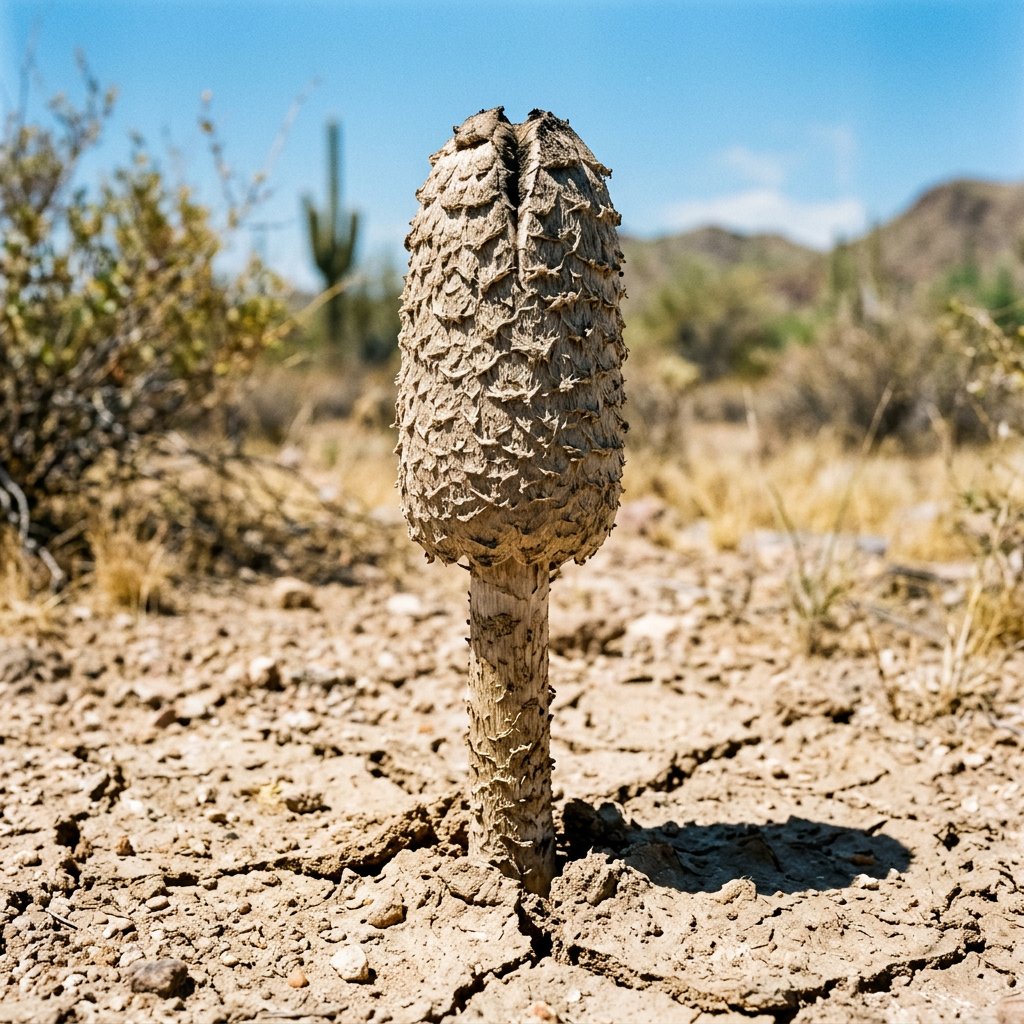
Often called the Desert Shaggy Mane or the False Shaggy Mane, Podaxis pistillaris is a true survivor of the world’s harshest environments. While it looks remarkably like a common garden mushroom that has been "mummified" by the sun, it is actually a specialized desert dweller designed to protect its spores from extreme heat and drought. In many cultures, this "drumstick" of the desert has been used for centuries as a natural dye and traditional medicine.
🔍 How to Identify
- 🍄 The Cap: It features a woody, cylindrical, or bell-shaped cap that never truly opens. The surface is covered in papery, shaggy scales that range from white to a dusty tan.
- 🖤 The Gleba (Interior): Unlike typical mushrooms with exposed gills, the "gills" inside this cap turn into a dense, dark brown to black powdery spore mass as it matures.
- 🧪 The Stem: The stalk is exceptionally tough, woody, and fibrous. It often extends deep into the sandy soil to anchor the fungus against desert winds.
🌲 Habitat & Ecology
- 🏜️ Arid Specialist: You won’t find this in a lush forest; it thrives in sandy soils, deserts, and semi-arid shrublands. It is one of the few large fungi capable of fruitng in the middle of a heatwave.
- 🐜 The Termite Connection: In many regions, Podaxis pistillaris is frequently found growing directly out of or near termite mounds, benefiting from the moisture and nutrient-rich environment provided by the insects.
⚠️ Safety & Toxicity
- 🚫 WARNING: While some traditional cultures have used very young, white specimens as food, this mushroom is not recommended for consumption.
- 🪵 Palatability: As it matures, it becomes extremely woody and unpalatable. The black, powdery spores can also cause respiratory irritation if inhaled in large quantities.
- 🧤 Skin Contact: It is generally safe to touch, but the dark spores will leave a persistent, ink-like stain on your fingers and clothing.
✨ Fun Fact
In parts of Australia and Africa, the dark, powdery spores of the Desert Shaggy Mane were historically used by indigenous tribes as a natural pigment for face paint, hair dye, and even as a primitive "ink" for drawing.
More Details