Info
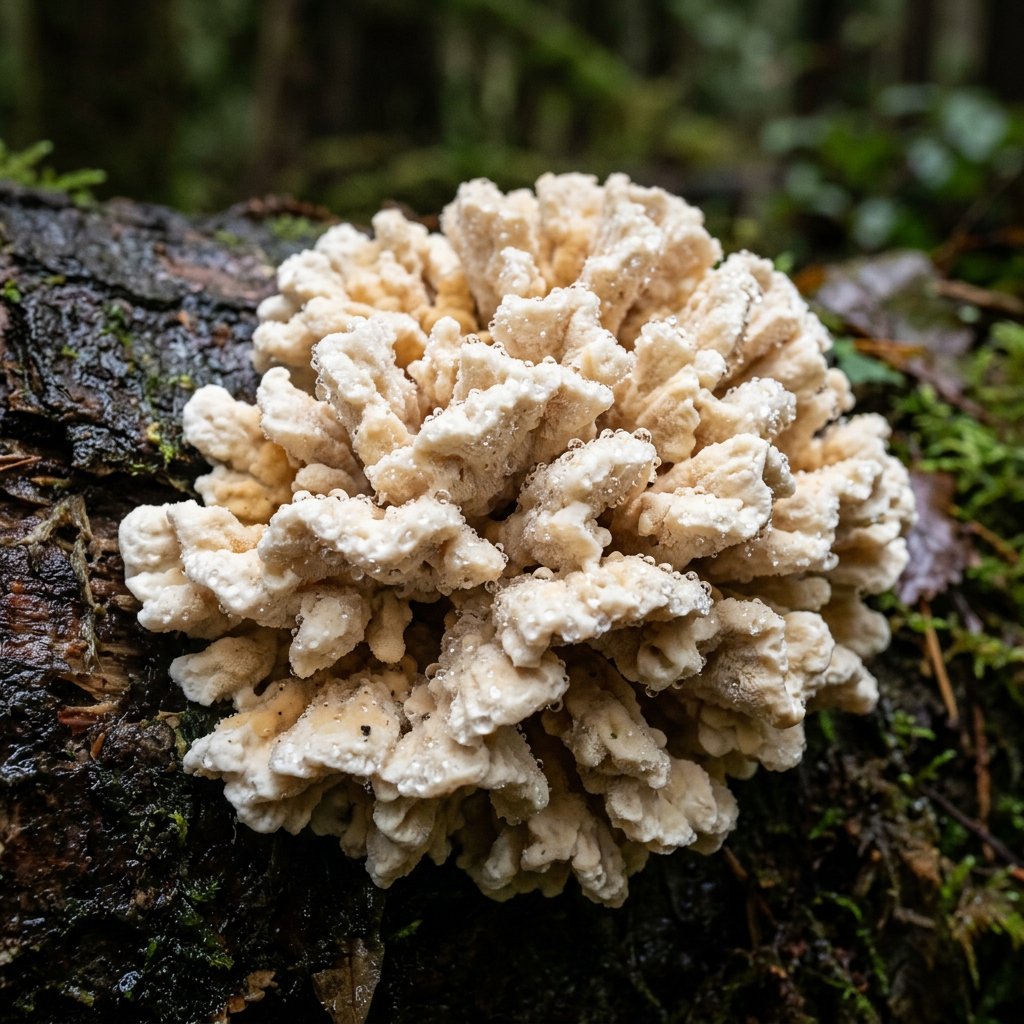
Often called the "Powderpuff Bracket," this strange fungus looks less like a mushroom and more like a discarded ball of cotton or a soft, fuzzy marshmallow stuck to a tree stump. It is most famous for its ghostly white "anamorph" stage, where it skips the traditional cap-and-gills look entirely in favor of a shaggy, spherical form that looks plucked straight from a winter fairy tale.
🔍 How to Identify
- ☁️ Shape: It typically appears as a rounded, cushion-like mass (1–5 cm wide) without a distinct stem or cap.
- 🧶 Texture: The surface is densely covered in long, soft, white hairs or bristles, giving it its iconic "shaggy" or "powderpuff" appearance.
- 🟤 Aging: As it matures, the pristine white "fur" collapses and turns into a dusty, cinnamon-brown mass as it produces millions of asexual spores.
🌲 Habitat & Ecology
- 🌲 The Conifer Recycler: This fungus is a specialist that feeds on decaying conifer wood. You are most likely to spot it tucked into the side of rotting spruce or pine stumps.
- 🍂 Late Season Resident: It thrives in the damp, cool conditions of late summer and autumn. It plays a vital role in the forest ecosystem by breaking down tough wood fibers (cellulose) and returning nutrients to the soil.
⚠️ Safety & Toxicity
- 🚫 Status: WARNING: Inedible. The Powderpuff Bracket is not considered a food source.
- 👅 Texture & Taste: Beyond potential toxicity, the texture is described as corky or hairy, and the taste is often bitter or unpleasant.
- 💨 Spore Irritation: When the mushroom turns brown and "dusty," avoid squeezing it or inhaling the clouds of spores, as fungal spores can irritate the respiratory system.
✨ Fun Fact
This mushroom is a biological "shape-shifter." The fuzzy white ball is actually its asexual stage (anamorph). It very rarely produces a "sexual" fruitbody, which looks like a completely different, thin, white bracket fungus. The "powderpuff" version is so successful at spreading clones of itself that it rarely feels the need to grow a traditional mushroom cap!
More Details