Info
Known famously as the "Landslide Mushroom" or Derrumbes, this fungus holds a legendary status in the cloud forests of Mexico. It gained worldwide fame as one of the primary species used by the renowned Mazatec healer María Sabina during sacred "velada" ceremonies. Its name comes from its peculiar habit of sprouting on steep, disturbed embankments where the earth has recently shifted.
🔍 How to Identify
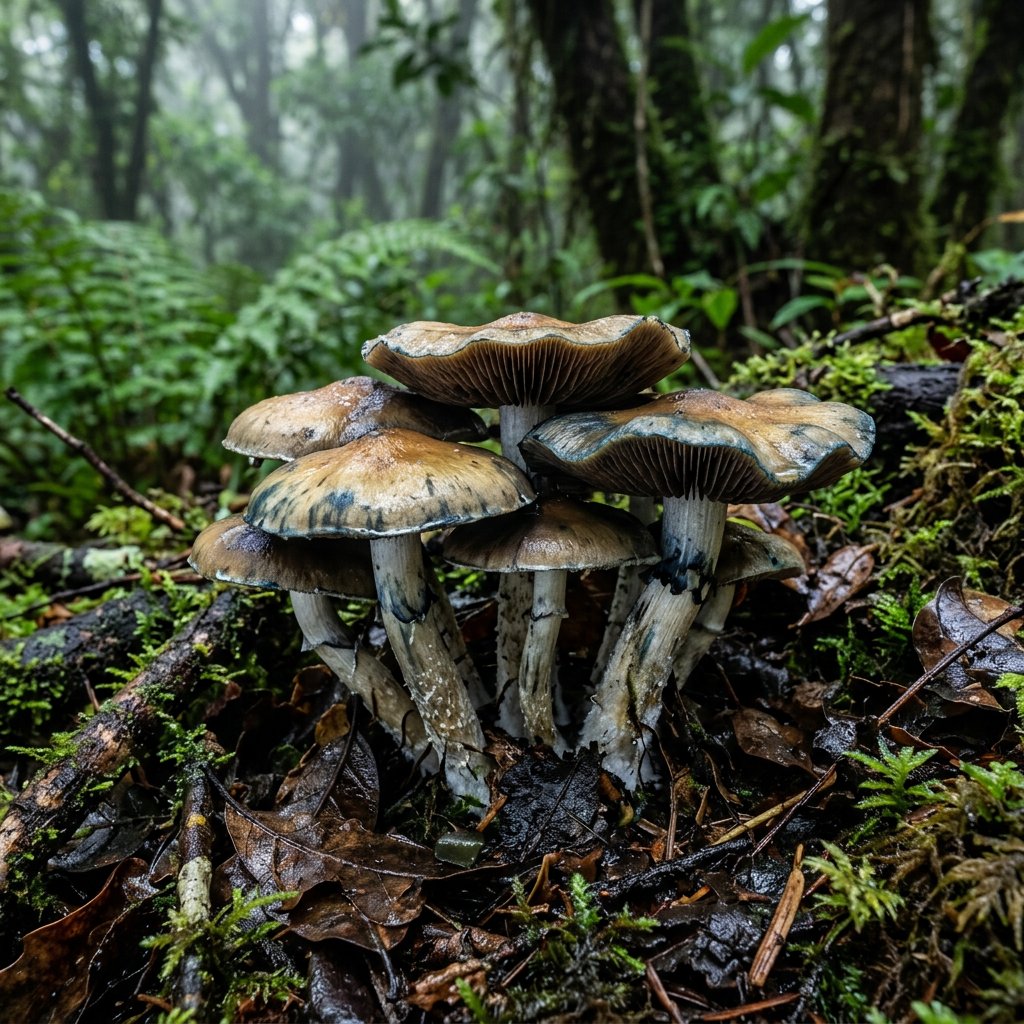
- 🍄 The Cap: Ranges from 2 to 9 cm, starting as a bell shape and flattening out with a slight central bump (umbo). It is typically honey-brown to dark olive-brown, often appearing translucent when wet.
- 🧬 Blue Bruising: A key identifying feature is that the stem and cap edges turn a vivid blue or sea-green color when touched or damaged, a reaction of its psychoactive compounds to oxygen.
- 🌑 The Gills: Underneath, the gills are closely packed and transition from a pale grey to a deep, dark purplish-brown as the spores mature.
🌲 Habitat & Ecology
- ⛰️ The Landslide Specialist: True to its nickname, this mushroom prefers "disturbed" ground. You’ll often find it growing on steep ravines, landslide sites, or areas where the soil has been turned over, particularly in high-altitude regions.
- 🌱 Substrate Preference: It thrives in clay-rich soils and is frequently associated with woody debris or even sugar cane mulch in subtropical climates.
⚠️ Safety & Toxicity
- 🛑 WARNING: This mushroom is highly psychoactive, containing significant levels of psilocybin and psilocin. Ingestion causes intense sensory distortion and hallucinations.
- ⚖️ Legal Status: Possession or cultivation of this species is illegal in many countries and jurisdictions.
- 💀 Deadly Look-alikes: Foragers must be extremely cautious. It can be easily confused with the Deadly Galerina (Galerina marginata), which contains lethal toxins that cause liver failure. Never consume wild mushrooms based on amateur identification.
✨ Fun Fact
The specific epithet caerulescens is Latin for "becoming blue." This refers to the mushroom's dramatic color shift, which was once thought by ancient cultures to be a sign of the mushroom's "divine" or "electric" energy.
More Details
| Hymenium Type | Lamella |
| Stipe Character | Bare Stipe |
| Spore Print Color | Purple-Brown |
| Mushroom Cap Shape | Convex Mushroom Cap |
| Hymenium Attachment | Adnate Hymenium Attachment |
| Mushroom Ecological Type | Saprobiont |







